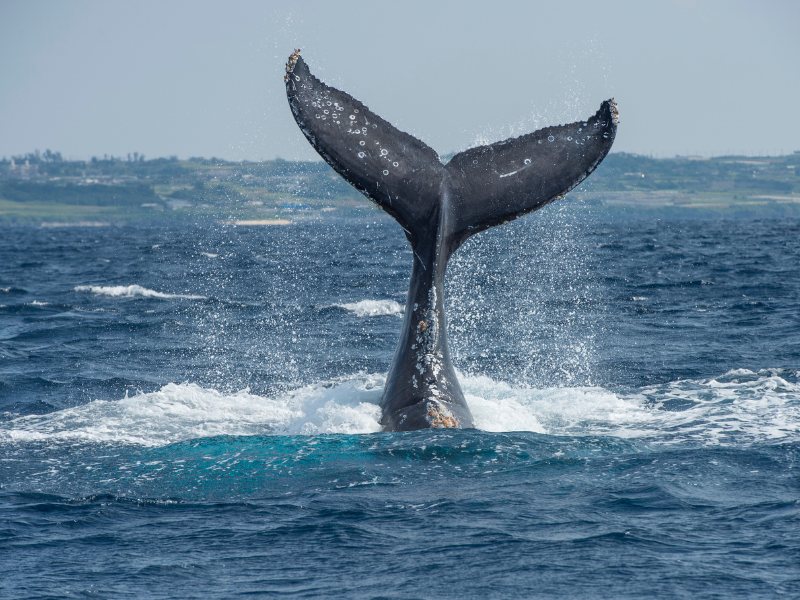
Lawsuit seeks preliminary injunction to force comprehensive studies on the massive project’s effect on habitat of critically endangered North Atlantic right whale
Spike in whale deaths occurring at same time early stages of project got underway off Atlantic Coast
Judge’s ruling stops project that was slated to begin ‘pile driving’ this week; gives Dominion, Biden Administration May 6 deadline to respond to legal challenge
WASHINGTON, DC (May 1, 2024) — An order by a federal judge on Monday delayed the start of “pile driving” construction for a massive wind project off the Atlantic Coast by Dominion Energy. Judge Loren L. AliKhan convened an expedited status conference hearing in response to a coalition of three public interest groups—The Heartland Institute, the Committee for a Constructive Tomorrow (CFACT), and the National Legal and Policy Center (NLPC)—suing Dominion and the Biden administration, claiming they have not done the legally required research to determine the project won’t harm the critically endangered North Atlantic right whale.
The coalition requested a preliminary injunction Monday to stop the project before pile driving began, allowing time to further study its environmental impact – specifically the cumulative risk this project and others along the Eastern Seaboard, pose to the North Atlantic right whale, of which only 350 remain, including an estimated 70 females capable of weaning a calf.
In Monday’s hearing, Judge AliKhan expressed concern that Dominion Energy did not yet gain approval by the federal government for its five mitigation plans, and she grilled the attorneys for Dominion Energy and the Justice Department (DOJ) about when they would gain approval. While Dominion and the DOJ were vague in their answers, the judge ordered them to file a status report on approval by this Friday, May 3. She also ordered Dominion and the Biden administration to file their response to the coalition’s lawsuit by May 6, and for the coalition to file its response by May 9. She is expected to rule on the preliminary injunction shortly thereafter.
See previous press releases about the efforts by the coalition of The Heartland Institute, CFACT, and NLPC at this link.
To speak to members of the coalition filing suit to protect the North Atlantic right whale, please contact Jim Lakely at [email protected] or text/call 312-731-9364.
Along with the preliminary injunction, the coalition on April 2 filed a request under the Freedom of Information Act (FOIA) to compel Dominion Energy to reveal the methods it intends to use to protect the critically endangered Right Whale from extinction. Dominion has hidden its species protection plan from public view.
Dominion Energy stated in documents filed with the Bureau of Energy Management (BOEM) that it intended to begin offshore construction activities no later than May 1. The project plans to erect 176 giant wind turbines—with each tower taller than the Washington Monument, and turbine blades longer than a football field—to be constructed in the open ocean 25 miles off the coast of Virginia Beach, Virginia. If completed, the project would be the largest of its kind in the world.
This Dominion Energy project is but one of many massive offshore wind projects mandated by an executive order issued by President Biden on January 27, 2021 declaring that a “climate crisis” exists which “threatens mankind’s existence.” The Biden administration has given fast-track approval to dozens of wind projects off the East Coast with the goal of producing 30 gigawatts of electricity by 2030.
The amount of federal waters leased for these projects constitutes an area larger than the states of Rhode Island and Connecticut combined. The North Atlantic right whales would be forced to navigate a gauntlet of 32 separate lease areas from Georgia to Maine twice each year.
In the midst of a spike in whales washing up on shore in East Coast states, a dead North Atlantic right whale was found near Virginia Beach on March 30. It was a female, named “Catalogue No. 1950” by the New England Aquarium. accompanied by a newborn calf. That marked the fourth documented North Atlantic Right Whale death in US waters this year. Experts do not expect the calf to survive without the support of its mother. According to the Clearwater Marine Aquarium’s aerial survey, the mother had successfully raised five prior calves.
###

Jim Lakely is the Vice President and Director of Communications of The Heartland Institute.