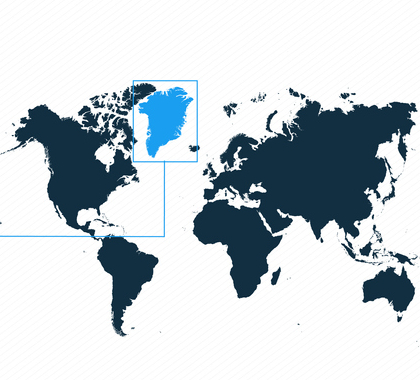
President Trump initially left all options, presumably including military options, open to secure U.S. interests in Greenland. Wars fueled U.S. territorial expansion during the nineteenth century. A peaceful acquisition of Greenland would demonstrate the folly of the progressive left’s “land acknowledgements.”
President Harry Truman tried to buy Greenland from Denmark after World War II. Little economic development has occurred on the world’s largest island under Danish rule. If President Trump wants to return to his real estate developer roots, we could offer up to $1 million per Greenlander and try to make a deal.
Land acknowledgements are the brainchild of post-modern decolonialization scholars. Universities and local governments, in addition to celebrities like Billie Eilish, use them to acknowledge European “theft” of North America from its native inhabitants.
Many land acknowledgements are performative. Consider an elite private university. If the university leaders believe that their ownership is illegitimate, they could dispense with the words and deed the land to the victims’ descendants. Ms. Eilish could give her Los Angeles home back to the Tongva tribe.
To be clear, Europeans took land by force in the New World. The Spanish enslaved native populations in Central and South America. I believe in objective reality and not denying history’s uncomfortable facts.
Land acknowledgements miss the bigger truth. Social relations have throughout human history involved slavery, serfdom, and conquest.
The Enlightenment and political liberalism radically changed human society. Liberalism, America’s creed, ended this, replacing force with exchange. Voluntary exchange occurs because all parties recognize the other’s moral value and ownership claims.
Exchange requires ownership of land and other things. A system of property rights has two components, assignment of first ownership and a mechanism to transfer already owned things. The second is relatively easy: voluntary exchange. You must offer the property owner sufficient value to voluntarily trade with you.
First acquisition is more challenging. John Locke argued that ownership arose through people mixing their labor (according to liberalism, individuals own themselves) with physical goods. For land in the United States, this was homesteading or living on and using the land.
Property rights and voluntary exchange form the basis for markets and are a core element of Western civilization. A market economy is the only form of economic organization to ever lift humanity above the subsistence level.
This transformed mere possession of land and goods into ownership by right, ending the era of “might makes right.” Libertarian economic and legal historians argue that most indigenous American land claims did not meet the homesteading threshold, meaning that the wilderness of North America was by rights unowned.
Land acknowledgements wish to codify indigenous possession based on force into a system of ownership by right, the very “colonial” system the scholars detest.
Western liberalism emerged over centuries and was applied consistently and immediately. American history consequently includes slavery and the forcible dispossession of Native Americans. But the Declaration of Independence’s principle of equality eventually won out.
The current distribution of land and other property is shaped somewhat by past force. Redistribution to rectify historical wrongs would be dubious, for several reasons.
As noted, the prior land claims themselves were based on forcible possession. Further, neither the perpetrators nor victims of these bad acts are alive today. Indeed, the victims’ descendants have benefitted from the prosperity property rights generate. And a massive inquiry to determine what property government will forcibly return would nullify the security of property rights needed to spur investment and prosperity.
Ownership by right is one key to peaceful and prosperous societies. This makes even threatening to take Greenland by force intolerable. A military occupation to preempt Russia or China from seizing Greenland could be justifiable.
Who should President Trump try to buy Greenland from, the people or the Danish government? National sovereignty means Denmark gets a say, but I think that Greenlanders should decide their future.
An offer of $1 million to each resident would total $57 billion, given Greenland’s population. While much more than Alaska’s $7.2 million price in 1867 (about $130 million today), we have “paid” Somalis in Minnesota upwards of $9 billion, receiving nothing in exchange.
President Donald Trump’s real estate career personifies the core Western value that today land must be acquired by voluntary exchange, not taken by force.

Daniel Sutter is Affiliated Senior Scholar at the Mercatus Center and Professor of Economics at the Manuel H. Johnson Center for Political Economy at Troy University.