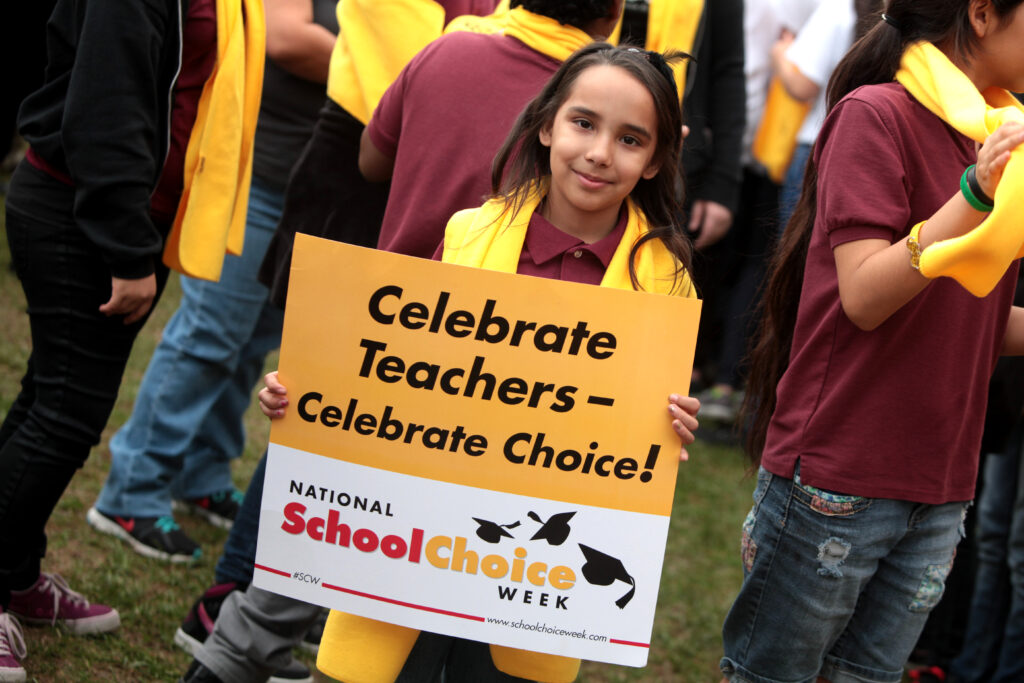
Effective Jan. 1, the Federal Scholarship Tax Credit Program (FSTC)—part of the One Big Beautiful Bill Act, signed into law by President Donald Trump in July 2025—will become the largest school-choice program in the U.S.
There has been considerable confusion about the FSTC’s specifics, but in an interview with American Enterprise Institute scholar Rick Hess, veteran education-reform expert Jim Blew clarifies many of the details.
The program allows taxpayers to claim a dollar-for-dollar credit of up to $1,700 per year for donations to a scholarship-granting organization (SGO). When filing jointly, couples can claim a total credit of $3,400. That credit can then fund scholarships for educational expenses, including tutoring, after-school programs, and private school tuition.
So far, 31 states have agreed to become part of the program, and the rest have until January 1, 2027, to do so. States must opt in each year. If a state doesn’t choose to join, its students can’t access these funds that calendar year, though taxpayers can still donate to SGOs in other states and claim the credit.
To qualify for the FSTC, the student’s family income must be no more than three times the area median income—a threshold that typically includes households earning up to about $500,000.
Importantly, public school students can also benefit from the FSTC. The program’s detractors ignore this point, but scholarship funds can support students in government-run schools by covering tutoring, after-school programs, books, computers, services for students with disabilities, and other costs.
Also worth noting is that under a proposed rule published Oct. 1 by the U.S. Treasury Department, states would have limited authority to set specific conditions for how the FSTC would operate within their jurisdictions. A public hearing on this issue is scheduled for December 15.
Politically, Republicans have generally favored parental choice in education, whereas Democrats have not. Yet many high-profile Democrats are supporting the FSTC program.
In a Washington Post op-ed, Arne Duncan, who served as U.S. Secretary of Education under President Obama, and Jorge Elorza, president of Democrats for Education Reform (DFER), stress the importance of states taking advantage of the new law. They write that opting in “doesn’t take a single dollar from state education budgets. It simply opens the door to new, private donations, at no cost to taxpayers, that can support students in public and nonpublic settings alike.”
In another Washington Post op-ed, Elorza and Ben Austin, a former Clinton White House staffer who authored California’s landmark parent trigger law, write that Democrats have “remained tethered to institutions, frameworks, and assumptions from a political era that is disappearing. If they don’t adapt, they risk becoming the minority party in a political order they had little role in shaping.”
They add, “K–12 education might not be the first issue that comes to mind when diagnosing Democratic drift, but if you want to understand how Democrats went from the party of reform to defenders of the status quo, start with public schools.”
Another Democrat vocal about educational change is Rahm Emanuel, who served as White House chief of staff under President Obama from 2009 to 2010 and as mayor of Chicago from 2011 to 2019. He states, “For decades, when pollsters asked voters which party they trusted more on education, Democrats maintained, on average, a 14-point advantage. More recently, that gap closed, then flipped to favor Republicans.”
Charles Barone, senior fellow at the National Parents Union and former director of policy at DFER, takes a swipe at the teachers’ unions, saying, “Democrats must come to an understanding with teachers’ unions and white progressives that unconditional opposition to innovation, accountability, and public school choice is a political and moral dead end. The unions’ positions are at odds with both an overwhelming body of evidence and public opinion, even among Democrats. You can be pro-teacher and even pro-union and still demand innovation and results. That should be the party’s goal.”
Barone is correct. The teachers’ unions are adamantly opposed to the program. On Oct. 1, Randi Weingarten, president of the American Federation of Teachers, slammed the FSTC, incoherently saying, “This scheme is a poison pill for the 90 percent of American children who attend public schools. Instead of strengthening public education, President Trump is diverting $500 billion in taxpayer cash into private hands, with everyone else left fighting for scraps in a real-life Hunger Games.”
Additionally, in June, teachers’ unions in 23 blue states sent a letter to Democratic leadership warning that opting into the program would jeopardize the unions’ election endorsements and campaign donations and that funding is substantial. A report released in April by Defending Education found that the two national teachers’ unions have donated nearly $700 million to left-leaning political groups and causes since 2015.
That said, Colorado, Nevada, New Hampshire, Virginia, Georgia, and, as of Oct. 9, New York—all blue states—have opted in.
Another cohort of opponents decries the FSTC for destabilizing public school funding and blurring the line between public and private—especially religious—education.
Rachel Laser, president of Americans United for Separation of Church and State, said, “Public funds belong in public schools, which are open to all and educate 90% of America’s students. The new national voucher scheme will funnel billions of taxpayer dollars into private, mostly religious schools to pay tuition for families who already can afford to send their kids to private schools.”
This argument does not hold water. Billions of taxpayer dollars already flow to private schools, many of which are religious, through state-authorized choice programs, and the U.S. Supreme Court has weighed in on the issue. In Espinoza v. Montana (2020), SCOTUS endorsed a state tax credit program that funds students’ attendance at religious schools.
Naysayers aside, the Federal Scholarship Tax Credit Program will take effect shortly in at least 31 states. Although some details still need to be resolved before it begins, it will proceed despite objections from teachers’ unions and other anti-parental-freedom groups. Only time will tell how it will play out.
Larry Sand is former president of the California Teachers Empowerment Network.