The affordability crisis essentially boils down to high costs for staple goods against a backdrop of meek wage gains.
The Democratic Socialists of America (DSA) claim government can instantly solve the crisis by making the bare necessities “free,” and sending a universal basic income (UBI) for discretionary spending needs.
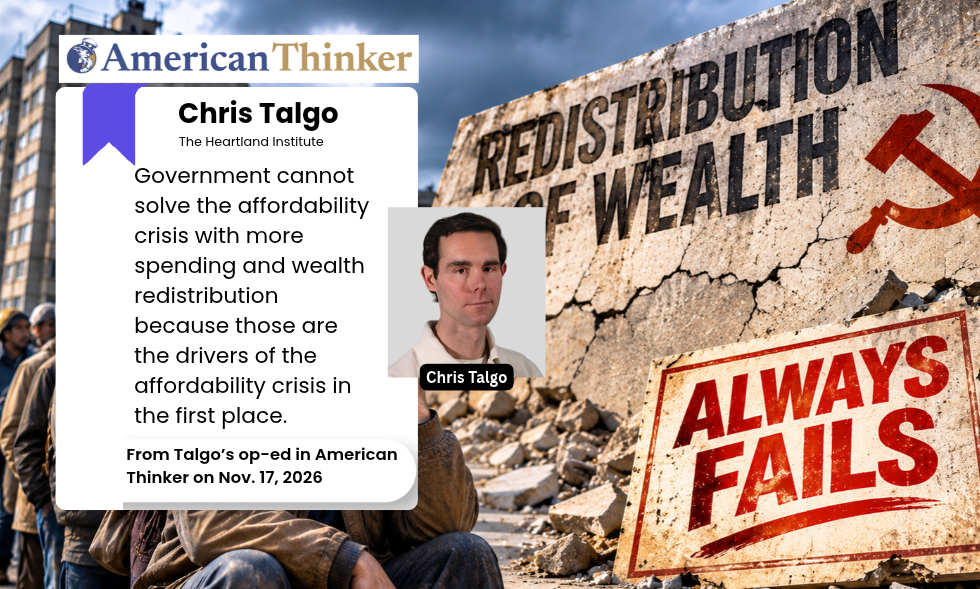
I contend the opposite: that government cannot solve the affordability crisis with more spending and wealth redistribution because those are the drivers of the affordability crisis in the first place.
Nevertheless, the DSA’s message resonated across the country in the midterm elections, as more than 200 DSA-aligned candidates won local, state, and national offices.
DSA candidates ran on affordability, championing the Workers Deserve More Program.
In a nutshell, the DSA agenda includes “free” health care, housing, transportation, education, childcare, groceries, utilities, medicine, and food.
That is the DSA’s imagination of “life without capitalism” in a “democratic socialist republic.”
But nothing is really “free.” In total, the DSA agenda is estimated to cost up to $212 trillion over the first 10 years.
Spending anything close to that sum would trigger runaway inflation, exacerbating the affordability crisis.
Essentially, this is what happened on a smaller scale during the first few years of the Biden administration.
From early 2021 to the middle of 2023, Biden signed multi-trillion-dollar bills like the American Rescue Plan and the Inflation Reduction Act. During that entire period, wages did not keep pace with inflation, which peaked at 9.1 percent in 2022.
In the 2022 midterms, voters connected the dots and Democrats, especially the DSA, paid the price.
In 2024, voters remained steadfast against big government, and fewer DSA candidates were on the ballot than in any prior election since 2016.
However, in 2026, voters shifted left, and the DSA had its best performance to date.
Come 2027, at the federal level, the DSA will have more influence than ever in both chambers of the U.S. Congress.
The DSA will have more power at the state level, with many members voted into state legislatures.
At the local level, DSA mayors will run more major and medium-sized cities, and dozens of DSA members will sit on city councils, school boards, and various commissions.
The DSA argues that the government can solve the affordability crisis by enacting more government programs.
However, the DSA’s approach of wealth redistribution via government programs has been tried and failed countless times over more than two centuries.
Read the rest at American Thinker.

Chris Talgo is the Editorial Director for The Heartland Institute and a fellow for Heartland’s Glenn C. Haskins Emerging Issues Center.