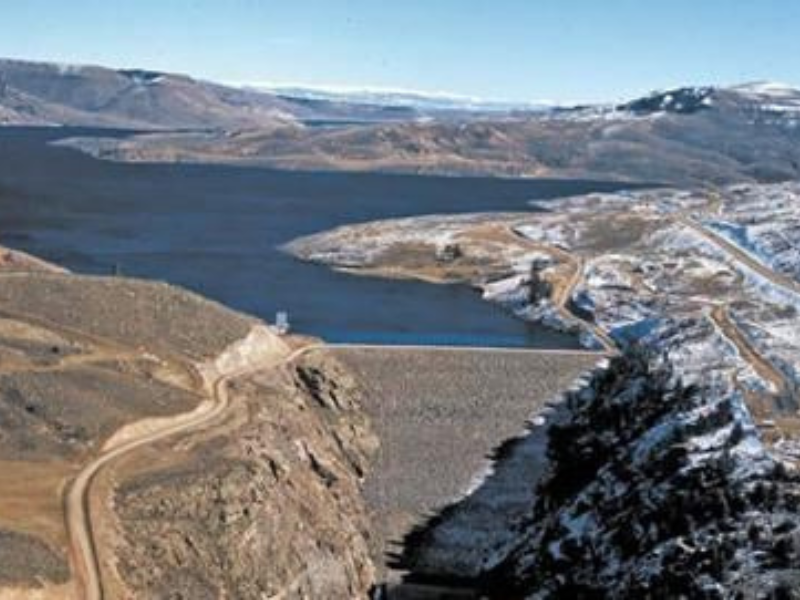
A couple years ago, I criticized the Bureau of Reclamation for draining Blue Mesa Reservoir without bothering to tell the people in Gunnison whose livelihoods would be affected. I got a little push-back for saying that while the Bureau owned the dam, it did not own the water. A close friend and water lawyer told me to be careful, that the Bureau does in fact own some water rights in the Gunnison River.
I admit the legal nuance but still insist it is a debatable point. That’s because Congress never funded such water projects for the purpose of the federal government owning and controlling the West’s water. The Colorado River Storage Project Act of 1956 led to the construction of Glen Canyon, Flaming Gorge, and Navajo Dams, as well as the Aspinall Unit, comprising Blue Mesa, Crystal, and Morrow Point. It is named for the late House Interior Committee Chairman Wayne Aspinall (D-CO), who spoke often about the projects. I was in the room a number of times when he talked about the vital importance of agriculture to the southwest, and about the growing needs of growing populations, especially the water and power supplied by those reservoirs. He never talked about flows for endangered fish, and not once did he ever suggest the government should keep people from using the water stored in the reservoirs. Why would Congress have spent millions to store water during spring runoffs, if not to supply the needs of water users?
In fact, the same Congress had just four years earlier passed The McCarran Amendment, which remains a primary facet of federal water law. It waives U.S. sovereign immunity in suits concerning ownership or management of water rights, which must be tried in state courts. The Supreme Court has always interpreted it as clear proof that Congress recognized the primacy of state water laws, even when federal water rights are at stake.
The McCarran Amendment says, “The United States, when a party to any such suit, shall (1) be deemed to have waived any right to plead that the State laws are inapplicable or that the United States is not amenable thereto by reason of its sovereignty, and (2) shall be subject to the judgments, orders, and decrees of the court having jurisdiction…” Meaning the state water courts.
Who decides the needs and uses of stored water? Who owns it? It is a fascinating debate that has raged for years, and the U.S. Supreme Court may be about to weigh in on it again. A case originating in California has brought the issue back to the forefront of western jurisprudence. The ownership of water rights in federally owned reservoirs is at the heart of it, and it is no small matter. The Bureau owns 338 reservoirs, 489 dams, and 10,000 miles of canals.
The question is whether the Bureau must recognize property rights in the water it stores and delivers from its reservoirs, a question the plaintiff’s lead attorney, Roger Marzulla, calls “one of the most significant water rights disputes in decades.” It involves the livelihoods of thousands of farmers in the San Joaquin Valley, and perhaps more importantly, the Fifth Amendment guarantee against private property being taken for public use without just compensation.
The case, City of Fresno, et al. v. United States, et al., began with the 2014 drought, and the Bureau’s decision to withhold available water from part of the Central Valley Project. Irrigation districts and municipal suppliers on the east side of the San Joaquin Valley received a “zero allocation,” while the Bureau released water to other districts. More than 15,000 farms were dried up, crops died, and orchards that took decades to establish were lost, costing billions in economic losses in Fresno and surrounding communities.
Is the Bureau required to pay for those property losses when taking that water for other uses deemed more important? A federal claims court said no, ruling that those farmers had no property right in water from federal reservoirs. The appellate court agreed, saying the government, not the landowners, holds the rights to Central Valley Project water. Growers with no property interest in water deliveries cannot claim compensation under the Fifth Amendment.
Appealing to the Supreme Court, the farmers point out that the ruling conflicts with established precedents. In the 1937 Ickes v. Fox case, the Court soundly rejected the government’s claim that it owned reclamation project water, pointing out the obvious, that “appropriation was made not for the use of the government, but, under the Reclamation Act, for the use of the landowners,” and that “the water rights became the property of the landowners…” The Court has repeated that lesson in at least two other cases, in 1945 and again in 1983.
Farmers throughout the West have lived for decades with the understanding that water delivered from reclamation projects is a right attached to their land. Water law in every western state relies on the assumption that these reservoirs will deliver water as required by the prior appropriation system, not at the discretion of federal bureaucrats. Taking those rights away is no different than taking any other property, and for that the Constitution requires just compensation.

Greg Walcher is one of the most recognized and respected national leaders in natural resources policy.