Life, Liberty, Property #133: Is Inflation Already Below 1 Percent?
Forward this issue to your friends and urge them to subscribe.
Read all Life, Liberty, Property articles here, and full issues here and here.
- Is Inflation Already Below 1 Percent?
- Video of the Week: They’re Dumbing Down NYC Schools… On Purpose — In the Tank Podcast #525
- Washington Post Layoffs Mark Decline of Regime Media

Is Inflation Already Below 1 Percent?
Although price inflation in the United States has fallen far from its June 2022 peak of 9.1 percent, it has yet to descend to the Federal Reserve’s target rate of 2 percent.
Or has it?
Using a more-accurate measure, the U.S. inflation rate is now below 1 percent per year, writes Heritage Foundation Chief Economist E. J. Antoni at TownHall. That is great news if true, of course.
Antoni cites Truflation, an independent economic data platform that monitors millions of prices each day to compile its inflation measure. Treasury Secretary Scott Bessent “gave a shout-out to the alternative inflation-measurement firm Truflation during a Hearing of the Senate Banking Committee last week,” Crowdfund Insider reported.
The consumer price index (CPI) from the Bureau of Labor Statistics (BLS) is currently more than three times as high as the Truflation number, Crowdfund Insider notes:
The US government, and importantly, the US Federal Reserve, tout current inflation rates hovering around 2.7% as reported by the Department of Labor Statistics.
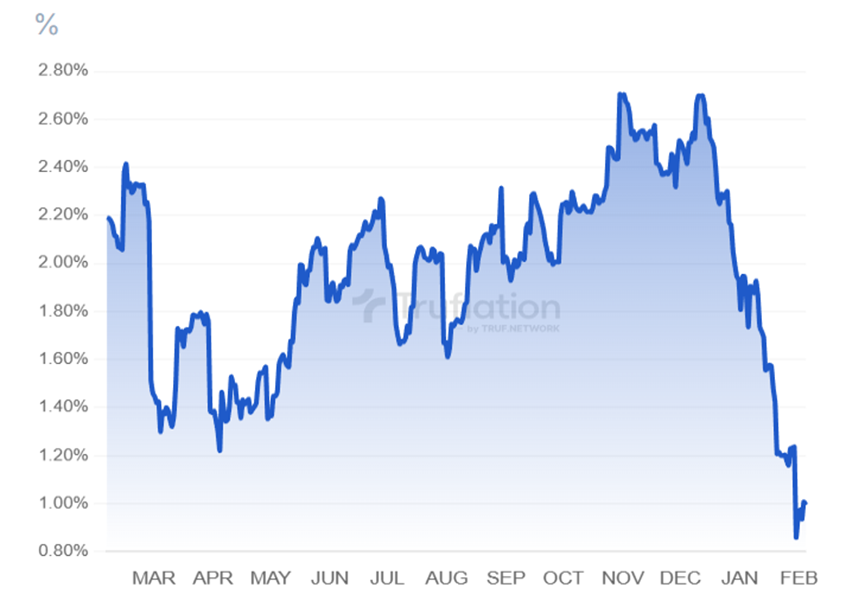
Truflation recently reported that their measures indicate inflation has cratered, going from 1.24% to 0.86%, the lowest since 2020.
Truflation reported an annual inflation rate of 0.99 percent on Friday:
Source: Truflation
The CPI and the Truflation index usually do not differ by much, Antoni notes:
Truflation typically correlates at 97 percent with the official CPI, meaning the indexes track closely with one another. Truflation is not some cockamamie guessing game but a highly accurate and scientific project to create up-to-the-minute information on inflation.
And Truflation is not usually so far below the CPI. In fact, Truflation was higher than official numbers under Biden, peaking at around 17 percent during Bidenflation, when the official CPI was closer to 9 percent.
Determining which number is most accurate at present requires a look at the differences between the two measures. Their methodologies differ greatly.
“Truflation monitors 35 million prices in real-time, scraping data directly, while the BLS literally sends out ‘secret shoppers’ every couple of weeks,” Antoni writes. “They manually count a tiny fraction of the prices measured by Truflation. Some of the data is a month old by the time it’s reported.”
The most important difference between the two indexes is a factor I have mentioned here before: how the BLS measures changes in housing costs. The BLS uses an artificial number, “owner equivalent rent” (OER), as an estimate of what it costs a homeowner to sustain his or her own residence—mortgage, maintenance costs, and the like. The OER does not measure any costs, however: it is based on a survey of what homeowners think their residences would rent for.
The data used to calculate it is obtained through surveys, which ask members of a household (called a consumer unit) the following question: “If someone were to rent your home today, how much do you think it would rent for monthly, unfurnished, and without utilities?”
That is obviously a highly indirect measure, to say the least. If homeowners watch the TV news and hear that rents are rising, OER will increase—regardless of any changes in the actual expense of owning their homes. As that estimated (in fact imaginary) number rises or falls, so does the CPI. OER comprises about one-third of the CPI, Antoni notes, so it can have a very large and distorting effect on the commonly reported “headline inflation” number.
OER has risen very rapidly since the Biden inflation surge arrived in mid-2002, and it has still not returned to anywhere near its pre-pandemic trend line.
The cost of housing is declining now, however, as are rents. “Even the slight easing of interest rates since over the last several months has brought more supply to the market, pushing down prices,” Antoni writes.
Unlike notorious urban basket cases such as New York City and Los Angeles, cities with smarter governments are increasing the housing supply by lowering regulatory barriers that affect residential construction, the Washington Examiner reports:
Many homes are coming available because of permitting reforms that have made construction easier and less expensive. Austin, Texas, for example, has a booming economy with thousands of new jobs added every month. Aggressive housing construction has kept up, and Austin leads the league in falling rents, with prices 6.3% lower today than a year ago.
Meanwhile, significantly lower demand is also driving housing prices down. The federal government has deported 2.5 million illegally resident aliens since President Donald Trump took office, “which frees up a lot of housing,” Antoni notes. “Illegals tend to rent, and last month’s rents nationwide were down double digits at an annualized rate. Home prices are actually falling in deportation-heavy cities like Austin, Dallas, Tampa, and Miami.”
As supply increases and demand decreases, prices fall. January was the sixth consecutive month of falling rent prices, with rents down 1.4 percent in the past twelve months, the National Rent Report from Apartment List reported. That is the first annual decline in decades, the Examiner reports. The national multifamily rental vacancy rate is 7.3 percent, the highest the index has ever registered since its inception in 2017.
Any rapid change in housing prices intensifies the inaccuracy of the CPI because the BLS delays the OER “number by several months, on the rationale that most rents don’t renegotiate every month,” Antoni notes. “But that’s like saying we should use 2018 car prices because people keep their cars for eight years. Consequently, BLS’s metric is usually about eight to 12 months behind real-time changes in the housing market.”
Taking all that into consideration, a big chunk of the CPI represents housing expenses of several months ago, calculated not as actual ownership costs but as what homeowners thought they could rent their houses for back then. In the present case, those personal estimates were certainly a good deal higher than they would be today, with rental prices having decreased in the intervening months.
“This means the official numbers ignored the single biggest source of inflation under Biden—housing—and they’re ignoring the single biggest source of deflation under Trump,” writes Antoni. “They’ll keep ignoring it through 2027 until the lagging metrics catch up to reality.”
The public seems to understand that inflation has recently slowed greatly, with expectations of future inflation falling by a half a percentage point in January, from 4.0 percent to 3.5 percent, though the survey respondents still think upcoming price increases will be much higher than Truflation’s 1 percent annual rate or the Fed’s 2 percent target, as this Bloomberg chart reprinted at ZeroHedge illustrates:
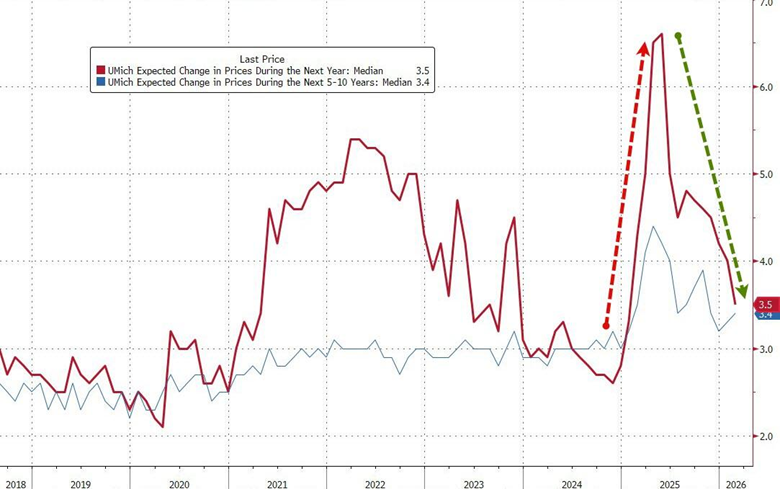
“Inflation expectations for the next 12 months plummeted to 13-month lows (while medium term expectations rose modestly),” ZeroHedge reported.
Could inflation really be down below 1 percent, well short of the Fed’s 2 percent target rate? Definitely.
Sources: TownHall; Truflation; Crowdfund Insider; National Rent Report; Washington Examiner; ZeroHedge

Video of the Week
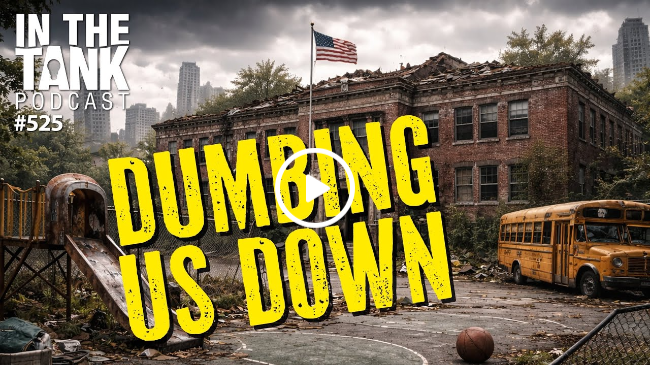
This week, Bitcoin is DOWN, but does that mean anything to those of us who don’t own it? Some argue that it indicates the dollar is strengthening, which is good news for affordability. AND the Washington Post has laid off a third of their staff, journalists are unemployed all over the place, and it could mean the beginning of the end for the far-left publication. Finally school is out… all the time, it seems, because students seem to be missing class for protests, snow weeks, all kinds of things that aren’t school. In New York City, Mamdani’s government is focusing on removing programs for high-achievers, and refocusing on “green” initiatives.
Washington Post Layoffs Mark Decline of Regime Media
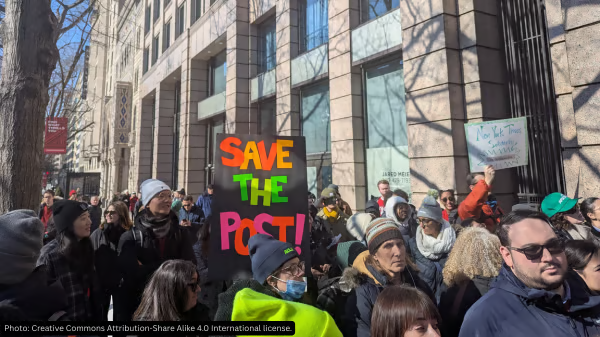
The announcement that the Washington Post is laying off one-third of its staff is big news. It reflects an ongoing reversal of more than a half-century of deleterious trends in journalism.
“The troubled Post began implementing large-scale cutbacks on Wednesday, including eliminating its sports department and shrinking the number of journalists it stations overseas,” AP reported. “Significantly, our daily story output has substantially fallen in the last five years.” Executive Editor Matt Murray told the paper’s staff.
That indicates gross inefficiency, which certainly calls for belt-tightening and possibly more-drastic measures. A spokesperson for the newspaper said the cuts were difficult but part of a necessary “significant restructuring across the company.”
The Washington Post was losing money, and lots of it. The staff blamed owner Jeff Bezos and President Donald Trump: “The newspaper has been bleeding subscribers in part due to decisions made by [Bezos]—pulling back from an endorsement of Kamala Harris, a Democrat, during the 2024 presidential election against Trump, a Republican, and directing a more conservative turn on liberal opinion pages,” AP reported.
The paper had been losing subscribers for a long time, however. Newspapers across the country are struggling to make ends meet as other media provide the same information without the high cost of printing and delivering it on newsprint. Neither Trump nor Bezos had anything to do with that.
In addition, the Washington Post layoffs arrive in the wake of a severe decline in journalistic standards over the decades, accompanied by expansive claims of special status for regime-media journalists. A couple of weeks ago, Washington Post staff and other journalists around the country castigated the Trump administration severely after federal agents confiscated “a phone, two laptops and a Garmin watch” from WaPo journalist Hannah Natanson in “an investigation into a government contractor accused of illegally retaining classified government materials,” AP reported at the time.
The regime media denounced the search and seizure as an unconstitutional attempt to chill criticism of the Trump administration, as did numerous conservatives and libertarians. “The action ‘signals a growing assault on independent reporting and undermines the First Amendment,’ said Tim Richardson, journalism and disinformation program director at the advocacy group PEN America,” AP reported. “Like [Columbia University professor Jameel] Jaffer, he believes it is intended to intimidate.”
That was an entirely false characterization of the situation. The government’s confiscation of evidence in the investigation of a crime—a crime that the journalist herself could be implicated in committing if she had those classified materials in her possession—does not prevent the press from publishing anything based on information it has obtained legally. It is not an infringement of First Amendment rights at all.
This should be obvious. After all, freedom to do one thing does not mean freedom to do everything else you claim to see as connected to it. That is a silly argument. You cannot make extortion legal by publishing a news story based on information you extract from the victim. The same is true of bribery, theft, and any other criminal activity.
What made the situation even more perverse and damning was the regime media’s prior open glee at the indictment of Donald Trump for possession of classified materials, with incessant reports and commentary on it. Now journalists were arguing that what was a crime for a president of the United States is a right for journalists.
The regime media’s expectation of special treatment was clearly arrogant, elitist, and self-serving. That attitude has ruined the credibility of American journalism and accelerated the industry’s demise and ongoing transformation into something very different. Is what we have now, better? Well, it’s certainly not worse.
The Washington Post and nearly all other newspapers should now have staffs about the size of the Daily Caller. That is the financial reality of the business today.
The news media exist to make money. Their self-characterization as a Fourth Estate that speaks truth to power, holds politicians’ feet to the fire, comforts the afflicted and afflicts the comfortable, is a genius-level sales pitch, but it has lost all credibility. The partisanship has been too, too obvious.
After openly working as a free propaganda arm for Barack Obama and colluding to destroy Trump through Russiagate, “very fine people,” the Ukraine phone call, and a very long and ignominious list of other operations led by the Deep State, journalists conspired with Joe Biden’s presidential campaign to suppress legitimate and important news (especially Hunter Biden’s laptop computer revelations) that would have benefited Donald Trump’s reelection bid in 2020. They then worked with the Biden administration to censor every possible bit of information that would have shown what a catastrophic mess the Biden team was creating.
The truth came out when Elon Musk bought Twitter. Technology met history and exploded a mountain of leftist myths.
For decades, the news media had successfully persuaded the American people to think of newspapers as a public good. They are nothing of the sort and never have been. The news media are a private, profit-seeking enterprise. Their market appeal today is largely in their ability to increase their readers’ social status through the latter’s assimilation and repetition of received opinion.
The regime media sell social status, not wisdom, knowledge, or even information. Just status.
Their overt politicization and partisanship over the past several decades, especially in the wake of Watergate and the Washington Post’s braggadocio about bringing down a sitting president, increasingly divorced journalists from their customers and exposed their claims of special status as monumentally self-serving and undeserved.
The media’s sharp turn to the left began in the 1960s, accelerated in the 1990s, and rocketed into outright Soviet-style propaganda in the 2020s. Now the results are in. As with American elections, it takes a very long time for the foreordained decision to arrive.
The American people have done what the Washington Post staff, the rest of the regime media, and their well-paid allies in nonprofits, nongovernmental organizations, and academia continually claimed President Trump was going to do (which he never would or could). The people are silencing the regime media.
Important Heartland Policy Study
‘The CSDDD is the greatest threat to America’s sovereignty since the fall of the Soviet Union.’

Contact Us
The Heartland Institute
1933 North Meacham Road, Suite 559
Schaumburg, IL 60173
p: 312/377-4000
f: 312/277-4122
e: [email protected]
Website: Heartland.org