Life, Liberty, Property #135: The Great Battle Behind the Trump Tariff Case
Forward this issue to your friends and urge them to subscribe.
Read all Life, Liberty, Property articles here, and full issues here and here.
- The Great Battle Behind the Trump Tariff Case
- Video of the Week: Socialism In Our Schools — In The Tank Podcast #527
- Transaction Digitization Is Theft
Space is limited, so act now!
The Great Battle Behind the Trump Tariff Case
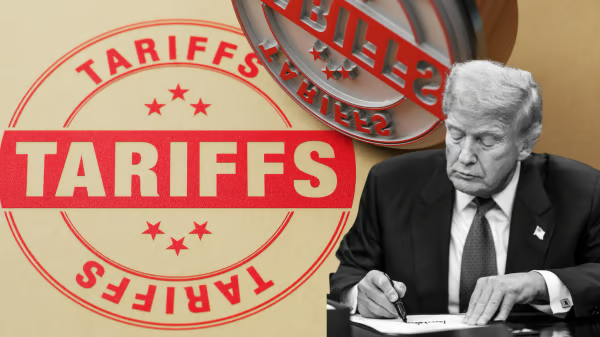
The biggest economic and policy news of the week was the U.S. Supreme Court’s 6-3 decision ruling that President Donald Trump exceeded his presidential authority in imposing tariffs without direct congressional agreement.
The Court’s decision in Learning Resources v. Trump states the government’s interpretation of the International Emergency Economic Powers Act (IEEPA) to apply to tariffs in peacetime would “give the President power to unilaterally impose unbounded tariffs and change them at will. That would represent a transformative expansion of the President’s authority over tariff policy.”
The Court’s decision deployed Chief Justice Roberts’ practice of using the definition of a tax to reach a seemingly preordained decision, as in his notorious choice to uphold the Affordable Care Act’s (ACA) flagrantly unconstitutional “individual mandate” for health insurance in the 2012 National Federation of Independent Business v. Sebelius decision. The ZeroHedge summary of the Court’s Friday decision to strike down Trump’s tariffs echoes the ACA case:
Friday’s decision rests on the notion that tariffs are not merely a tool for regulating trade, but also a form of taxation that the Constitution reserves to Congress. Citing Article I, Section 8, the majority stressed that the power to impose tariffs is “very clear[ly] … a branch of the taxing power,” and that the Framers gave Congress “alone … access to the pockets of the people.” [Emphasis in original.]
The majority’s decision accords with the Court’s recent attention to its “major questions” doctrine and precedents, an ongoing effort to clarify the constitutional separation of powers under which the federal government is supposed to operate and which prior Courts, Congresses, and presidents ignored for decades:
The Court has long expressed “reluctan[ce] to read into ambiguous statutory text” extraordinary delegations of Congress’s powers. West Virginia v. EPA, 597 U. S. 697, 723 (quoting Utility Air Regulatory Group v. EPA, 573 U. S. 302, 324). In several cases described as involving “major questions,” the Court has reasoned that “both separation of powers principles and a practical understanding of legislative intent” suggest Congress would not have delegated “highly consequential power” through ambiguous language. Id., at 723–724. These considerations apply with particular force where, as here, the purported delegation involves the core congressional power of the purse. Congressional practice confirms as much. When Congress has delegated its tariff powers, it has done so in explicit terms and subject to strict limits.
Roberts firmly states that the major powers doctrine applies to the present case:
There is no exception to the major questions doctrine for emergency statutes. Nor does the fact that tariffs implicate foreign affairs render the doctrine inapplicable. The Framers gave “Congress alone” the power to impose tariffs during peacetime. Merritt v. Welsh, 104 U. S. 694, 700. And the foreign affairs implications of tariffs do not make it any more likely that Congress would relinquish its tariff power through vague language, or without careful limits.
Congress gets to decide whether to allow the president to impose tariffs in peacetime even in response to an “emergency,” the Court stated: “the President must ‘point to clear congressional authorization’ to justify his extraordinary assertion of that power. Nebraska, 600 U. S., at 506 (internal quotation marks omitted). He cannot.”
To support that assertion, the majority decision examines the text of the IEPPA and notes that it does not use the word “tariffs” in its grant of powers to the president:
IEEPA authorizes the President to “investigate, block during the pendency of an investigation, regulate, direct and compel, nullify, void, prevent or prohibit . . . importation or exportation.” §1702(a)(1)(B). Absent from this lengthy list of specific powers is any mention of tariffs or duties. Had Congress intended to convey the distinct and extraordinary power to impose tariffs, it would have done so expressly, as it consistently has in other tariff statutes.
The power to “regulate . . . importation” does not fill that void. The term “regulate,” as ordinarily used, means to “fix, establish, or control; to adjust by rule, method, or established mode; to direct by rule or restriction; to subject to governing principles or laws.” Black’s Law Dictionary 1156. The facial breadth of this definition places in stark relief what ”regulate” is not usually thought to include: taxation. Many statutes grant the Executive the power to “regulate.” Yet the Government cannot identify any statute in which the power to regulate includes the power to tax. The Court is therefore skeptical that in IEEPA—and IEEPA alone—Congress hid a delegation of its birth-right power to tax within the quotidian power to “regulate.”
The decision states that the president tried to stretch the statute too far:
While taxes may accomplish regulatory ends, it does not follow that the power to regulate includes the power to tax as a means of regulation. Indeed, when Congress addresses both the power to regulate and the power to tax, it does so separately and expressly. That it did not do so here is strong evidence that “regulate” in IEEPA does not include taxation.
A contrary reading would render IEEPA partly unconstitutional. IEEPA authorizes the President to “regulate . . . importation or exportation.” §1702(a)(1)(B). But taxing exports is expressly forbidden by the Constitution. Art. I, §9, cl. 5.
Let me interject here to note that an authorization of the president to “regulate … importation or exportation” would not authorize the president to tax exports, precisely because the Constitution forbids it, so the authorization clearly does not do that, and the majority decision’s argument in that regard is invalid.
The real problem with the majority’s decision is its failure to apply the nondelegation doctrine accurately, which holds that the branches of government must neither interfere in nor forfeit their constitutional powers: the Congress cannot delegate legislative matters to the Executive Branch and the courts to sort out; the president must not reinterpret statutes in ways that conflict with their clear text or expand or contract their reach beyond what the laws say; and the courts must interpret the laws objectively and without imposing their own political and policy ideas.
The majority decision does not mention nondelegation even once, whereas the dissents use the word 53 times. Yet nondelegation is the obvious foundation for the majority decision. A failure to show how it applies in this case is a damning omission.
The dissents bring that issue to the fore. Justice Brett Kavanaugh’s lengthy dissent, joined by Justices Thomas and Alito, strongly suggests that the majority justices based their decision on a preferred policy and not on the letter of the law and the nation’s founding documents:
Acting pursuant to his statutory authority to “regulate . . . importation” under the 1977 International Emergency Economic Powers Act, or IEEPA, the President has imposed tariffs on imports of foreign goods from various countries. The tariffs have generated vigorous policy debates. Those policy debates are not for the Federal Judiciary to resolve. Rather, the Judiciary’s more limited role is to neutrally interpret and apply the law. The sole legal question here is whether, under IEEPA, tariffs are a means to “regulate . . . importation.” Statutory text, history, and precedent demonstrate that the answer is clearly yes: Like quotas and embargoes, tariffs are a traditional and common tool to regulate importation.
Since early in U. S. history, Congress has regularly authorized the President to impose tariffs on imports of foreign goods. Presidents have often used that authority to obtain leverage with foreign nations, help American manufacturers and workers compete on a more level playing field, and generate revenue for the United States. Numerous laws such as the Trade Expansion Act of 1962 and the Trade Act of 1974 continue to authorize the President to place tariffs on foreign imports in a variety of circumstances, and Presidents have often done so. In recent years, Presidents George W. Bush, Obama, and Biden have all imposed tariffs on foreign imports under those statutory authorities.
President Trump has similarly imposed tariffs, and has done so here under IEEPA. During declared national emergencies, IEEPA broadly authorizes the President to regulate international economic transactions. Most relevant for this case, during those national emergencies, IEEPA grants the President the power to “regulate . . . importation” of foreign goods.
Kavanaugh proceeds to provide extensive documentation to show that “As a matter of ordinary meaning, including dictionary definitions and historical usage, the broad power to ‘regulate . . . importation’ includes the traditional and common means to do so—in particular, quotas, embargoes, and tariffs,” and that “History and precedent confirm that conclusion.”
The majority’s decision uses cherry-picked quotations as excuses for a political decision on the justices’ part, Kavanaugh’s dissent suggests:
[T]he Court’s decision is splintered. In today’s six-Justice majority, three Justices (JUSTICE SOTOMAYOR, JUSTICE KAGAN, and JUSTICE JACKSON) interpret IEEPA not to authorize tariffs as a matter of ordinary statutory interpretation. I disagree for the reasons noted above and elaborated on at length in this opinion.
Three other Justices (THE CHIEF JUSTICE, JUSTICE GORSUCH, and JUSTICE BARRETT) lean on the major questions canon of statutory interpretation to resolve this case. That important canon requires “clear congressional authorization” for an executive action of major economic and political significance, particularly when the Executive exercises an “unheralded” power.
Kavanaugh rejects the majority’s use of that doctrine: “the major questions canon does not control here,” Kavanaugh writes. The majority ignored critical precedents and the statute’s text in making its decision, Kavanaugh argues:
First, the statutory text, history, and precedent constitute “clear congressional authorization” for the President to impose tariffs under IEEPA. In particular, throughout American history, Presidents have commonly imposed tariffs as a means to “regulate . . . importation.” So tariffs were not an “unheralded” power when Congress enacted IEEPA in 1977 and authorized the President to “regulate . . . importation” of foreign goods. Therefore, the major questions doctrine is satisfied here. Cf. Biden v. Missouri, 595 U. S. 87 (2022) (per curiam).
Second, in any event, the Court has never before applied the major questions doctrine in the foreign affairs context, including foreign trade. Rather, as Justice Robert Jackson summarized and remains true, this Court has always recognized the “‘unwisdom of requiring Congress in this field of governmental power to lay down narrowly definite standards by which the President is to be governed.’” … In foreign affairs cases, courts read the statute as written and do not employ the major questions doctrine as a thumb on the scale against the President.
The use of the term “thumb on the scale against the President” is a strong allegation of policy bias among the Court majority. Kavanaugh points out that “many current federal laws continue to grant the President expansive tariff authority,” yet “Neither the plaintiffs nor the Court has suggested that the numerous laws granting tariff power to the President violate the Constitution’s separation of powers.”
The president is only claiming powers granted to him by multiple laws that the Court has not challenged, and Trump explicitly acknowledged that Congress has the power to grant or deny such authority, Kavanaugh writes:
[T]he President does not claim unilateral authority to impose IEEPA tariffs without congressional authorization or over a congressional prohibition. On the contrary, the President’s argument recognizes that, in exercising his statutory tariff power under IEEPA, he must act within the scope of Congress’s authorizations and abide by Congress’s limitations.
Trump’s tariffs fall within the authority Congress has delegated to the president, in accordance with explicit language granting him that authority, Kavanaugh argues:
The President here contends only that Congress, by enacting IEEPA in 1977, authorized the President to impose tariffs on foreign imports in declared national emergencies. To use the familiar vernacular of Justice Robert Jackson in Youngstown, the President argues that this case falls into category one, where the President is acting “pursuant to an express or implied authorization of Congress.” Youngstown Sheet & Tube Co. v. Sawyer, 343 U. S. 579, 635 (1952) (concurring opinion). The President has not here asserted authority to impose IEEPA tariffs in a peacetime emergency in a Youngstown category two or three scenario.
Congress understood the full implications of this grant of authority when they passed it in 1977, Kavanaugh observes, and the Court’s 2022 decision in Biden v. Missouri “strongly supports the President’s position here.” That decision “upheld the Government’s vaccine mandate based on a general statutory authorization for HHS to impose safety requirements for healthcare facilities—notwithstanding the lack of explicit statutory reference to vaccines,” Kavanaugh notes (emphasis in original).
The Court was not nearly so persnickety about the separation of powers and the major questions doctrine when President Joe Biden wanted to force millions of people to accept an experimental injection to stop the spread of Covid-19. “The clarity of the congressional authorization in today’s case is far stronger than in Biden v. Missouri,” Kavanaugh notes.
The Court’s tariff decision flatly contradicts the majority’s argument in the Biden case (with which Kavanaugh assented): “Because the Court upheld the Executive’s exercise of a major power in Biden v. Missouri, it follows that the Court today should likewise uphold the President’s assertion of a major power here. Like cases should be treated alike.”
Kavanaugh concludes by once again highlighting the majority justices’ apparent desire to reach a preferred policy outcome instead of forming an unbiased interpretation of the law, the Constitution, and the facts of the case: “The tariffs at issue here may or may not be wise policy. But as a matter of text, history, and precedent, they are clearly lawful.”
Kavanaugh’s allusions to the majority’s apparent desire to impose a preferred policy outcome are especially salient in light of the fact that the Court’s majority opinion completely ignores the question of what the president is supposed to do with the billions of dollars in tariff revenue the federal government has already collected. The majority’s interest in policy issues apparently wanes when it comes to dealing with the resulting chaos, as with the Obamacare decision.
The Court’s decision creates “the possibility of a wave of refund litigation in the months ahead,” as ZeroHedge notes. “There are currently hundreds of tariff refund lawsuits pending in US trade court.” Kavanaugh’s dissent correctly notes that this is likely to be a “mess.” The majority opinion “offers no guidance on restitution, repayment, or whether importers may be entitled to recover duties paid pursuant to tariffs the Court has now deemed unlawful,” as ZeroHedge reports.
In an additional, solo dissent, Justice Clarence Thomas rejects the majority’s claim that the IEPPA’s lack of an explicit authorization of tariffs means that the president cannot impose tariffs under the grant of powers in the statute. That authorization was implicit in the wording of the IEPPA, Thomas writes:
Congress authorized the President to “regulate . . . importation.” 50 U. S. C. §1702(a)(1)(B). Throughout American history, the authority to “regulate importation” has been understood to include the authority to impose duties on imports. Post, at 9–13, 22–29 (KAVANAUGH, J., dissenting). The meaning of that phrase was beyond doubt by the time that Congress enacted this statute, shortly after President Nixon’s highly publicized duties on imports were upheld based on identical language. Post, at 14–22. The statute that the President relied on therefore authorized him to impose the duties on imports.
Thomas adds much to the discussion by explicitly considering whether the statute and Trump’s use of it honor the separation of powers and conform to the nondelegation doctrine:
I write separately to explain why the statute at issue here is consistent with the separation of powers as an original matter. The Constitution’s separation of powers forbids Congress from delegating core legislative power to the President. This principle, known as the nondelegation doctrine, is rooted in the Constitution’s Legislative Vesting Clause and Due Process Clause. Art. I, §1; Amdt. 5. Both Clauses forbid Congress from delegating core legislative power, which is the power to make substantive rules setting the conditions for deprivations of life, liberty, or property. Neither Clause prohibits Congress from delegating other kinds of power. Because the Constitution assigns Congress many powers that do not implicate the nondelegation doctrine, Congress may delegate the exercise of many powers to the President. Congress has done so repeatedly since the founding, with this Court’s blessing.
The power to impose duties on imports can be delegated. At the founding, that power was regarded as one of many powers over foreign commerce that could be delegated to the President. Power over foreign commerce was not within the core legislative power, and engaging in foreign commerce was regarded as a privilege rather than a right. Early Congresses often delegated to the President power to regulate foreign commerce, including through duties on imports. [footnote callout omitted]
Thomas goes on to cite 15 pages of evidence from the Constitution, prior lower-court and Supreme Court decisions, and the common law supporting his interpretation as the proper application of the nondelegation doctrine. That includes a spicy reference to a recent decision by the current Court: “In fact, less than a year ago, the Court explicitly rejected ‘a special nondelegation rule for revenue-raising legislation,’” Thomas writes, citing FCC v. Consumers’ Research from 2025.
Thomas’s dissent patiently recounts the principles in the majority decision and refutes them. It is a compelling argument on the specific case before the Court. Kavanaugh’s dissent goes further in subtly yet undeniably calling attention to the context in which these arguments over the major powers and nondelegation doctrines are being offered: the long-established use of courts to legislate through sweeping judicial decisions, which reached its height during Trump’s first term as president.
Opponents of Trump’s agenda essentially initiated a new form of government: rule by injunction. Activist groups used forum shopping for activist judges to impose injunctions and temporary restraining orders (TROs) to block the president’s initiatives. Their successes in Trump’s first term emboldened them, and leftist activist judges around the country, to pursue a multitude of further lawsuits toward that end during Trump’s second term.
Trump and his team, however, returned to office much better prepared for the legal onslaught, fighting the claims of authority by these lower-court judges. The president’s team has combed the statutes going back almost all the way to the eighteenth century for precedents and congressional grants of authorization for things the president wants to do. It is a novel approach when done to this extent, yet entirely legal and in fact more justifiable than the multiple decades of courts and presidents ignoring the existence of manifold contradictory statutes on the books.
The Trump team’s legal strategy achieved a major, history-making success when the Supreme Court ruled last June, in Trump v. CASA, Inc., that federal courts’ injunctions blocking enforcement of executive actions apply only to the specific parties in the lawsuit. That ended the legal authority claimed in the prolific abuse of nationwide injunctions and TROs.
Judges are still imposing these injunctions in great numbers, however, playing rope-a-dope with the higher courts by forcing the Trump administration to wade through judicial appeals which they will eventually win. That strategy gives the leftists and their activist-judge allies short-term victories and delays implementation of presidential actions.
Trump’s team quickly responds with new arguments citing support from additional statutes. The process is like a whack-a-mole game for both sides.
It is obvious that Trump will now reimpose all the tariffs the Court just struck down, with his team providing different statutory justifications for them. That will surely go back to the courts for more legal maneuvering. Meanwhile, the tariffs will remain in place as presumptively legal presidential actions.
Kavanaugh’s dissent in Learning Resources v. Trump includes an implicit invitation and instruction guide for the president to do this:
Although I firmly disagree with the Court’s holding today, the decision might not substantially constrain a President’s ability to order tariffs going forward. That is because numerous other federal statutes authorize the President to impose tariffs and might justify most (if not all) of the tariffs at issue in this case—albeit perhaps with a few additional procedural steps that IEEPA, as an emergency statute, does not require. Those statutes include, for example, the Trade Expansion Act of 1962 (Section 232); the Trade Act of 1974 (Sections 122, 201, and 301); and the Tariff Act of 1930 (Section 338). In essence, the Court today concludes that the President checked the wrong statutory box by relying on IEEPA rather than another statute to impose these tariffs.
President Trump had already said that he had a “backup plan” for the tariffs. His Truth Social post in response to the Court’s decision mentioned Kavanaugh’s observations about alternative justifications for the tariffs and stated, “effective immediately, all National Security TARIFFS, Section 232 and existing Section 301 TARIFFS, remain in place, and in full force and effect. Today I will sign an Order to impose a 10% GLOBAL TARIFF, under Section 122, over and above our normal TARIFFS already being charged, and we are also initiating several Section 301 and other Investigations to protect our Country from unfair Trading practices.”
The president checks another box, the opposition will find another judge to tear up the president’s order, and the issue will head back up the chain toward the Supreme Court. Meanwhile, Trump gets to implement his agenda, having learned from the opposition exactly how to use the courts to get what he wants.
The difference is that the American people elected Trump to make these decisions, and his opponents in the courts are intent on reversing that choice. That’s clearly what they mean by “Our Democracy.”
Sources: U.S. Supreme Court; The National Law Review; ZeroHedge; President Donald Trump (Truth Social)
Hot off the Presses! Our Latest Best-seller

Video of the Week
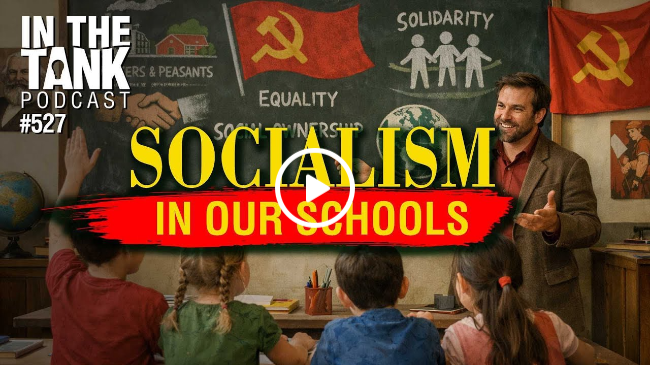
New York City is struggling with its budget, and despite Mayor Mamdani campaigning on affordable housing, he’s now turning to property tax hikes to try to close the gap. This is fairly typical for Democrats—and totally unsurprising. Meanwhile, Trump struck a deal with Japan that looks poised to sidestep China while also boosting American energy abundance. We’ll also cover socialism in our schools—how bad it really is—and how to counter it.
Get the latest best-seller from Heartland’s Justin Haskins!

America’s economy is teetering on the edge of disaster. Hidden beneath record stock market highs and reassuring headlines lies a fragile system riddled with debt, reckless speculation, and decades of political negligence. When the next big crash strikes—and it will—the fallout could be unlike anything we have ever experienced.
Click here to get it at Amazon.
Transaction Digitization Is Theft

Cash is freedom, and we are voluntarily giving up that liberty for convenience.
So writes farmer, rancher, and book author Mollie Englehart at The Epoch Times (behind paywall; republished at ZeroHedge).
At a farmer’s market a week ago, Englehart found that she could not pay with cash at various vendors. Even at “a pop-up tent at a farmer’s market,” cash is unwelcome, Englehart observes:
Cash itself is becoming strange, inconvenient, outdated, and almost suspicious. We’re being trained to accept that every exchange must be mediated, approved, and recorded by a third party, and that third party isn’t free.
That is a costly choice for both sellers and buyers and is a huge bounty for financial institutions, Englehart notes:
Most of the vendors there were using Square to process payments. The typical fee is about 3 percent to 4 percent per transaction. That might not sound like much, but that percentage is shaved off every single time money changes hands digitally.
If I hand $20 in cash to the empanada vendor, and he hands that same $20 to the barber who cuts his hair, and the barber gives it to a babysitter, and the babysitter uses it to buy a pizza, that same $20 bill keeps moving through the community at full value. No one skims anything off the top.
But in the digital system, that cut happens again and again, and the effect compounds. At a 3.5 percent fee, after one transaction, that $20 becomes $19.30. After two, $18.62. After three, $17.97. After four, $17.34. After five digital transactions, only about $16.74 remains in circulation. More than $3 of the original $20 has quietly disappeared in just a handful of everyday exchanges. That money didn’t go to the farmer, the barber, the babysitter, or the pizza shop. It left the community entirely.
This system transfers power from individuals and small businesses to private-sector financial institutions and to big businesses that can more easily absorb the costs: “Every digital transaction comes with processing fees and interchange costs,” Englehart writes. “Small businesses quietly lose a percentage of every sale, and customers pay more over time as those costs are baked into prices.”
Big businesses benefit greatly from the information we all provide them, monetizing our buying habits for their own profit:
When everything becomes digital, spending can be tracked, restricted, frozen, or flagged. We may not feel that pressure today when we’re buying coffee and pastries in beautiful spaces, but systems built for convenience can easily become systems of control.
And we pay them for the privilege!
Digitization of transactions is creating an enormous cultural change, Englehart writes:
What struck me most that morning was the irony. I was at a farmers market, a place that represents local food, small producers, and community resilience, and yet even there, we’ve accepted the idea that every transaction must flow through the same centralized financial rails. We tell ourselves that it’s about ease, but what we’re really trading is privacy, resilience, and a small but meaningful piece of our sovereignty over how we spend the fruits of our labor.
Meanwhile, governments are doing their best to get into the game by creating central bank digital currencies. That is an ominous prospect which my colleagues at The Heartland Institute have been warning about:
CBDCs are the central bankers’ primary solution to the threat cryptocurrencies pose to their power, and central bankers have not been shy about how they intend to utilize CBDCs to achieve ideological goals and limit individual privacy. Agustin Carstens— general manager of the Bank of International Settlements, known as the “central bank of central banks”—infamously stated, “We don’t know who’s using a $100 bill today and we don’t know who’s using a $1,000 peso bill today. The key difference with the CBDC is the central bank will have absolute control on the rules and regulations that will determine the use of that expression of central bank liability, and we also will have the technology to enforce that.
That information, of course, will go right to the national government to use in increasing the centralization of power, ignoring your individual rights, and awarding advantages to ostensibly private businesses that kick back a portion of those profits to the politicians. Any “protections” of your data will be strictly pro forma and cast aside at the government’s convenience and the behest of the big-money interests.
Our convenience will become the government’s sword. That will create an even bigger price for handing our liberties over to others.
Source: The Epoch Times; The Heartland Institute
Important Heartland Policy Study
‘The CSDDD is the greatest threat to America’s sovereignty since the fall of the Soviet Union.’
Contact Us
The Heartland Institute
1933 North Meacham Road, Suite 559
Schaumburg, IL 60173
p: 312/377-4000
f: 312/277-4122
e: [email protected]
Website: Heartland.org



S. T. Karnick is a senior fellow and director of publications for The Heartland Institute.