The U.S. Department of Energy’s “Critical Review of Impacts of Greenhouse Gas Emissions on the U.S. Climate,”(hereafter, DOECR) serves as powerful refutation of the oft-repeated claims that the science is settled concerning the role humans are playing in ongoing climate change and that present climate change poses an existential crisis meriting a wholesale government directed remaking of the economy, eschewing the use of hydrocarbons to prevent a dangerous increase in greenhouse gas emissions.
These comments focus on a few key points that the DOECR discusses that have largely been ignored or suppressed in the settled science narrative of anthropogenic climate disaster and will suggest a couple of issues that merit further consideration.
DOE Secretary Chris Wright’s comments in the forward are worth repeating as they accurately frame consideration of the relative threats posed by climate change when compared to the considerable harms proposals to prematurely end the use of hydrocarbons before commercially available, comparable technologies and materials exist to economically and reliably substitute for them are developed. Wright correctly states:
Climate change is real, and it deserves attention. But it is not the greatest threat facing humanity. That distinction belongs to global energy poverty. As someone who values data, I know that improving the human condition depends on expanding access to reliable, affordable energy. Climate change is a challenge—not a catastrophe. But misguided policies based on fear rather than facts could truly endanger human well-being.
The authors of the DOE report are all noted experts on climate and/or weather. Their reputations and qualifications are above reproach.
Concerning substance, in contrast to the work of the Intergovernmental Panel on Climate Change, and many scientists in the “settled science” community, the DOECR acknowledges significant uncertainties surrounding the extent to which greenhouse gas emissions are driving present climate change, recognizing other natural factors have historically driven such changes. The are significant uncertainties concerning climate response to carbon dioxide (CO2) emissions, both the physics of the response in the light of questions about CO2 saturation, and concerning the weather any physical forcing from CO2 impact other largescale systems that affect climate change, and what positive and negative feedback might arise to increasing CO2.
Also, unlike the typical discussion of CO2, the DOECR report specifically and rightly acknowledges that CO2 is not a pollutant in any traditional sense, not being directly toxic to human life or welfare at any foreseeable levels.
The DOECR details the significant discrepancies between modeled impacts of, among other features, on surface warming, snow coverage, stratospheric cooling, and projected regional impacts on the U.S. corn belt and what has actually been recorded or measured.
To its credit, unlike typical discussions of climate change, the DOECR examines the ongoing benefits of both CO2 fertilization for crops and other plants, human health and the life saving benefit of a modestly warmer world, and the significant social benefits of fossil fuels. Each of these topics are largely ignored, downplayed, or directly misrepresented in typical discussions of anthropogenic climate change by the mainstream media and all too often in government reports and scientists representing the settled science consensus position.
Arguably Section 3.3, on the influence of urbanization on temperature trends is not as strong as it could be. Specifically, it is not just urbanization that biases measured temperatures. Such biased measurements are also recorded in rural or relatively rural areas where surface temperatures stations are poorly cited, failing to meet the National Weather Service’s own standards for data quality and because temperatures are “reported” from stations that have been closed or discontinued. The former problem has been detailed in two reports produced by The Heartland Institute, “Corrupted Climate Stations (2022),” https://heartland.org/wp-content/uploads/documents/2022_Surface_Station_Report.pdf and “Is the U.S. Surface Temperature Record Reliable?,” (2009) https://heartland.org/publications/is-the-us-surface-temperature-record-reliable/. The latter was discussed in a report by an investigative journalist with The Epoch Times, which found that, for continuity reasons, the National Oceanic and Atmospheric Administration reports temperature measurements, from more than 30 percent of the 1,218 USHCN reporting stations that no longer exist. These measurements are nothing more than guesstimates assigned to a location based on temperatures from nearby stations which may, in fact, not be representative of the temperatures that would have been recorded at the ghost site had it still been in operation.
As the report points out, despite years of work, the climate research community has still been unable to narrow the estimated range of equilibrium climate sensitivity (ECS). Yet this is the key critical metric that is supposed to drive dangerous climate changes. If our understanding of the ECS is incomplete or inadequate, climate projections-based greenhouse gas driven ECS changes are not fit for scientific pronouncements, much less for imposing policies that impact peoples’ personal freedom and individuals’ and societies’ economic prosperity. The whole edifice of climate alarm is built on claims of ECS driving dangerous temperatures increases.
One of the key problems in producing an ECS with some level of confidence, as the report discusses, is the complexity of cloud coverage and changes in cloud cover and type in response to cosmic rays and CO2 forcing. Concerning clouds, the IPCC acknowledges two things that are true, it can’t model clouds well, and it has only a poor understanding of how cloud cover might change and how that might impact global temperatures. Despite these admissions, the IPCC based on climate models, which run too hot, claims clouds aren’t significant forcing factors for climate change.
Another key point the DOECR report identifies that is often overlooked or downplayed by members of the so-called consensus community is the fact that for key features of the atmosphere, “observed warming trends are so small as to be consistent with the output of models that have no anthropogenic CO2, and inconsistent with the entire envelope of warming trends generated by models forced with increased CO2.” (P. 37) When one can’t distinguish an expected or forecasted effect from a situation of no change, a null case, background noise, or randomness, then there is no justification for assuming the cause-and-effect relationship is true, accurately modeled, or well understood.
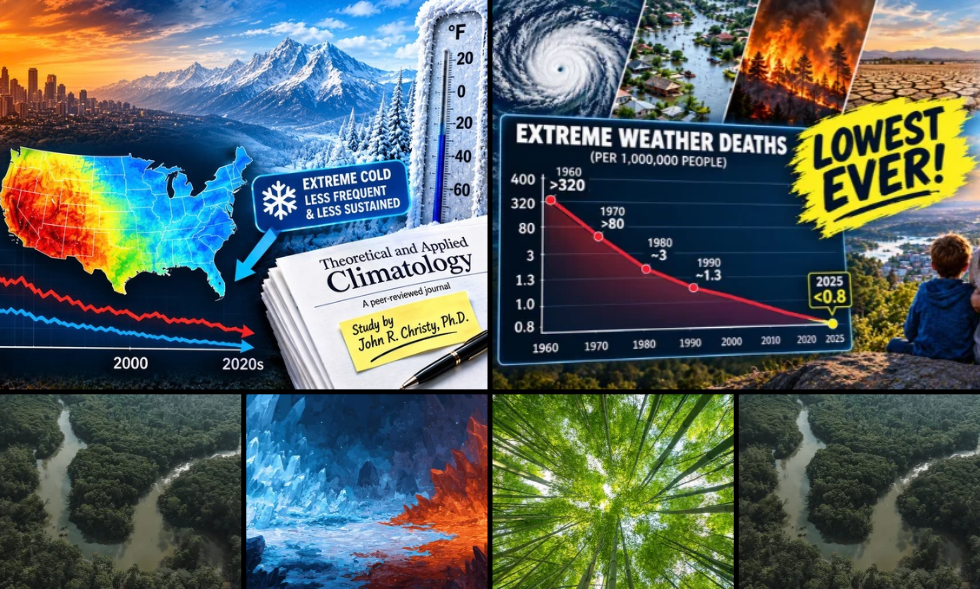
Perhaps the greatest service the DOECR provides by way of improving our understanding of the true state of the climate and opening the door for fair debate on the causes and consequences of climate change are its discussions of: 1) the fact that the IPCC actually has little confidence in its detection of climate signals for most atmospheric phenomena and shifting trends in extreme weather events, and is even more reticent or confident in its ability to attribute and changes identified to human actions; that there has been no identifiable worsening trend for most extreme weather event, either in number or intensity, despite repeated claims to the contrary in mainstream media reports and attribution studies; and its recognition and examination of the tremendous benefits to agriculture and human life of modest warming, higher CO2 and economic growth underpinned by hydrocarbon use.
Concerning economics, the DOECR’s survey of the literature concludes:
Economists have long considered climate a relatively unimportant factor in economic growth, a view echoed by the IPCC itself in AR5. Mainstream climate economics has recognized that CO2-induced warming might have some negative economic effects, but they are too small to justify aggressive abatement policy and that trying to “stop” or cap global warming even at levels well above the Paris target would be worse than doing nothing.
In short, most sound economic analyses conclude the policies proposed to fight climate change by imposing a coerced or incentivized reduction of hydrocarbons across the economy, will likely result in greater harm to human health and welfare than the realistically expected negative impacts of climate change itself. Economically, climate policies are worse for the world than ongoing climate change accompanies by hydrocarbon use.
The “. . . nuanced and evidence-based approach for informing climate policy that
explicitly acknowledges uncertainties,” recommended in this report should have been the standard from the start of the climate change scare when James Hansen testified at a Senate hearing in 1988 that humans were having a “discernable” and dangerous influenced on climate change. Hansen’s testimony was unjustified then and it remains so today. Humans are likely affecting the climate to some extent at the global and regional scales, but the extent of that impact, whether it is on net dangerous or beneficial, and how we ought to respond to maximize any benefits and minimize any costs, are all questions that remain very much open to debate. A debate this report was meant to spark and force into the light of day and public scrutiny.

H. Sterling Burnett, Ph.D., is the Director of the Arthur B. Robinson Center on Climate and Environmental Policy and the managing editor of Environment & Climate News.