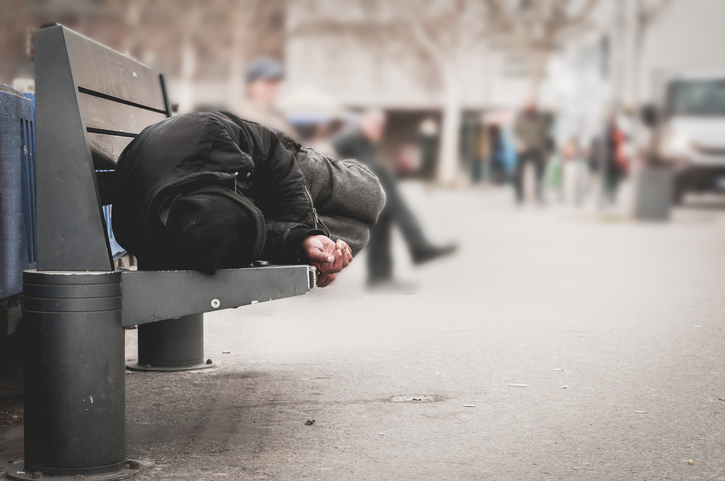
President Donald Trump issued an executive order (EO) in July urging local governments to clear homeless individuals from public areas, increase the use of involuntary commitment for psychiatric treatment, and reduce support for government programs such as Housing First and harm reduction, efforts that try to mitigate the consequences of risky behavior.
The order also encourages states and cities to adopt or enforce tougher laws against camping, squatting, loitering, and public drug use, while prioritizing federal grants for jurisdictions that comply.
The EO directs federal agencies to broaden the use of civil commitment, making it easier to institutionalize people, often without their consent, on the grounds of mental illness, substance abuse, or threats to public safety.
The framing of the issues as a matter of public safety amounts to a significant change in how the United States addresses mental illness, addiction, and housing.
“The Federal Government and the States have spent tens of billions of dollars on failed programs that address homelessness but not its root causes, leaving other citizens vulnerable to public safety threats,” states the EO.
“Vagrancy is a crime, and the pathology of homelessness is multifactorial, but the phenomenon has to be stopped,” said John Dale Dunn, M.D., a Texas physician, attorney, and policy advisor to The Heartland Institute, which co-publishes Health Care News. “A humane society does not allow it and ends it.”
Mental Health, First
The establishment approach, backed by progressives, is to get the mentally ill into housing first and then address issues of substance abuse and violence, says Merrill Matthews, Ph.D., a health policy analyst and columnist for The Hill.
“I think the better approach, which is generally favored by conservatives, is to take on mental illness and substance issues first, and then housing if and when the patients are ready,” Matthews said. “In other words, homelessness is a result of mental illness and substance abuse problems, not the other way around. That could mean controlled and even forced institutionalization for some patients.”
Staffing Shortages
States must take steps to ensure there are enough mental health professionals to deal with these patients, because there is a nationwide shortage of them, says Matthews.
“Two years ago, in my role as chair of the Texas Advisory Committee to the U.S. Commission on Civil Rights, we released a report on our findings related to the Texas Juvenile Justice System, especially as it related to kids with mental health issues,” said Matthews.
“The system was unable to provide the mental health professionals to see these kids,” said Matthews. “Staffing problems, in part because of low pay and pandemic-related challenges, left kids sitting in their cells for virtually the whole day, exacerbating their mental health troubles. The state needed more and better mental health care and decided to expand its efforts after our report appeared.”
Facility Needs
Last year in Texas, Gov. Greg Abbott said the state would spend $2.5 billion building or expanding seven psychiatric hospitals, including one for youth and a new facility in Lubbock. There is no question of demand as an increasing number of prisoners require psychiatric care.
“In 2023, 60 percent of those treated in the state’s psychiatric hospitals came from county jails or the prison system,” said Matthews.
Texas is taking the right approach, says Matthews. “If states are going to address mental illness and addiction first, and then try to get stabilized patients into housing, they will likely need to spend more on facilities,” said Matthews. “But it’s important to try and ensure there are enough facilities for families to visit their loved ones to provide that emotional support. That may mean a larger number of smaller facilities.”
Emergency Failures
Too many advocates on the issue don’t know the value of “tough love” in dealing with mental illness and substance abuse, says Dunn.
“I practiced emergency medicine for 50 years, and the emergency department is where mentally distressed, drug- and alcohol-impaired people get treated,” said Dunn.
“I involuntarily committed hundreds of people in my career, and every state I practiced in had mental institutions where mental health crises and definitive treatment were imposed on those suffering from a crisis that resulted in their arrest, apprehension, or having friends or family take them in for evaluation and treatment. I worked with local mental health services people to address homeless, drug- and alcohol-addicted, and mentally disabled persons. I never saw a psychiatrist in the emergency department—they were always in mental institutions or mental health clinics.”
Deinstitutionalization Legacy
Taking severely mentally disabled, drug-addicted, homeless people out of institutions and putting them on the street does what everyone knew it would do, messing up the streets and neighborhoods and creating disorder and disturbance of the peace, says Dunn.
“Particularly in cities, the welfare of the citizens is compromised,” said Dunn.
The deinstitutionalization project developed in the 1950s and matured in the 1960s because people didn’t like institutions for the insane and severely disabled, says Dunn.
“I watched it happen, and deinstitutionalization increased the problem of public behavior that was disruptive and disturbing, all the way to violent,” said Dunn.
The abuse of drugs increases as street chaos and homelessness expand, says Dunn.
“Most of the homeless use drugs of abuse; it’s self-treatment in many cases,” said Dunn. “Mentally ill individuals are inclined to abuse drugs to reduce their discomfort and mental stressors. Criminal behavior follows mental illness and substance abuse, and it ranges from behavior problems to violence, along with criminal activities to enable drug abuse.”
Kenneth Artz ([email protected]) writes from Tyler, Texas.
Internet Info:
Merrill Matthews et al., “Mental Healthcare in the Texas Juvenile Justice System,” Texas Advisory Committee to the U.S. Commission on Civil Rights, May 2023

Artz has more than 20 years’ experience in nonprofit organizations, publishing, newspaper reporting, and public policy advocacy.