Life, Liberty, Property #150: Rhode Island Starts Tax Hike Death Spiral
Forward this issue to your friends and urge them to subscribe.
Read all Life, Liberty, Property articles here, and full issues here and here.
In This Issue:
Rhode Island Starts Tax Hike Death Spiral
Video of the Week: Social Security Insolvency by 2032 – In The Tank #540
Cities Spending More Than Ever, Getting Nothing for It
Voters Hate Government Program Fraud, Survey Finds
Hot off the Presses!
‘Today’s crisis is a product of government errors, not greedy landlords, institutional investors, and so-called market failure.’
Rhode Island Starts Tax Hike Death Spiral
Rhode Island just enacted a tax increase that will chase the highest-earning households out of the state and ensure revenue shortfalls as long as it remains in place.
Gov. Dan McKee signed a state budget on June 12 that raises the tax rate on annual income above $1 million to 8.99 percent, up from the current 5.99 percent. That is a 50 percent tax hike on the state’s most successful people.
These millionaire taxes are an increasingly popular idea that benefits low-tax states while punishing everyone who remains stuck in high-tax ones.
McKee, a Democrat, is up for reelection this year and is in a tough primary battle against wealthy opponent Helena Foulkes. That explains McKee’s newfound support for a monster tax increase he opposed last year.
I am by no means convinced that all these governors and state legislators really believe these tax hikes will raise additional money. Some dimwitted true believers certainly do imagine that people are so enamored of their current places of residence that they will accept anything as the price of remaining there. New York City Mayor Zohran Mamdani, Los Angeles political boss Karen Bass, and Seattle chief executive Katie Wilson are apparently among these.
Their policies and public statements demonstrate this amply. At a news conference early this month, Wilson “laughed off warnings of a millionaire exodus even as a new survey shows many business leaders are considering leaving the state,” the New York Post reported. “I still think that claims of a large exodus of rich people due to our statewide millionaire tax that the legislature passed this year are overblown,” Wilson told FOX 13 Seattle with a laugh.
Just a few days later, the Downtown Seattle Association issued a report stating the “JumpStart” business taxes Seattle passed in 2020 have resulted in the loss of 30,000 jobs, a near-quintupling of the downtown office vacancy rate to 32 percent, and a 21 percent decline in the value of office properties. As a result, “the taxable value of its office buildings has fallen 48%—even as [nearby] Bellevue [Washington], which has no comparable tax, added jobs and saw commercial values rise 7%,” Geekwire reported.
The report clearly shows these taxes do not increase affordability or lower the burden on low- and medium-income residents as these politicians always promise. They do the opposite, in fact. “Since 2020, King County’s tax base has shifted further toward residential property (1–4 units), which grew from 59.3% of total taxable value to nearly 67% in 2025—an increase of more than six percentage points,” the report states.
Despite all that, Wilson laughs at the idea of a connection between the tax hikes and the exodus.
Meanwhile, Los Angeles has become a hellscape under Bass, who took office in 2022 and is up for reelection this year. Businesses are leaving, and the city now leads the nation in the annual number of people moving out: “Los Angeles County is losing residents at a pace that now leads the nation, according to recent census data, Los Angeles Magazine reports. “The county has lost more than 300,000 people since 2020, a shift large enough to affect federal funding, infrastructure planning and long-term economic strategy.”
Bass’s own brother is suing the city for damages from “a series of cascading failures” by local and state-level agencies in dealing with the 2025 Palisades fire. In short: Los Angeles is in a death spiral.
In New York City, Mamdani is openly warring with business leaders, notoriously telling them “Well, today, we’re taxing the rich!” in a bizarre video explicitly naming Citadel CEO Ken Griffin as a target. Griffin responded by expanding his investment operations in Miami.
The flight from oppressive regimes with sky-high taxes is gaining speed. Between 2012 and 2023, the state of New York lost 13.4 percent of its population in net migration to other states, Illinois lost 9.22 percent, California 6.14 percent, Massachusetts 6.2 percent, and New Jersey 5.66 percent.
Those people are moving to low-tax states such as Florida (gain of 12.35 percent), Texas (up 7.55 percent), North Carolina (8.44 percent), Arizona (10.99 percent), Tennessee (up 8.42 percent), and South Carolina (15.43 percent).
And what about Rhode Island, with its top tax rate of 5.99 percent and sales tax of 7.0 percent? The Ocean State lost 3.69 percent of its population during those years.
With the state now in a budget crunch caused entirely by overspending, McKee’s genius idea is to compound the problem by charging the dwindling number of high-income Rhode Islanders even more in taxes, thus encouraging them to leave as well. They will take successful businesses with them.
That will cause even greater revenue shortfalls and further money grabs that will make the state even less attractive.
There is simply no way to reverse this kind of death spiral by increasing tax rates. Spending cuts are the only way to change the dynamic, as unpleasant as that prospect may be for those who get to dole out the cash.
Instead, Rhode Island will now rejoin the loser states while government services deteriorate, crime rates and homelessness rise, infrastructure falls into disrepair, and the people suffer.
One would think a major terror attack just occurred on U.S. soil, for all the reactions that Democrats and socialist friends are having to the news that Elon Musk’s net worth just hit a trillion dollars. He is the first person in history to make that mark, and leftist progressives absolutely hate it. We will discuss the politics of ENVY, and how poisonous jealousy is to society and the economy.
Also, as the World Cup continues in the United States, many visiting Europeans are finding themselves loving American culture and community, reality is refuting the scary picture painted by their own media. American communities have always been loyal and close-knit, as the history of the “Midnight Ride” network of Paul Revere and his fellow messengers shows us. For our Countdown to 250 segment, we discuss the trust and coordination it took to make their mission a success.
On UNHINGED: Lefties lose it over Elon Musk’s trillionaire status. The Heartland Institute’s Linnea Lueken, Jim Lakely, S. T. Karnick, and Chris Talgo talk about all of this and more on Episode #541 of the In The Tank Podcast.
Get the latest best-seller from Heartland’s Justin Haskins!
America’s economy is teetering on the edge of disaster. Hidden beneath record stock market highs and reassuring headlines lies a fragile system riddled with debt, reckless speculation, and decades of political negligence. When the next big crash strikes—and it will—the fallout could be unlike anything we have ever experienced.
Cities Spending More Than Ever, Getting Nothing for It
American cities are increasing spending at a pace very rarely matched in the nation’s history, a new report from Real Clear Investigations states. What makes things even worse is that the cities do not have the money for this splurge, and the results of the spending are poor at best.
RCI’s Jeremy Portnoy reports:
A RealClearInvestigations analysis of cities with at least 500,000 residents found they cumulatively raised their per-person spending by 18% over the last 10 budget cycles, accounting for inflation [meaning these are real increases, above the inflation rate]. The only equivalents on record are the spending surges ignited by the Great Society programs of the 1960s and Franklin D. Roosevelt’s New Deal during the 1930s.
But unlike those past eras, today’s cities do not have the revenue to support their heavy spending. State and federal funding have dropped off from their record highs during the COVID-19 pandemic, and local tax hikes have not kept pace with spending. Large tax increases or reductions in city services will eventually be required to address burgeoning structural deficits, placing a burden on future generations.
The tradeoff would be easier to explain if cities were making strides to improve life for their residents. Census data, however, shows that key quality of life metrics in major cities have mostly been stagnant during the spending spree.
The analysis covered government data from 38 cities, all of which increased spending faster than the overall inflation rate in the past decade. The result: “the cities that boosted their spending the most were, on average, no more or less likely to see measurable progress in reducing homelessness, lowering violent crime rates, tackling income inequality, improving rent affordability, and more.”
The cities are overspending, pure and simple, the study found:
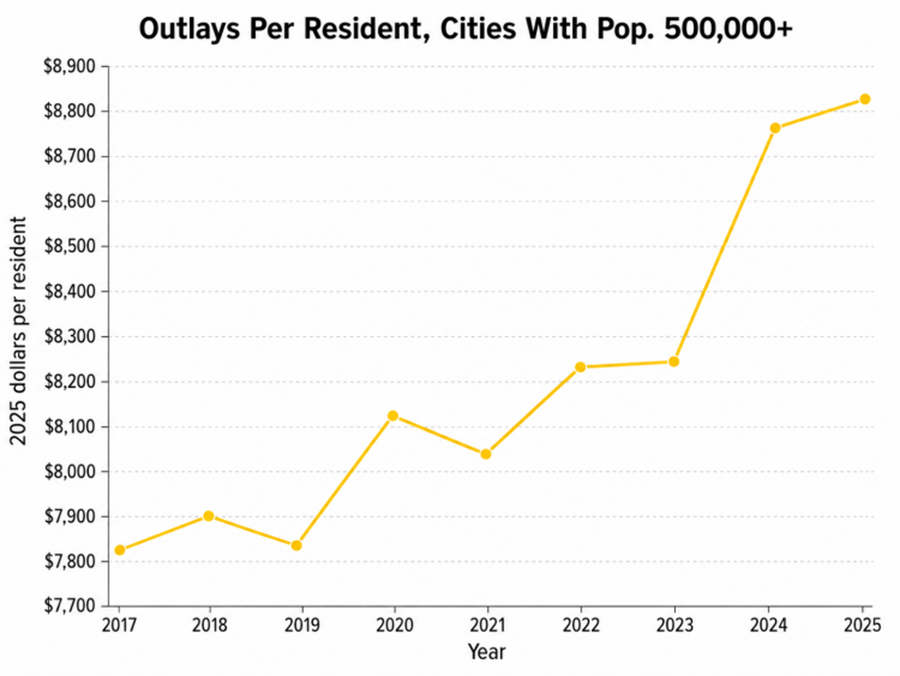
In 2016, large cities collected $6,727 of revenue per resident from local, state, and federal sources, adjusted for inflation. They spent 14% more than that: $7,685 per person.
Outlays Per Resident
RCI
By 2025, revenues had increased to $7,063 per person, but outlays had skyrocketed to $8,827. The difference of 25% is the largest gap on record since at least 1940.
It is a spending problem, not a revenue shortfall, the report states:
The gap was not caused by low revenues. Cities earned record amounts of sales and property taxes last year. Instead, the deficits were driven by expanded bureaucracy, rising payrolls, overtime costs, and pension liabilities.
From 2017 to 2026, the public workforces of large cities grew faster than their populations. There were at least 12 cities that added new municipal jobs even though their populations dropped (A handful of cities do not disclose their staff headcounts). In an extreme example, Memphis added more than 1,000 public jobs even though the city lost more than 40,000 residents.
Many of those new hires work desk jobs. Census data shows large cities increased their administrative expenses—mayor’s offices, human resources departments, accountants, zoning departments, and more—by 55% from 2016 to 2023, accounting for inflation.
Cities are hiring administrative staff while making cuts in areas such as police and corrections. Whereas big-city political machines in the early and middle decades of the twentieth century built powerful voting blocs by paying city employees well for performing essential services, while padding the payrolls with far more workers than were needed, today’s city governments are just throwing money around with no idea of what they’re getting for it:
RCI took a look at how some representative cities have responded to major issues.
Homelessness in America’s largest cities jumped by 34% on average from 2017 to 2024, driven partly by increased housing costs and job losses during the pandemic. RCI’s analysis found no statistically significant association between increased public welfare spending and reduced homelessness.
No surprise there. Portnoy continues:
While Los Angeles is the poster child for getting little bang for the bucks it’s spent to combat homelessness, it is not alone. Seattle and surrounding King County were among the biggest spenders, with money pouring into the Regional Homelessness Authority. It was created by former Mayor Jenny Durkan in 2019 to “significantly decrease the incidence of unsheltered homelessness.” Washington State has also lifted its spending on housing construction by six times since then. But homelessness in Seattle increased at a faster rate than in any other large city but one, and rent price increases were also among the nation’s highest.
It’s easy to see where things went wrong. Astate audit released in April found that the Homelessness Authority overspent its $200 million annual budget by $45 million, with portions of the money completely unaccounted for or spent on administrative expenses the city never approved. The authority is also paying individual contractors close to $500,000 annually, an amount unlikely to be seen as reasonable for a salaried public servant.
As I noted in the lead item of this issue, this high spending brings no net benefits to these cities’ residents. Poverty and income inequality remain unchanged despite the promises of pandering politicians, Portnoy writes:
Although many big cities explicitly state that their budgets are designed to reduce inequality, large cities’ Gini index—a measurement of how evenly wealth is distributed—was virtually unchanged from 2017 to 2024. So was the percentage of the population with health insurance. Poverty rates improved by 1% on average. Cities that increased their overall budgets at a faster rate were no more or less likely to see improvement in any of those three categories.
The 10 cities with the smallest topline budget increases since 2017 all saw their poverty rates drop or remain unchanged. Those 10 cities, including Minneapolis and Long Beach, now have an average poverty rate of 13.8%, lower than most of their peers.
The same is true of crime prevention, Portnoy notes: “[T]here was no statistically significant association between spending levels and violent crime rates. Cities that increased their police budgets were just as likely to see crime rates rise as cities that decreased theirs.” As I have noted regularly, law enforcement and prosecution are the keys to making city streets and homes safe.
Finally, Portnoy outlines the ways cities get around laws mandating balanced budgets. These include overly rosy estimates of expected revenues and costs, and “issuing bonds, digging into reserve funds, selling municipal property, and ignoring obligations to fund public employees’ future pension and healthcare plans.”
The last item is particularly ominous. For decades, cities across the land granted public workers lavish pension promises, obligations that are now eating up ever-greater percentages of annual government revenue. Today’s taxpayers are paying enormous sums for people who are not contributing anything to meet current service and infrastructure needs.
As the retiree-to-worker ratio continues to increase, those obligations only worsen.
To stop adding to the problem, cities can switch over to defined-contribution plans like the 401(k)s private-sector workers get, phasing out pension plans that require specific payouts from future taxpayers. Some states, however, such as Illinois, do not allow employers to put even new workers into these plans, let alone transition current workers into such a system.
Politicians have pushed the nation’s big cities into a fiscal hole they may never be able to get out of by honest means. With the federal government in a similar situation, the only viable resolutions may be urban bankruptcies and rapid monetary inflation, all arriving within a decade or so.
Nobody wants that, of course, but few, if any, politicians want to make the spending cuts that will be necessary to avert it.
‘The CSDDD is the greatest threat to America’s sovereignty since the fall of the Soviet Union.’
Voters Hate Government Program Fraud, Survey Finds
Likely voters across the United States overwhelmingly believe fraud in federal government programs is a major problem, and they think so even though they greatly underestimate the amount of fraud that is occurring.
“Fraud in federal government spending is a serious problem, most voters believe, but not many realize just how big the problem really is,” Rasmussen reported on a recent survey the organization performed.
The survey found 79 percent of likely voters think fraud is a big problem, and 55 percent describe it as “very serious.” Only 17 percent say fraud is not a serious problem.
Although the Government Accountability Office has estimated fraud may total more than a half-billion dollars a year, only 19 percent of the likely voters polled said they think the annual fraud toll is more than $500 billion. Eighteen percent said it is between $250 trillion and $500 trillion, which tracks well with GAO’s estimate of $233 billion to $521 billion.
Of the rest who gave an estimate, 25 percent said the annual amount of fraud is $100 billion to $250 billion, and 21 percent said it’s less than $100 billion. That amounts to 46 percent saying it is below the GAO’s estimate, and 37 saying it is at or above that range.
Voters strongly support greater eligibility enforcement, the survey found. Investigative journalist Sharyl Attkisson summarizes those results (which are behind a paywall at Rasmussen) as follows:
Ninety percent (90%) say it is important to arrest and prosecute those who commit fraud in federal government spending programs, including 72% who say it is very important.
Views vary somewhat by party. Republicans are more likely than Democrats or unaffiliated voters to estimate the amount of fraud at $250 billion or more annually. Majorities of Republicans, Democrats and unaffiliated voters also say prosecuting government spending fraud is very important.
The conclusion is clear, in my view: American voters hate theft from government programs, and they will be even angrier than they already are if the scope of the problem turns out to be far greater than they now think it is.
The Heartland Institute 1933 North Meacham Road, Suite 559 Schaumburg, IL 60173 p: 312/377-4000 f: 312/277-4122 e: [email protected] Website: Heartland.org