IN THIS ISSUE:
- Media’s Interest in Climate Change Is Flagging
- Study Credits Carbon Dioxide Increase for High Rice Production
- Wildfires Are Not Increasing Across the United States or the Mediterranean

Media’s Interest in Climate Change Is Flagging
The signs all over are indicating the media’s focus on climate change is dramatically and rapidly waning. Rather than reflecting an acknowledgment that a realistic assessment of climate facts shows no climate crisis is in the offing, the media’s declining climate coverage seems to be a bow to an economic reality: climate change just doesn’t sell. The media’s flagging coverage of climate change is a lagging indicator, following a trend rather than leading it. Polls have consistently shown climate change is not among the top issues of public policy concern for the vast majority of the public, and global finance, commercial activity, and politics have shifted away from concern about cutting carbon emissions toward bringing more affordable, reliable energy—which means fossil fuels—to the market as quickly as possible.
An initial indicator of the media’s climb down from the alarming 24 hours a day, seven days a week pronouncements of the so-called climate crisis came in early February, just over a year after Donald Trump took office as president of the United States for the second time. The Washington Post (WaPo), fired 13 of its Climate Desk reporters, about 2/3 of its staff dedicated to writing about climate change. The WaPo had long been leading the charge pushing climate scare stories and detrimental energy policies that were supposedly necessary to prevent a climate catastrophe.
Then in late May, National Public Radio (NPR) announced it was disbanding its 10-person climate desk, the department dedicated solely to reporting stories of climate doom. As part of a larger restructuring, NPR fired its chief climate editor, Neela Banerjee, and folded some of its remaining staff into other departments on its national desk.
Politico followed in early June, announcing it was shutting down its flagship climate and environmental publications: E&E News Daily, Greenwire, Climatewire, Energywire, and E&E News PM. These publications were leading independent outlets of climate, energy, and environment news for nearly three decades. Just a few years ago, Politico took over this publication group, supposedly to “substantially expand POLITICO’s footprint” in the energy, climate, and environment fields. Now it is ending them. As with NPR’s action, the closure of these climate publications is being portrayed as a restructuring: “E&E News will no longer operate as a separate brand. Its journalism and expertise will be fully integrated into POLITICO’s energy and environment portfolio of stories, briefs, analysis and newsletters.”
The union representing the E&E News branded journals sees Politco’s action as less of a restructuring and more of a betrayal.
“Union blindsided by E&E News closure,” is the title of a story on Politico’s E&E New closure in TalkingBizNews. “On January 29, as we were discussing buyouts for the energy and environment teams, Joe Schatz told PEN Guild union leaders, [t]he brands and the publications are not going away. We are looking to sharpen their missions.’
“This is the second time management has lied to employees in six months—the first being when John Harris said in December there would be no layoffs at the company, only to lay off some managers a month later,” the story continued.
It is likely the Trump administration’s decision to cut tens of millions of dollars in subscriptions across various departments and agencies for outside publications that taxpayers had been paying for, including more than $8 million to Politico, played a role in the company’s decision, just as the end of public funding for NPR surely contributed to NPR’s climate reporting decline. As the government has stopped funding climate propaganda, its propagators are being forced to retreat and retrench.
These are just three outlets, important outlets no doubt, but still just a ripple in the entire climate journalism industrial complex. But what’s happening there seems to be symptomatic of the decline of climate change coverage in general.
Fewer journalists are signed up to attend the U.N.-sponsored annual climate negotiations in Bonn, Germany this year than at any time since the COVID pandemic. The number is lower than even a decade ago in 2016. Climate Home News reports:
The number of journalists registered to attend the annual climate negotiations in Bonn has declined this year, as climate reporters have been let go and media coverage of climate issues falls around the world.
Data from UN Climate Change, which runs the two weeks of talks, shows that just 135 media representatives have signed up to attend. Climate Home News analysis of previous data shows this is the lowest figure since 2021, when COVID-19 restrictions limited travel and the Bonn talks were held in a hybrid format to enable online participation.
The number of journalists that actually attend the talks will not be known until later this month but is typically significantly less than are registered.
Media outlets that have registered fewer journalists than previous years, or no journalists, include global heavyweights like Reuters, Bloomberg and the BBC, as well as German outlets like Deutsche Welle and ZDF television … .
The same story notes the overall amount of climate coverage has seen a sharp decline over the past year: “climate coverage in the first five months of 2025 was 35 percent down on the same period of 2025 and 41 percent less than in 2021. Coverage is down even further in 2026, with just over 17,000 stories published January through May 2026, a 48 percent decline since a high-water mark of more than 34,500 stories published in 2021.
“[A] [n]ew analysis by the Yale Programme on Climate Change Communication found a similar fall in climate coverage in 2026. (See the graph, below)
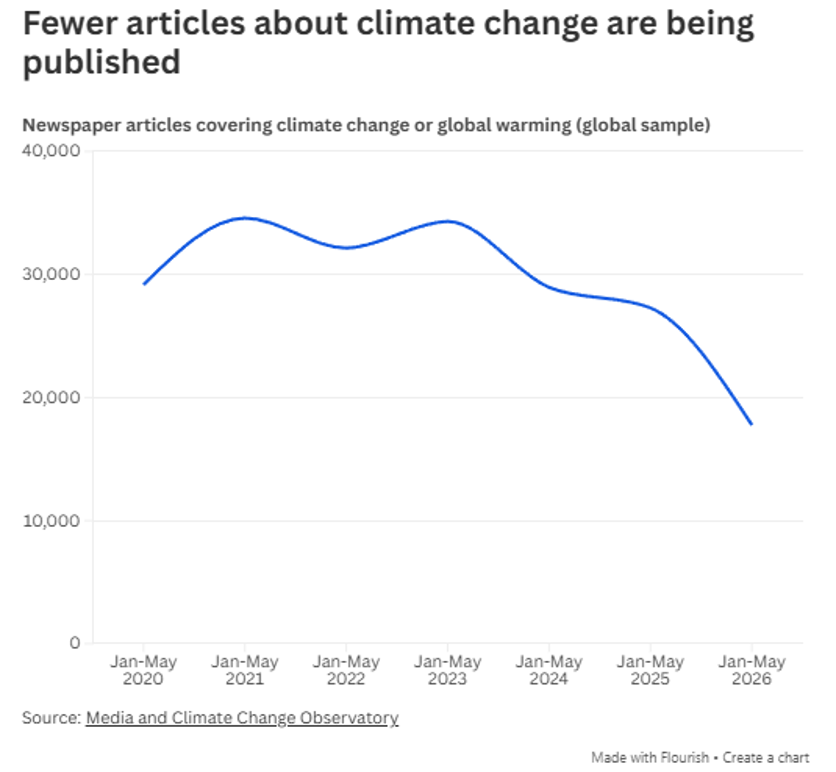
Any way you measure it, there is a sharp decline in reporting on climate change. That’s good news for the public, whom the media have misled for decades about the causes and consequences of climate change, haranguing them about their dining, shopping, travel, and voting habits, claiming their use of fossil fuels was killing them, their children, and the planet. This was always false.
Source: Climate Home News

Study Credits Carbon Dioxide Increase for High Rice Production
New research published in the Nature imprint Scientific Reports credits rising atmospheric carbon dioxide levels as one of the main factors contributing to increased yields and production of rice since the 1960s.
Rice is a staple crop for half of the world’s eight billion people. Fortunately, rice production has kept pace with population growth since the 1960s, aided by a variety of factors.
The researchers used data-modeling techniques to account for the range of factors that have produced record rice yields and production levels repeatedly from the 1960s through today. Contrary to the claims made by some that climate change would harm crop production, including rice production, the researchers found this is not the case, on net.
Rice production has more than doubled since the 1960s, topping 713 million tons per year from 2006 through 2015. Since then, FAO data show rice yields have continued to increase, resulting in production topping 800 million metric tons in 2023 and 2024. The largest factor the researchers identified as contributing to increased rice production and yields is improved management practices, including expanded, more efficient irrigation, increased nitrogen and manure fertilizer use, and transplanted rice varieties.
Second only to changes in management practices were improved environmental factors, accounting for a 24 percent boost in production. The leading environmental factor was rising CO2, which by itself produced 30 percent of that gain. Specifically, the researchers found high CO2 levels “contribut[ed] to increased rice production by enhancing photosynthesis and improving water-use efficiency.” Enhanced CO2 also resulted in improved nitrogen fixing in the soil, and it resulted in secondary environmental benefits that allowed multiple plantings and harvests in a single year.
The authors claim “climate change reduced production by 7%,” which, in the face of the large increase in production and yield one must take to mean they estimated production was 7 percent lower than it would have been absent climate impacts. Even if true, that impact is swamped by the acknowledged 30 percent improvement produced by CO2 enhancement. It is, in fact, unclear how climate change could have reduced rice production. The data show no long-term sustained trends of worsening storms, floods, droughts, or pest infestations that could indicate climate change was a factor in a season, year, or multiple years of subpar yields or production. As a result, there is no compelling evidence of any negative impacts from climate change. One or even multiple years of bad weather are not proof of climate change, as such down years are evident throughout history due to the normal seasonal, annual, and decadal variability of weather.
Sources: Nature; Climate Realism
Wildfires Are Not Increasing Across the United States or the Mediterranean
Contrary to what is often reported, data from the United States and the Mediterranean show no increase in wildfires over the past century. In fact, wildfire numbers and acreage lost to wildfires have declined.
Data from the National Interagency Fire Center covering 2015 through 2025 (see chart, below) and from 1996 to 2014 show no increase in wildfires.
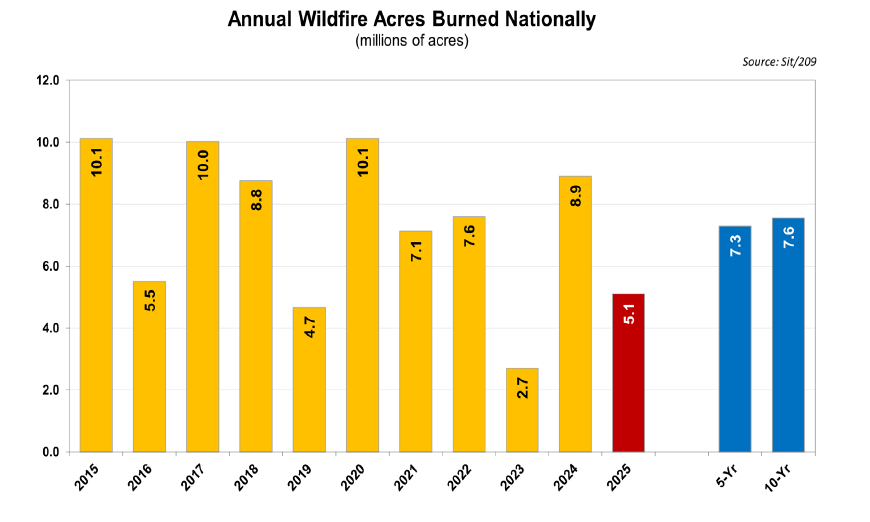
Going back further, as detailed at Climate at a Glance, the acreage lost to wildfires across the United States has declined dramatically since 1925.
Also, despite a particularly bad fire year in the Mediterranean region in 2024, with acreage lost to wildfires well above average, wildfire trend data since 1960 covering France, Greece, Italy, Portugal, and Spain show a modest decline in acreage lost to wildfires annually over time. The 2024 season was similar to wildfire seasons experienced in the early to mid-1980s, forty years of global warming ago.
Despite media lies about climate change causing worse wildfires, the data from the United States and the Mediterranean region should not surprise anyone: satellite data from NASA and the European Space Agency both show a significant decline in wildfires globally in recent decades. The data from the United States and the Mediterranean are consistent with global trends and inconsistent with any claims that climate change is causing more, more-frequent, larger, or more severe wildfires.
Sources: National Interagency Coordination Center; Not a Lot of People Know That