
Forward this issue to your friends and urge them to subscribe.
Read all Life, Liberty, Property articles here, and full issues here and here.
In This Issue:
Life, Liberty, Property #159
- Trump’s ‘Dividend’ Plan Could Work, With One Major Addition
- Video of the Week: What The Flock?! – In The Tank #549
- USDA Finds Massive Food Stamp Fraud
- American Homes Are Surprisingly Affordable, Study Finds
Trump’s ‘Dividend’ Plan Could Work, With One Major Addition
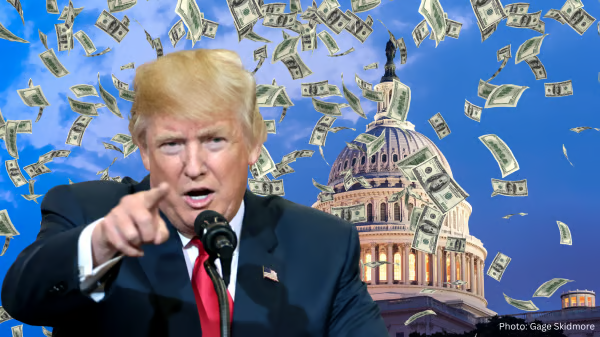
President Donald Trump made another of his bold and extravagant promises at the Republicans’ midterm convention last week, proposing to give “every adult citizen in the United States of America” a “dividend” of $5,000 if the Republicans win House and Senate majorities this November.
That would cost approximately $1.2 trillion, according to media estimates.
Democrats immediately derided the plan, as is their reflexive response to anything Trump does or says. Many Republicans quickly joined the chorus of woe, as is likewise their habit.
The complaints have substance: the plan is unworkable in the form in which Trump presented it. It would increase the already terrifying national debt and probably spark much-higher inflation, to be followed by a harsh recession, depression, or hyperinflation.
Trump argues that recent economic growth justifies a return of resources from the grossly overfed government to the private sector. That is a fair point. In fact, it identifies what the nation most needs today: liberation from the damage the federal government has been doing for decades in constructing and feeding a massive, costly, unwieldy, and enterprise-destroying welfare state and a similarly expensive national-security apparatus.
Trump, however, does not put it quite that way. The White House press release for his plan says, “Like a successful company returning cash to its shareholders, the Trump Dividend is possible only because of President Trump. In his second term, he has unleashed trillions in new private investment, launched an unprecedented crackdown on government waste, and rebuilt American strength at home. That success belongs to the American people—and the Trump Dividend returns it to them.”
It is only fair to note, however, that the American people have already received a “Trump Dividend.” It has arrived in the form of the economic growth he and his team cite, which has improved wages, spurred increases in the value of investments, reduced federal taxes (thus increasing after-tax income), and transferred jobs from criminal immigrants to American citizens and legal resident aliens.
Of course, the government is taking a large chunk of those wages and profits, so there is a strong case to be made for additional redress to people paying federal taxes.
The qualifier at the end of that sentence is important. To reduce the effect on debt and inflation, it would make sense to send the payments only to those who have actually paid federal taxes, and cap each check at the amount of taxes the person has paid since January 20, 2025.
Those who are paying taxes are the ones doing the productive work and investment that is creating the economic growth Trump says he wants to reward. They should be the ones to receive any cash dividend on that success.
With around 40 percent of U.S. households paying no income tax in the most recent year, the payout would be much less than $1.2 trillion.
Of course, this approach would not attract many votes from those who pay no taxes. Republicans, however, have long been strong proponents of “refundable tax credits,” in which the federal government sends tax “refunds” to people who paid no income tax. Hence, conservative critics of Trump’s plan have long supported it in principle. Just not this time.
They are right to complain that the increase in the national debt would cause economic havoc. Averting that outcome would require big spending cuts. That is exactly what the nation needs at this time anyway. Offsetting the payments with spending cuts should answer conservatives’ economic concerns, while raising political ones.
The political calculation is simple. Would more voters appreciate the prospect of a $5,000 check or bemoan a reduction of government spending?
In economic and ethical terms, the choice is simple. The amount the government takes from American workers and investors today is punitive, economically destructive, and immoral. It punishes enterprise and reduces incentives to work and invest. Reducing that ongoing damage by restoring some of the taxes paid is a very good thing to do, and it is honorable, whereas the current tax levels are not.
Such a historically large tax and spending cut would shrink the bloated government, stimulate the economy, and reduce inflation dramatically by spurring economic growth.
If political considerations require that the payments to achieve all that are also extended to “free riders” who didn’t pay taxes, the positive results may be well worth it.
Americans need and deserve tax cuts, not “conservative” suspicion of plans to return money to the private sector. Preserving the current high taxes, smothering regulation, and massive overspending will not conserve the American economy and way of life.
The conservatives’ complaints and inaction play into the hands of the democrat socialists, whose political support is based entirely on blaming businesses for the damage big government has caused.
Instead of dismissing Trump’s idea out of hand, the president’s conservative and libertarian critics can and should offer a better plan to accomplish the goal he says he’s aiming for.
Here’s my proposed alternative. Cut taxes by $1.2 trillion for one year, by sending out the Trump Dividend checks, while cutting spending to match. That is where spending would be if we simply returned to the pre-Covid trendline, which was too much government spending by far, anyway. Next year, keep the spending cuts.
Then, sit back and enjoy watching the greatest economic revival of all time, anywhere, an economy that would be truly worthy of the president’s hyperbolic praise.
Source: The White House
Video of the Week
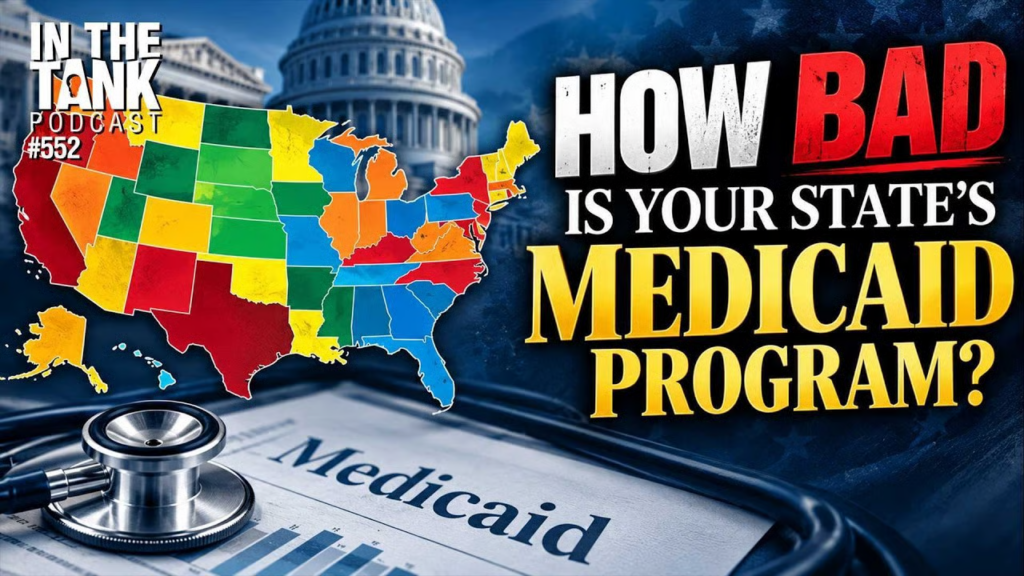
The Heartland Institute has released an important study ranking states based on how they handle Medicaid. Government is very fond of wasting your money, but some states waste less than others. We look at what the difference is between the top performing states, and the worst.
USDA Finds Massive Food Stamp Fraud

Enrollment in the federal Supplemental Nutrition Assistance Program has decreased by 13.5 percent since last year’s One Big Beautiful Bill Act went into effect and began requiring states to get serious about checking the eligibility of the people to whom they are sending the money, the U.S. Department of Agriculture reports.
The federal government has been paying for the entire cost of the food stamp benefits while letting the states manage the program. That creates a huge incentive for states to look the other way while ineligible people enroll. Now, states must pay a little for their negligence, deliberate or otherwise. The Unleash Prosperity Hotline reports the results:
States with error rates over 6% will no longer get 100% federal funding for their food stamp programs. They will still get 85 to 95% federal funding, but the risk of having even a little skin in the game has been enough to get the states to finally get serious about reforming this program, enforcing work requirements and cracking down on fraud.
Some of the first-year changes have been astounding: a 53.8 percent reduction in Arizona, 36.5 percent in Georgia, 23.1 percent in Nevada, 22.2 percent in Florida, and 21.5 percent in Louisiana. The only state with an increase was Alaska, at 4.7 percent.
Those states should be ashamed at how much fraud they were allowing.
These federally financed and state-administered programs are rife with fraud, suggesting that they were designed to create dependency on government and votes for big spenders. Even a small amount of responsibility for fraud can change the situation dramatically.
Sources: U.S. Department of Agriculture; Unleash Prosperity Hotline
American Homes Are Surprisingly Affordable, Study Finds

While Americans struggle with a sticky housing market and a housing affordability crisis that has the average age of a first-time homebuyer at a record 40 years, the United States is doing surprisingly well in international comparisons. In fact, housing in America is the second-most affordable in the world in terms of the amount of time a person must work to pay for it on a square-footage basis, RationalFX reports:
To put a human scale on property prices, the team at RationalFX combined residential property prices per square metre with average salaries around the world. The analysis asks two simple questions: how long would an average worker have to work to earn enough for one square metre, and how much space could one monthly salary buy? We then translated those figures into familiar everyday spaces—such as a small bathroom, a washing machine, or a compact dining table—to show what those numbers actually mean in physical terms.
A month of work can buy surprisingly little space in much of the world. In 62 of the 100 countries analysed, an average monthly net salary covers less than half a square metre of residential property. In Nigeria, it buys just 0.04 m²—roughly the footprint of a small plate—while in Cuba, Sri Lanka and Hong Kong, it covers less than 0.15 m².
At the other end of the scale, a monthly salary stretches to more than one square metre in just three countries: South Africa, Oman, and the United States, highlighting just how differently the value of a month’s work translates into physical space around the world.
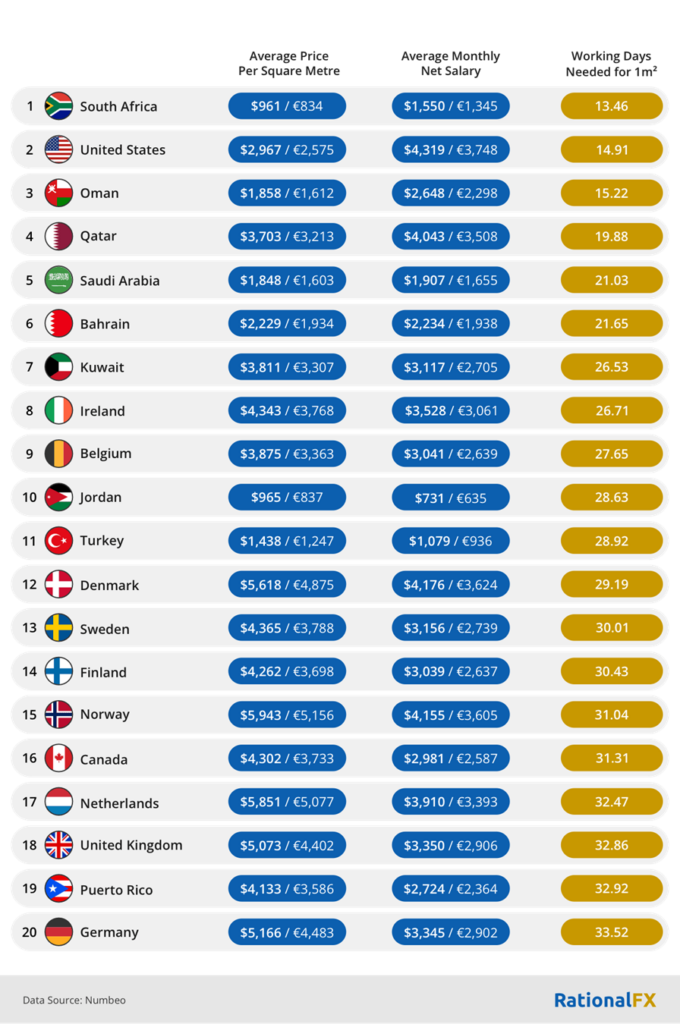
American workers have to put in the second-least work time among all nations in the world to buy a square meter of residential property, the article reports:
Countries Where You Need To Work The Least to Buy 1 Square Metre Of Property
Source: RationalFX
The American worker enjoys an ideal combination of high average salary and low housing costs per square meter, the study found:
The countries at the top of the ranking show that housing affordability is not simply a race to the lowest property prices. South Africa comes first with an average price of $961 per m², but the United States follows despite homes averaging almost three times as much, because its average monthly net salary is also far higher.
Housing in the United States costs an average of $2,967 per square meter, versus $23,128 in Hong Kong (highest cost on the list), $16,590 in Switzerland (third-most expensive), $7,017 in Australia (number 7), and $5,851 in Norway (number 10), the article reports.
Work time is an ideal way to measure the true costs of goods and services for comparisons across time and space, as it indicates the practical investment of time and effort an individual must make to afford a purchase.
Although Americans are indeed suffering major difficulties in finding affordable housing, and we have built far fewer new residences than required to accommodate our population growth since 2008, international comparisons indicate that the fundamentals of our housing market are better than nearly anywhere else.
Now just consider how great things would be if our federal, state, and local governments would get out of the way and let us build as many houses as we really want. Nobody would be in our league in terms of average wages and median housing price per square foot, at which we are already number 2. That is what the American Dream is all about.
Source: RationalFX
‘The CSDDD is the greatest threat to America’s sovereignty since the fall of the Soviet Union.’

Contact Us
The Heartland Institute
1933 North Meacham Road, Suite 559
Schaumburg, IL 60173
p: 312/377-4000
f: 312/277-4122
e: [email protected]
Website: Heartland.org



S. T. Karnick is a senior fellow and director of publications for The Heartland Institute.