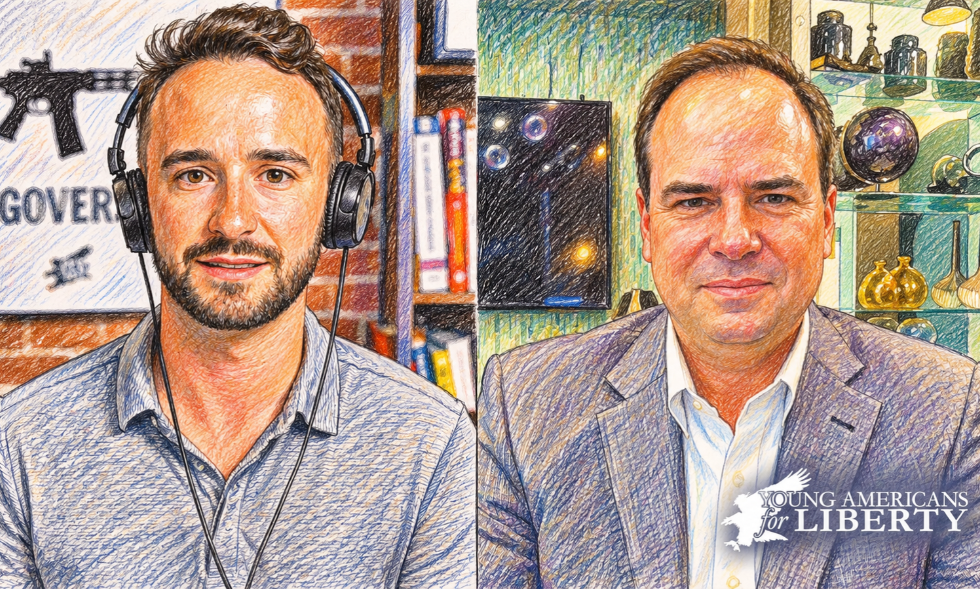
Heartland Institute President and CEO James Taylor joined the Voices of Liberty podcast of Young Americans for Liberty for a wide-ranging conversation on how free markets, not more government control, will solve the most-pressing problems in society.
The conversation spent a good bit of time on the move to ban or restrict AI data centers. Doing so would leave America behind, and the truth will catch up on technology, as he predicts it will on climate.
Heartland Institute President and CEO James Taylor joined host Sean Themea on Voices of Liberty, the podcast powered by Young Americans for Liberty (YAL), for a wide-ranging conversation. It began with how he discovered the ideas of liberty and ended with Chicago deep dish. The biggest news in between was Taylor’s warning about the growing push, across the political spectrum, to restrict AI data centers.
“Low tech is not our future”
Taylor said he is “very troubled” by calls for moratoriums on data centers. “Low tech is not our future,” he said, and the result of the pushback would be an America left behind while nations such as China, which “do not have our best interest at heart,” keep developing AI.
On the water concern, Taylor did not call it a complete myth. Data centers need cooling, he said, but the market is already responding: operators are adopting closed-loop systems that draw little water after the initial fill, and developing ways to cool without water at all. He called it a catalyst for innovation.
On electricity, Taylor noted that the tech sector used to back wind and solar groups, but that when data center developers plan their own power, they are mostly looking to restart nuclear plants and build natural gas plants. “That tells you all you need to know,” he said. “They’re not looking to lose money.”
“A lack of political courage”
Sean asked why Republican governors and candidates are calling for data center moratoriums. Taylor’s answer: “A lack of political courage.” He said some of the fear is organic and compared it to the Y2K panic, but argued that politicians are reacting to polls because the messaging “hasn’t caught up with reality yet.” Development is coming one way or another, he said, whether it takes the form of data centers or anything else.
“The truth is the truth”
Taylor drew a parallel to Heartland’s own history. In the mid-2000s, he said, some colleagues worried that rejecting the climate crisis narrative was costing the organization credibility with lawmakers on school choice, health care and fiscal policy. Heartland decided that “the truth is the truth, and we’re going to present the truth,” even if some politicians stopped listening.
He predicted the same will happen on technology: “Within a few years, I think the truth is going to catch up on this issue as well.” He added that Heartland has fought Big Tech over censorship and has little affection for some of its advocates, but he will not sacrifice the nation’s interests or his principles to keep fighting them.
Jobs, subsidies and the gas pump
Asked about fears that AI will eliminate entry-level jobs, Taylor pointed to the gas station attendants of his childhood. When self-service pumps arrived, those jobs disappeared, gas got cheaper, and households got wealthier. The same logic applies to AI, he argued, which makes goods and services less expensive and frees resources for other sectors.
On subsidies, he was blunt: Taylor said government “absolutely should not be subsidizing” data centers or any other industry. He said he tells tech leaders that if they want Heartland’s support, they should not ask for carveouts or cut deals with local utilities.
Embrace climate realism
Taylor urged young conservatives and libertarians to “do the research, find out the truth,” recalling that he was once ready to write a pro-climate-action editorial in law school before reading the primary sources. He summarized several claims from Heartland’s Climate at a Glance:
- Most of the roughly 6,000 years of human civilization were warmer than today, and the current warming is a recovery from the Little Ice Age.
- Depending on the study, 10 to 20 times as many people die from cold as from heat.
- Higher carbon dioxide levels and longer growing seasons are greening the planet.
- For most extreme weather categories, the trend is flat or declining.
- On sea level, Taylor said the pace has been about 8 to 12 inches per century since the mid-1800s, which he called “plenty of time to adapt.”
He also argued that climate fear is used to justify controls on daily life, citing the Green New Deal as an example of “using the climate scare to put into place the socialist vision.” Taylor recalled growing up in public housing during the Carter-era energy scare, when his family could not set the thermostat above 55 degrees in winter.
Energy: gas leads, wind and solar trail
Taylor pointed to Heartland’s Affordable, Reliable, Clean Energy Scorecard, which rates energy sources on cost, reliability and environmental impact. Natural gas comes out as a “gold standard,” he said, with nuclear, coal and hydro next and wind and solar scoring worst. To keep today’s deregulation from being reversed in 2028, he called on Congress to codify it into law.
Believe in yourself
Taylor closed with advice for young libertarians. He grew up in the projects, drinking powdered milk and wearing hand-me-downs, and said his mother always told him to study and apply himself. “Believe in yourself,” he said, and if you are interested in policy, reach out to Heartland. And the Chicago deep dish? Lou Malnati’s, though he said to try them all.
Watch the whole interview below.