IN THIS ISSUE:
- Wind Waste Is a Problem on and Offshore
- Pollution Decline Driving Recent Heat Waves
- Climate Change Real Estate Scam Costing Homeowners, Study Reports
- International Building Code Standards Causing Higher Housing Prices
Wind Waste Is a Problem on and Offshore
Waste, a problem endemic to industrial wind and solar facilities, is piling up or being scattered all over. In this essay I will leave aside discussions of the waste created in the mining, refining, manufacturing, and construction processes in the production and erection of wind and solar facilities.
Limiting this discussion to wind facilities, in previous Climate Change Weekly posts I described the problem of leading-edge wear of turbines, resulting from high winds, rain, hail, and other weather phenomena that erode the turbine blades and cause them to deposit tons of tiny bits of plastic/resin/polymer waste on the land surrounding land-based facilities in Scotland and Sweden. Leading-edge wear is even worse for offshore wind facilities, polluting the sea and the food chain.
Trash from wind is even more obvious and damaging when the turbines explode or collapse, which is not uncommon, as numerous videos demonstrate.
A recent Washington Times article described problems specific to Vineyard Wind, the nation’s first commercial-scale offshore wind farm.
In 2023, a turbine blade snapped off and disintegrated on the Masschusetts coast, forcing beach closures, with blade waste endangering commercial and recreational fishing and beachgoers. After the catastrophic failure, all the blades were inspected, and 68 out of 72 were found to be cracking or have serious defects, having to be replaced. Court battles over which company should pay for the nearly $1 billion dollars in damages caused by the collapse continue between Vinyard Wind and GE Vernova.
Despite new turbines being installed and construction being completed, Vineyard Wind is producing less than half the energy it promised to provide, with 13 of the now 62 turbines currently inoperative.
Ongoing and mounting repair costs and unanticipated operational costs threaten to turn the industrial facility into a “dormant wind farm graveyard,” a Vineyard Wind spokesperson acknowledged.
That’s the waste story (in terms of actually damaged parts and wasted resources) at just one wind facility.
Then there is the true, mounting waste problem associated with industrial wind.
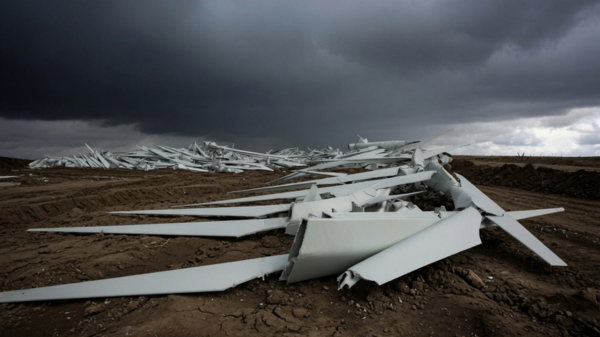
The material from each wind turbine has value. But if recycled, the value is less than 10 percent of the cost of decommissioning land-based turbines and just 3 percent of the cost of decommissioning offshore wind. And because the materials in the blades are of even less value and bound in a fashion that makes them difficult to recycle, wind turbines, blades, towers, and ancillary equipment such as nacelles containing gears are piling up, cluttering vast acres of land in some areas of the country.
Images are easily found that show broken and abandoned wind turbines in Hawaii rusting and falling apart, abandoned for years. In Texas, in lieu of promised proper disposal and recycling, the companies involved in decommissioning wind turbines have found it easier to stockpile the debris on open land, creating an illegal nuisance eyesore and a potential health danger.
This practice, however, is coming to an end. As USA Today reported recently,
A Texas court has granted the state a temporary injunction to prevent wind turbine recycling companies from accepting shipments of wind turbine blades and requires them to begin the cleanup of two West Texas facilities where blades have been discarded illegally.
Texas Attorney General Ken Paxton announced Tuesday that his office obtained a temporary injunction against Global Fiberglass Solutions, Inc. and other affiliated entities. The injunction also requires the company to clean up thousands of discarded turbine blades at two facilities in Sweetwater, Texas.
“No new wind turbine blade shipments will be accepted at these illegal sites and the defendants are now legally required to begin cleaning up the thousands of discarded blades they irresponsibly abandoned in Sweetwater,” Paxton said in a statement. “We will not allow Texas land to be used as an illegal dumping ground.”
With such a low value of the materials composing wind towers, mechanisms, and blades, and the decommissioning costs so high, Global Fiberglass Solutions and other companies that have agreed to dispose of wind turbines properly may soon find themselves in bankruptcy. If the generating facilities that build, operate, or contract for industrial wind facilities have to end up covering their full lifecycle costs, including proper disposal, the cost of the facilities will rise, making wind even less competitive than it already is, sans subsidies and tax payments, with traditional sources of electric power generation.
Will other states follow Texas’ lead? Who knows? But at there is at least some evidence the waste stream from greener-than-thou wind is being increasingly recognized, a necessary first step to it being managed properly or prevented entirely by halting new industrial wind facilities.
Sources: USA Today; Washington Times (behind paywall)

Pollution Decline Driving Recent Heat Waves
Research has emerged to suggest recent heatwaves, much ballyhooed by climate alarmists and the mainstream media as being caused by climate change, may in fact be due at least partly to a decline in pollution.
Data indicates Britain and much of Western Europe have warmed at twice the rate of the rest of the world, a fact that scientists have been unable to explain. However, a study published in the journal Geophysical Research Letters produced by a team of researchers from centers in Barcelona and the U.K. Met office may provide an answer regarding the phenomenon and the recent spate of heat waves that, while not unprecedented, are still unusual. The answer: a decline in sulfate aerosol emissions, which when combined with previously unaccounted-for prevailing summer wind and weather patterns, has contributed to hotter temperatures sometimes lingering for days at a time, in other words, heat waves.
As the plain-language description of the study’s findings states,
[T]he reduction of sulfate emissions over Europe starting from 1980 is associated with changes in the atmospheric circulation and an additional warming over Europe. Climate models reproduce this behavior, but with a magnitude much smaller than that of observations. If the outputs of the models are corrected to compensate for this underestimation, the increase in European summer temperatures becomes largely predictable. Our results highlight the need to take model error into account to estimate past and future climate change.
“On the one hand, the cleaner air lets more sunlight reach the surface,” study co-author M. G. Donat of the Earth Sciences Department at the Barcelona Supercomputing Center told The Telegraph. “On the other hand, we think that this additional energy causes atmospheric circulation changes that bring even more heat to Western Europe.”
That’s one more warming factor unaccounted for in the models, models that persistently overstate measured warming and attribute almost all warming to greenhouse gas emissions.
Sources: The Telegraph; Geophysical Research Letters

Climate Change Real Estate Scam Costing Homeowners, Study Reports
Over the past couple of years, Climate Realism has repeatedly debunked claims that climate change was causing higher housing and home insurance costs. These claims are based largely on the location-specific housing risk ratings from First Street, an organization that was formed specifically to connect climate change to property risk. Real estate platforms, including Zillow, Realtor.com, Homes.com, and Redfin, have seemingly begun to treat First Street’s scoring system as if it had legitimacy equal to the maps and ratings produced over decades by the Federal Emergency Management Agency (FEMA).
First Street’s speculative scoring system, based not on data but on flawed climate models, is at odds with FEMA’s long-term risk databases for flooding, hurricanes, and wildfires, which result in the federal risk maps and ratings. There is no economic justification for national real estate firms to post First Street’s climate risk ratings, since the threats it counts as “climate risks” are nothing more than the weather risks FEMA already calculates without reference to climate change.
Only politics—the politics of wishing to appear green, in part by adopting internationally endorsed net zero goals—can be behind the real estate platforms’ embrace of First Street’s rating system.
It is the rating system itself that is decimating the value of some homes, making them nearly uninsurable and impossible to sell at a reasonable market price, while boosting the prices of homes not rated badly by First Street, since they are now selling in a housing market with fewer supposedly climate-viable homes for sale.
In a recent study, the American Energy Institute (AEI) analyzed the impact of First Street’s climate risk ratings and the national real estate listers’ and brokers’ embrace of them. The analysis shows First Street’s impact on the housing market is even worse than previously described.
In contrast to FEMA’s rating system, which is established under federal law with formal procedures for review and appeal, AEI notes First Street’s ratings:
- are based on forward-looking predictive modeling, not historical or regulatory data;
- carry no statutory authority;
- offer little or no meaningful dispute process for homeowners;
- can directly contradict FEMA’s official flood determinations; and
- appear prominently on home listings alongside FEMA flood maps, creating the false impression that they carry equivalent legal weight.
It is perhaps unsurprising that Zillow, Realtor.com, Homes.com, and Redfin have posted First Street’s climate risk rating system: the “Big Three” index fund managers that dominate global finance and corporate ownership—BlackRock, Vanguard, and State Street—hold a substantial stake in the listing services. The Big Three have been at the forefront of pushing Environment, Social, and Governance metrics, including specific climate goals such as net zero.
Evidence of the impact of First Street’s rating system comes from a case study of a $6.2 million property the owners of which have been unable to sell after First Street’s climate risk rating of it was posted on the listing sites. Whereas FEMA designated the home in Zone X, meaning minimal or virtually nonexistent risk of flooding, First Street rated the home at a high risk of flooding, nine out of a possible 10. After First Street’s score was posted, buyer interest collapsed, and showings declined. Time on market increased, and the seller was forced to reduce the sales price drastically despite a hot real estate market in the region where the home sits. In addition, First Street’s score, though at odds with FEMA’s official rating, could not be effectively challenged. The listing services ignored repeated requests by the owners and a local real estate agent to remove First Street’s rating. One service, on its own, continued to show the property on its website, despite suggesting it was off the market. The service changed the listing price to $400,000 without the owners’ knowledge or consent.
AEI suggests several steps to protect private property from devaluation based on large corporate ESG proponents’ climate-risk concerns and First Street’s ratings when real-world data show the ratings are unjustified. The suggestions include the following:
- Initiate a congressional investigation into the integration of private climate risk scores into real estate platforms to determine whether they are unjustifiably suppressing property values, as well as an examination of institutional shareholder influence on housing-market information and whether it conflicts with U.S. or state laws.
- Require contract disclosure of all agreements between real estate platforms and third-party data providers, including financial terms, data usage rights, and governance considerations.
- Establish homeowner appeal rights, making any climate-risk score appearing on a real estate listing site open to a formal, accessible, and timely dispute process.
- Use federal housing policies to protect private property markets from the impact of private, predictive climate modeling from activist organizations, to ensure they are prevented from suppressing the market value of American homes without transparency, accountability, and due process.
None of these proposals should be controversial.
Sources: American Energy Institute; Climate Realism

International Building Code Standards Causing Higher Housing Prices
The International Energy Conservation Code (IECC) is a model code for setting minimum energy efficiency requirements for commercial and residential buildings, developed by the International Code Council (ICC).
The ICC doesn’t have the authority to mandate jurisdictions adopt its code, so in one sense it is suggestive and voluntary. However, the IECC is the most widely adopted set of building codes across the United States, recognized in federal law as the national model energy code for low-rise residential buildings. As result, many states and local jurisdictions mandate the code for local buildings. It turns out, however, that adopting the IECC may be a mistake if a jurisdiction wants to make housing more affordable.
The IECC revised the code in 2024 from the 2006 version. Examining the code recently, the U.S. Department of Energy (DOE) found it would add dramatically to the cost of new homes and buildings while any energy savings would be paid back over decades, not months or years. That means the owners, or at least the original owners, may never reap net benefits from the stricter building efficiency codes.
Writing about the DOE’s assessment of the IECC, The Epoch Times reports,
Regarding the latest IECC codes published in 2024, the DOE has determined that adoption of the code “would increase residential construction costs by more than $9.2 billion annually compared to the 2006 code levels, adding more than $127 billion in cumulative costs nationwide.”
The IECC model regulation forces “American families to pay thousands of dollars more upfront for a new home, while projected energy savings may take decades to materialize,” the DOE stated.
Putting this in perspective for the average home buyer and for affordable-housing advocates, jurisdictions that adopt and enforce the IECC model code should expect cost increases of $14,000 per home for new houses, for an energy savings of 6.5 percent for commercial buildings to 10 percent for single family homes.
“In most states, estimated payback periods exceed 10 years, with some exceeding 20 years—locking American families into decades-long repayment timeframes and restricting consumer choice,” the DOE concludes.
“This analysis shows how unnecessary regulations and ineffective building codes have drastically increased housing costs with little to no benefit for homeowners or communities,” Assistant Secretary of Energy Audrey Robertson said in a DOE statement on the impacts of the revised IECC.
A large part of the additional cost results from the ICC shifting focus from traditional efficiency and cost-savings metrics to avoidance of greenhouse gas emissions and promotion of onsite energy generation, both of which add to construction costs but do little to promote energy efficiency or savings.
Because the DOE focuses its efforts on ensuring affordability and choice in housing and appliances, the department recommends the ICC withdraw the revised code and, when rewriting the new code, focus solely on technology and materials improvements that provide “clear cost savings and beneficial efficiency advances” for consumers, homebuyers, and businesses.
Sources: Zero Hedge; The Epoch Times