IN THIS ISSUE:
- The Song Remains the Same: Politically, Climate Change Still Doesn’t Matter
- UK Met Office Drops Inconvenient Climate Data Previously Considered Critical
- Study Finds Even More CO2-Induced Greening Than Previous Research
The Song Remains the Same: Politically, Climate Change Still Doesn’t Matter
One of the favorite bands of my youth, Led Zeppelin, performed a song called “The Song Remains the Same,” the bridge of which included this lyric:
“California sunlight,
Sweet Calcutta rain,
Honolulu star bright,
The song remains the same.”
Those are the perfect lyrics to understand the truth about present weather and long-term climate change. Weather is the same as always: chaotic and variable, with little if any in the way of worsening trends. Climate is also the same, changing slowly over time, with species adapting to such changes or, in some cases, altering the local environment to fit their needs.
That’s not the understanding of climate change and weather one gets from the alarming daily headlines in the mainstream media, but it’s what real-world weather data show.
“The Song Remains the Same” is also an apt description of the current state of climate-change concerns among the public, more specifically the voting public. They didn’t care much about climate change two and a half decades ago, and climate change still ranks at the bottom of people’s concerns despite years of propaganda and fearmongering in an effort to get the public to cede their personal freedom to international climate bureaucrats.
The most recent public opinion survey from The Washington Post (WaPo) and Ipsos unsurprisingly found Democrats are favored in the next election. This could reflect President Trump’s high unfavorable ratings, the public’s concern about the state of the country, the normal “party in power loses seats” result of off-year elections, or a combination of factors. Still, Republicans’ chances of retaining Congress are near the survey’s margin of error despite most of the public being dissatisfied with the direction of the country, especially the state of the economy, due in part to favorable redistricting. It seems that whichever party proves most effective at energizing its voters to get to the voting booth will win the day.
The polls also show climate change will not factor into the midterm election results. It never has before, so why should it be a factor now?
As occurred during the 2024 elections, Democrats are running away from climate change on the campaign trail. Also, displaying common sense or at least electoral sense and possibly the ability to read data, few Republicans have ever run on climate change as an important issue. Republicans, or at least the bulk of them, have never bought into the idea that a pending climate disaster justifies a big-government, top-down remake of the entire economy, which is what climate alarmists have been calling for.
Interestingly, this latest poll came even as daily headlines falsely declared the world was experiencing unprecedented global heat waves, announced in big print complete with exclamation points. Okay, I admit I made up that last bit. Still, headlines were blaring that the National Oceanic and Atmospheric Administration said July was the hottest on record.
Even with those doomsaying pronouncements ringing in their ears and scrolling along the bottom of their social media feeds, however, the vast bulk of the public remains largely unimpressed by the alleged dangers of climate change. If polling is to be believed, climate change, at just 3 percent, ranks lower on the public’s list of issues of concern than almost every other issue that can be imagined.
Concern about the economy, high prices, and jobs ranked as the joint top issues of concern, as they almost always do even during good times.
To Democrats’ consternation, I’m sure, illegal immigration remains the second issue of greatest concern, trailing only the economy. Foreign policy comes next, which is not surprising in light of the ongoing shooting wars in Iran and Ukraine and our continuing engagement with foreign-government-backed drug runners.
What may surprise some is some of the other issues ranking above climate change: voting integrity, the SAVE Act, for instance, along with LGBTQ rights and values, morality, and fairness. All these ranked above climate change as issues of concern. Climate change came in 16th or lower; it’s hard to tell since the Washington Post story discussing the poll cut off its list at the top 15, so anything lower than 3 percent didn’t make it into the graphic.
While WaPo didn’t make much of climate change’s anemic rating, CNN did, producing a whole segment discussing it. After reiterating multiple times how hot it has been, Harry Enten, CNN’s chief data analyst, explained, “Bottom line when it comes to voters is, simply put, they don’t care [about climate change]. They don’t care.”
“I mean, just look at these numbers, okay, top issue in a midterm vote—you can list up to three issues. The economy, not surprisingly, comes in at number one at 54%. Immigration, 28%. Look at climate change . . . all the way down here at 3%,” continued Entin. “I’m not the greatest mathematician in the world, but I sure as heck know that 54% is a whole heck of a lot higher than 3%.”
“So, despite the climate being so warm in the month of July, the hottest month on record here in the United States of America, the voters, simply put, do not say that climate change is going to be an issue on which they vote in the midterm election,” Entin remarked. He then went on to explain that concern about climate change is about the same now as it was in 2016. In 2016, 40 percent of those surveyed counted climate change as a big issue. In 2026, that number had declined slightly to 39 percent. This despite years of CNN, other media outlets, and numerous leftist politicians hyping climate risk as an existential threat to humanity.
These results should not surprise anyone who has followed similar public opinion surveys over the past few decades. As Climate Change Weekly has noted multiple times in the past, climate change consistently ranks at or near the bottom of the list of concerns. Interestingly, even for voters who believe climate change is a direct threat to their health and well-being, those same polls show they aren’t willing to pay very much—almost nothing, in fact—to prevent it or mitigate its ill effects.
As I wrote in 2019, a prior WaPo/Kaiser Family Foundation poll found:
[60 percent] of … survey respondents said they believed the world had less than 10 years to prevent the worst effects of climate change (with most of those respondents claiming the world has two years or less to act), and 70 percent of respondents were “very” or “somewhat” worried climate change would harm the health of Americans.
Despite this, 51 percent of those surveyed would be “somewhat” or “strongly” opposed to paying a $2 monthly tax on U.S. residential electric bills to pay for the fight against climate change. Similarly, 61 percent would reject a 10 cents per gallon increase in the gasoline tax to fight climate change. The number of respondents opposed to electric bill fees and gas tax hikes rose sharply when the proposed fees were increased: 71 percent oppose a $10 monthly tax on U.S. residential electric bills, and 74 percent oppose increasing the gas tax by 25 cents per gallon.
I’m not in the election prognostication business, so I won’t predict whether Democrats or Republicans will have the majority in Congress and various state houses after the next election. Regardless of who carries the day and where, however, climate change won’t be the issue that propelled them to victory.
To quote another famous song, this one from the Talking Heads, when it comes to climate change and elections, “Same as it ever was!”
Sources: The Washington Post; CNN
UK Met Office Drops Inconvenient Climate Data Previously Considered Critical
For decades the U.K. Met Office has warned that one of the dangers and signs of human-caused climate change was an increase of extreme storms and higher wind speeds.
In its annual reports, the Met Office devotes chapters each year to what it has referred to as “essential climate variables,” including wind speeds, temperatures, and rainfall. The Met Office said in 2025 wind speeds were a “useful measure” of storm frequency and strength. Data on these phenomena come from the U.K.’s nationwide network of weather stations, with the Met Office in 2024 describing the measurements recorded there as “ground truth,” the basis for weather forecasting and its climate change analyses.
Yet the Met Office’s most recent report drops the wind speed chapter entirely. One might well ask why the agency would remove a chapter on what it claims is a critical climate change indicator. The answer is perhaps in the inconvenient long-term data on wind speed across the U.K. Measurements across the nation over the past 50 years show a significant decrease in wind speeds, not the increase repeatedly referenced and warned of by the Met Office. Met Office data on maximum wind speed gusts going back to the 1970s shows a clear decline:
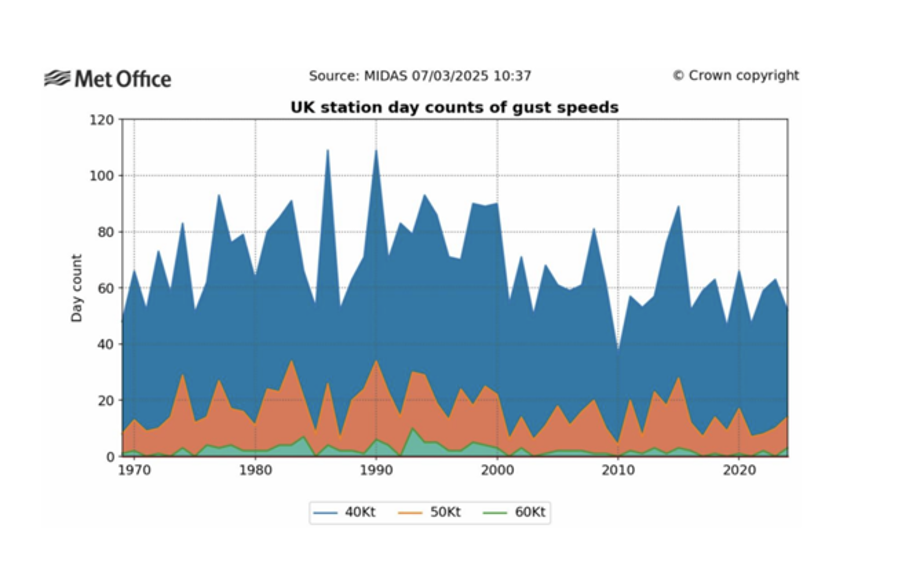
As the graph shows, days with extremely high wind gusts of 60 kilometers per hour or more, always relatively rare, have had the steepest decline.
In lieu of that chapter, the Met office has issued a supplementary series of guidance notes on wind speeds, referencing disputed climate models’ projections instead of real-world data, and citing damage from individual storms. Anecdotes and prognostications replace data.
“In future, most climate projections indicate that winter windstorms will increase slightly in number and intensity over the UK i.e. more winter storms, including disproportionately more severe storms, are projected to cross the UK.,” the Met Office’s guidance states. “However, this has medium confidence because a few climate models indicate differently.”
As is true with so many bought and paid for (with taxpayer dollars) agency reports issued by bureaucracies across the globe, when weather data doesn’t fit the climate crisis narrative, they fall back on models’ forecasts of doom instead of following the facts, despite the known flaws in those models and their patent historical inability to model temperatures accurately.
Source: The Daily Skeptic
Study Finds Even More CO2-Induced Greening Than Previous Research
To relatively little fanfare and almost no mainstream media coverage, a recent study published in the journal Nature finds the Earth continued greening through 2025, setting new records for global leaf and vegetation cover—a record largely attributable to the fertilization effect of rising carbon dioxide (CO2) concentrations.
The international team of scientists and scholars from universities and research institutes in China, the United Kingdom, and the United States integrated multidecadal remote sensing, optical Earth observation indices, and long-term land-cover annual data sets to discover anomalies and trends over time. What they found is good climate news—for those who care about the Earth’s vegetation.
The study found “2025 set a record for global vegetation greenness, steepening the global average greening trend [measured] from” 2000 through 2024.
The beneficial greening was not limited to select regions or continents. It was experienced around the globe, in large parts of Africa, Australia, China, Europe, North America, and South America. In addition, the greening was common across plant types. The study found:
- nearly 80 percent of croplands experienced greening;
- a little over 72 percent of grasslands greened appreciably; and
- 60 percent of forests exhibited increased greening.
Commenting on the mainstream media’s stubborn insistence, hard data be damned, that climate change is causing a browning of the Earth and crop failures, Chris Morrison writes in the Daily Sceptic,
This greening story—a tale that gets more impressive every year—is largely absent from the mainstream media. It was certainly missing from a recent climate contribution from Sandwich-board Stanley (a.k.a. Tim Stanley of the Telegraph) who made an unsourced claim that one third of the agricultural production of Bangladesh “is feared to vanish by 2050”. Happily, there is no sign of that invented fear coming true since agricultural production has more than doubled in the country since the turn of the century. Notes Stanley: “The evidence is stacking up—we only have to look out of our windows,” a comment that suggests journalists hired to broadcast opinions and beliefs should steer well clear of science where data and facts are given a higher priority. …
As noted, mainstream media is largely absent from covering the sensational greening of the Earth—for obvious reasons, of course, since it detracts from the hard Left political message hammered home daily to promote the Net Zero fantasy.
Canadian psychologist, author, and popular public speaker Jordan Peterson responded to Stanley’s Telegraph article with his own in the paper a few days later, writing,
Widespread catastrophic desertification and system wide crop failure have largely failed to materialize. Instead, the broader trend has been of increasing agricultural yields and vegetation density. What actually happened did not follow the predictions and should force a drastic re-evaluation of the entire climate narrative, not least among those committed to honesty and scientific integrity.
It’s good that prominent writers are publicizing the reality of global greening. I personally hope their message reaches the widest possible audience of the public and politicians.
It’s the same message Climate Realism, Climate Change Weekly, and Climate at a Glance have discussed across dozens of articles and posts over the years.
The popular folk singer Don McLean wrote a powerful ode to Vincent Van Gogh that ended on a plaintive and relevant note:
Now I think I know
What you tried to say to me
And how you suffered for your sanity
And how you tried to set them free
They would not listen, they’re not listening still
Perhaps they never will
Let’s hope what McLean wrote in “Vincent” is not true of the message climate realists have been trying for decades to get out. Human well-being literally depends on that message getting heard: the world does not face a climate catastrophe, and government policies intended to fight climate change are resulting in unnecessary deaths and poverty.
Source: Nature (behind paywall); The Word Merchant; The Daily Sceptic