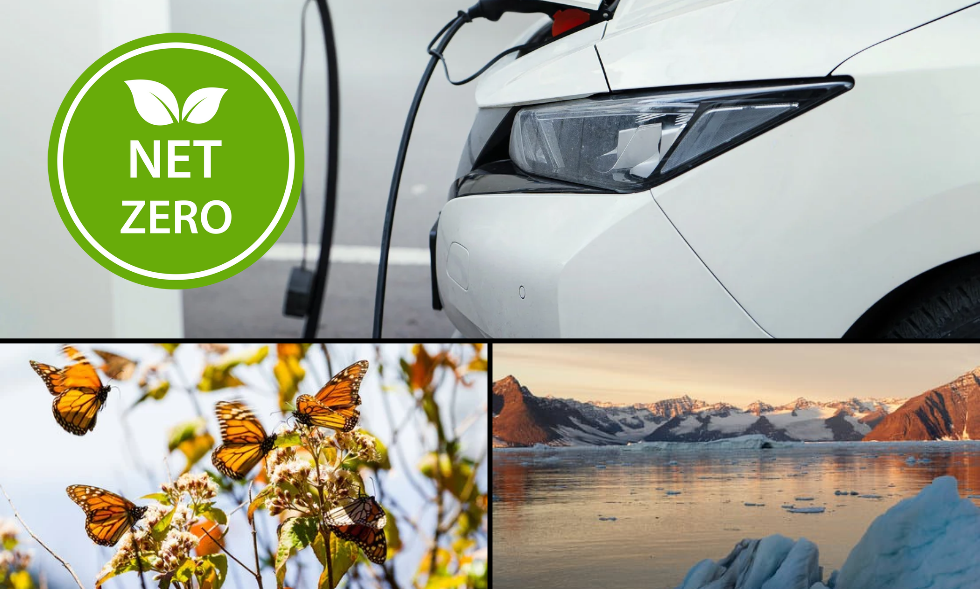
IN THIS ISSUE:
- Study: Net Zero Climate Policies Carry a High Price Tag
- Monarch Butterfly and Honeybee Populations Are Increasing
- Greenland Ice Cores Reveal Warmer Periods in the Past

Study: Net Zero Climate Policies Carry a High Price Tag
A new study published by the Committee for a Constructive Tomorrow (CFACT) details high costs and damage done by efforts to force drivers into electric vehicles and to transition the electric grid to net zero. The conflicting goals involve electrifying as much energy use as possible while forcing a transition to intermittent wind and solar power and battery backup.
The study’s author, auto industry figure Geoffrey Pohanka, examined official reports and legal filings to ascertain the losses to automakers on their electric vehicle fleets.
Examining the record, Pohanka writes,
The transition to electric vehicles has not gone well. Consumers are smart, and no mandate makes a family buy a car that does not fit their life or their budget. What is left is a slow-motion failure measured in the tens of billions, borne by automakers and by taxpayers.
The legacy automakers, mostly in the United States and Europe, have piled up more than $100 billion in losses and write-downs on their electric-vehicle programs, chasing demand that never showed up with investment that ran years ahead of it. Ford, General Motors, Stellantis, Honda: every one of them is pulling back now, idling plants and returning to hybrids, after losing an average of nearly $21,000 on each EV they sold. And that $100 billion is only the money the manufacturers wrote off themselves. It says nothing of the billions more the federal government spent on buyer subsidies, charging stations, and grants for battery and assembly plants that may never run at capacity.
Specifically, Pohanka discovered Ford has lost more than $16 billion dollars since 2022 on its electric vehicle fleet, a loss of $57,000 per vehicle sold, even after accounting for tax credits and carbon credits. The losses required cross subsidies from Ford’s internal combustion engine (ICE) vehicles, which caused their prices rise to make up for the money transfer. Other manufacturers did even worse. Electric vehicle manufacturer Rivian lost $85,000 on every vehicle sold, and Lucid lost $170,000 per vehicle sold.
Electric vehicles, already more expensive than cars and trucks powered by fossil fuels, would be affordable only to the ultrawealthy if their manufacturers had to price them at a level covering their full cost, much less to make a profit.
Other research indicates the losses and subsidies have been even steeper. A study by the American Energy Institute calculated the total cost of EV ownership ranges between $186,626 and $245,199 per vehicle, with 49 to 61 percent of those costs socialized to ICE owners, taxpayers, and utility ratepayers.
Pohanka discusses the latter point about ratepayers, noting no one ever figured in the full cost of the infrastructure, charging stations, additional electric power, etc., required to transition the vehicle fleet to electric vehicles. And lest one argue widespread adoption of electric vehicles produces a climate benefit by reducing carbon dioxide emissions, Pohanka shows the lifetime emission footprint of electric vehicles—including mining, construction, and operation—at 67 tons can be commonly higher than those of both fuel-efficient ICE vehicles (40 tons) and even popular SUVs (59 tons).
Pohanka provides a case study of the impact of net zero emissions goals on electric power prices and reliability, using Maryland as his example. Maryland’s electric power rates have risen 44 percent just since 2020, in large part due to the state’s replacement of dispatchable coal-fueled power plants with intermittent wind and solar industrial facilities and expensive battery backup, Pohanka notes. Maryland now imports 42 percent of its electricity from neighboring West Virginia and Pennsylvania, both of which still have significant fossil fuel powered electric fleets. The loss of reliable power and the limited nature of the supply from battery storage facilities, on top of mandated rising demand from the transition from fossil fuels to electricity, is putting Maryland’s power grid at risk of regular, sustained outages.
In addition to the cost and reliability problems, Pohanka also briefly touches on the fact that the government-encouraged push for EV adoption and greater electrification puts Americans at strategic geopolitical and economic risks because China controls the minerals, refining, and manufacturing technologies that make this transition possible. China is playing the long game and playing it well, writes Pohanka:
China is using the West’s fear of climate change to sell the West green products, cashing in on emissions rules it has no intention of living by. It is not a consumer economy the way the United States is. It lives on exports; its car industry is heavily subsidized, and even tariffs do not always stop it, because for Beijing this was never about profit and loss. It is about GDP, jobs, and leverage. Chinese cars, gas and electric alike, are now a real threat to every other country’s auto industry, and the plan behind them has almost nothing to do with the climate and almost everything to do with power.
Source: CFACT

Monarch Butterfly and Honeybee Populations Are Increasing
New research indicates monarch butterfly and honeybee populations have increased substantially over the past couple of years, defying predictions of climate-change-induced extinction that have regularly made headlines in recent years.
Even as the mainstream media have fearmongered false stories that climate change has caused a catastrophic decline in butterfly and bee populations, Climate Realism and Climate at a Glance have both explained butterfly and bee populations declines aren’t universal but are localized and due to factors other than climate change.
Two studies conducted jointly by the World Wildlife Fund-Mexico and the Xerces Society for Invertebrate Conservation found monarch butterfly populations are rebounding from a sustained decline, as deforestation has declined in their winter habitat and people have increasingly planted butterfly-friendly plants in their gardens and along their migration routes.
The studies found a 64 percent increase in monarch populations in the 2025-2026 hibernation season, with monarchs occupying 7.24 acres of forests, compared to just 4.42 acres the previous season. Monarch populations are still low from a historical perspective, but the rebound shows habitat destruction and to a lesser extent pesticide and herbicide use have been behind the decline, not climate change. Preserving and expanding habitat and improved management along migration routes can result in rapid population recovery.
Concerning honeybees, a species not native to the United States, by the way, the USDA reports colony collapse disorder losses declined from 2024 to 2025, with the number of colonies expanding 6 percent overall from 2024, even as Varroa mites continued to claim some colonies.
In short, whether it is monarch butterflies, honeybees, or other butterfly or bee species, there is no long-term, consistent decline that can be tied exclusively or even primarily to climate change. Invasive pests and habitat loss are the main drivers of the bee and butterfly declines, and populations can be boosted rapidly if those factors are managed, regardless of the climate.
Sources: Legal Insurrection; World Wildlife Fund; RFD TV

Large Areas in the Pacific Ocean Appear to be Cooling
A recent study examined recently rediscovered ice cores taken from Greenland during the Cold War, which show areas of Greenland that are currently under 1.6 miles of ice were ice-free in the ancient past when temperatures were warmer than they are now, despite CO2 levels being significantly lower than today’s.
The team of researchers examined isotopic biomarkers from ice cores taken from Camp Century in northwestern Greenland, to reconstruct summer temperature and atmospheric circulation some 416 000 ± 38 000 years ago. The ice cores were extracted in the 1960s and put into storage when the Cold War project they were taken for was cancelled.
Based on the samples, the researchers estimate temperatures were nearly 5℃ warmer there 416,000 years ago than today, and that the area was ice-free. For the area to be ice-free today, the glaciers would have to retreat more than 60 miles.
Interestingly, the isotopic analysis from the same sample indicated summers from 5,000 to 10,000 years ago, after the last ice age, were as warm at Camp Century as they were 416,000 years ago. Even so, thick ice persisted at the location.
Also notable is that CO2 levels were lower during both extended periods of higher temperatures than they are today. Under current IPCC scenarios, average temperatures are not expected to increase to the levels experienced during those periods, despite rising CO2.
In Greenland, CO2 is evidently not the control knob for temperature or glacial ice.
Sources: Phys.org; Climate of the Past
Recommended Sites

H. Sterling Burnett, Ph.D., is the Director of the Arthur B. Robinson Center on Climate and Environmental Policy and the managing editor of Environment & Climate News.