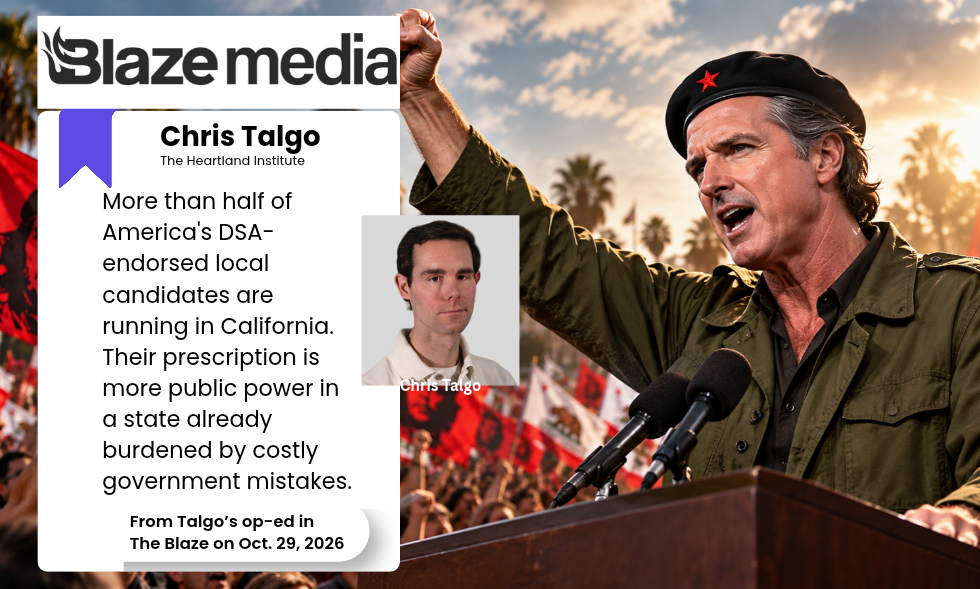
More than half of America’s DSA-endorsed local candidates are running in California. Their prescription is more public power in a state already burdened by costly government mistakes
On November 3, California voters will find 37 candidates for local office on their ballots endorsed by the Democratic Socialists of America. That’s more than half of the 69 DSA-endorsed local candidates nationwide, according to Ballotpedia. Minnesota, the distant runner-up, has six.
California, it seems, has become fertile ground for politicians promising to cure the failures of big government with still more government.
This is quite a reversal for the once Golden State. The Gold Rush, the transcontinental railroad, agriculture, manufacturing, and Silicon Valley transformed California into a magnet for Americans who wanted to build businesses and fortunes. Opportunity was its calling card.
Today, millions of Californians find it increasingly difficult even to afford the place.
The socialist candidates did not create all these problems. California’s governing establishment spent decades laying the groundwork. Nor is every progressive regulation a socialist policy; California remains a powerhouse of private enterprise. But that only sharpens the question facing the newcomers: Why should voters trust a more expansive government to repair what government has helped break?
Consider housing. According to the Public Policy Institute of California, the typical home was worth roughly $776,000 in the first seven months of 2026. The national figure was $372,000. California has under-built for decades, leaving a housing shortage that estimates put at more than 1 million units.
Land and construction costs are high, and people still want to live in California. Those realities do not absolve lawmakers who imposed layers of local restrictions and cumbersome approval procedures. The obstacles became so obvious that Gov. Gavin Newsom (D) signed legislation in 2025 to streamline environmental reviews and speed construction. Sacramento finally acknowledged that its rules had become part of the problem.
A state that spends years making homes harder to build should not act astonished when workers cannot afford them.
Then there is electricity. In July, California’s average residential price reached 33.6 cents per kilowatt-hour, compared with 18.3 cents nationally, according to federal energy data. Families do not experience those figures as an abstract dispute over climate policy. They experience them when the utility bill arrives.
The nonpartisan Legislative Analyst’s Office identified greenhouse-gas policies as one contributor to California’s soaring rates. Wildfire costs and the utilities’ operating structures also play a role. The explanation is complicated; the price is unmistakable. Politicians pursuing ambitious mandates owe residents an honest accounting of what those mandates cost.
And what has California received for its vast spending on homelessness?
Read the rest at The Blaze.

Chris Talgo is the Editorial Director for The Heartland Institute and a fellow for Heartland’s Glenn C. Haskins Emerging Issues Center.