New short-form video arms the public with data-driven science just in time for hurricane season, countering claims linking storms to climate change
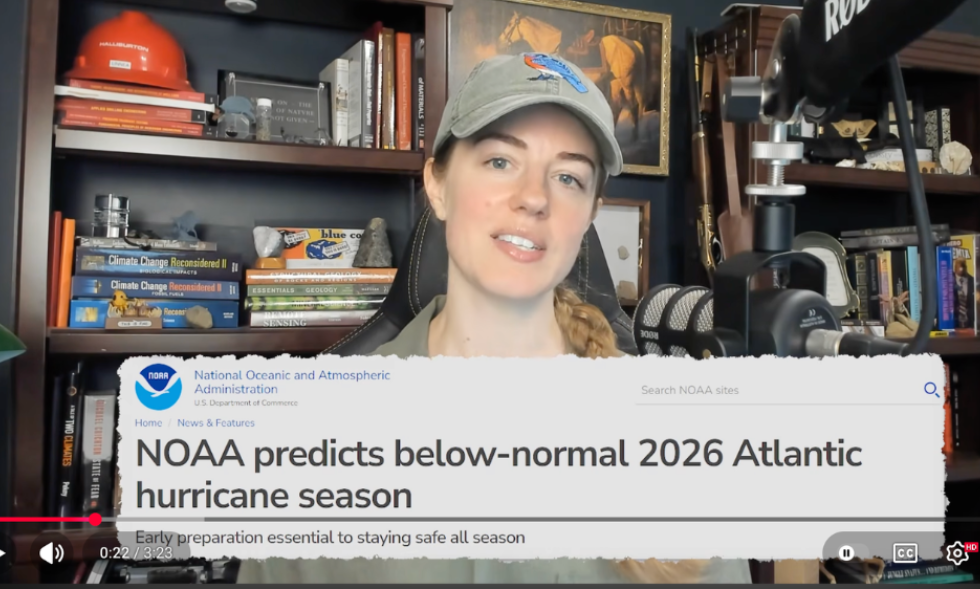
SCHAUMBURG, IL (May 29, 2026) — The 2026 Atlantic hurricane season officially begins on Monday, June 1. The Heartland Institute today released a new short-form video providing viewers with scientific facts about hurricanes, tropical storm trends, and the media’s habit of linking individual storms to climate change.
The video is one of dozens produced by Heartland providing the public with data-based analysis of climate and so-called “unprecedented extreme weather” that have been viewed millions of times on YouTube, X, and Facebook.
This latest video for the 2026 hurricane season, presented by Heartland Institute Senior Fellow Linnea Lueken, points out that “the National Hurricane Center predicts that this year will be below-normal in the Atlantic, which means fewer named storms than the average, but like every year there will be tropical storms and some of them will become hurricanes, possibly major hurricanes.”
At the same time, the video pushes back on sensationalized media coverage, noting that “the media has gotten into a bad habit of trying to attribute every single hurricane to climate change” through attribution studies that “assume that storms must have been made worse by the modest warming of the past century.”
What the Data Actually Show
The video draws on decades of hurricane records to show the observable fact that there has been no increase in the global number or intensity of tropical cyclones since reliable satellite-era recordkeeping began. That accumulated cyclone energy — a key measure of storm intensity and duration — also shows no upward trend.
The video also addresses claims about rapid intensification: “Although there have been some recent years with high counts of rapidly intensifying storms, overall it doesn’t support the idea that it’s a sustained trend. Just as a winter storm is not proof of a coming ice age, a bad hurricane is not proof of climate emergency.”
On the claim that Category 4 and 5 hurricanes are increasing, the video explains the real story: The proportion of severe storms has risen only because “the total number of hurricanes globally has declined but the number of stronger ones has stayed relatively stable.”
“A single storm, or even a single year’s storms, can’t be legitimately used to prove any impact of global climate change. You need a sustained trend towards bigger, worse storms over time — and we just don’t see that in the available data.”
— Linnea Lueken, senior fellow, The Heartland Institute (from video script)
“Another year’s hurricane season has arrived and a few things are sure: Predictions of how many and how many powerful tropical storms and hurricanes will form will be made; some named storms will form; concern will arise about possible tracks, landfall, and damage from winds, rain, and floods; some people will prepare; and almost as certain as death and taxes, sooner or later, someone at some media outlet will claim the behavior of one or more storm is proof of climate change.
“Since James Hansen’s 1988 testimony that humans were causing climate change, some news outlet or another each hurricane season echoes the false claim promoted by harbingers of doom that climate change is making hurricanes more frequent or severe or rainier. Each claim is a false. Even the U.N. Intergovnermental Panel on Climate Change doesn’t support them.
“Here’s hoping this hurricane season is mild with few or no landfalling storms — but if its not, don’t blame climate change, it is normal hurricane season behavior.”
H. Sterling Burnett, Ph.D.
Director, Arthur B. Robinson Center on Climate and Environmental Policy
The Heartland Institute
[email protected]
The Heartland Institute is one of the world’s leading free-market think tanks, based in Schaumburg, Illinois. Founded in 1984, Heartland’s mission is to discover, develop, and promote free-market solutions to social and economic problems. The Economist magazine has called Heartland “the world’s most prominent think tank supporting skepticism about man-made climate change.”

Linnea Lueken is a Research Fellow with the Arthur B. Robinson Center on Climate and Environmental Policy.

H. Sterling Burnett, Ph.D., is the Director of the Arthur B. Robinson Center on Climate and Environmental Policy and the managing editor of Environment & Climate News.