Life, Liberty, Property #153: Positive Signs of an Economic Turnaround
Forward this issue to your friends and urge them to subscribe.
Read all Life, Liberty, Property articles here, and full issues here and here.
In This Issue:
- Positive Signs of an Economic Turnaround
- Video of the Week: Democratic Socialists of America’s Anti-American Platform – In The Tank #545
- Utah’s Housing Affordability Reform Effort
- Home Construction Activity Reinforces ‘Renter Nation’ Trend
DON’T MISS THIS!
Heartland and Ron DeSantis
Join us on Sept. 3

Positive Signs of an Economic Turnaround

Last week’s economic news suggests that the U.S. economy is reforming, moving in a long-term positive direction. The key factor is the slowing of the ongoing increases in federal spending and the removal of unnecessary, burdensome regulations emanating from Washington, D.C. Americans are responding very positively to the removal of some of the heavy chains the federal government has been loading onto them for decades.
The inflation reports for June show the greatest drop in headline inflation in six years, led by falling oil prices. Consumer prices dropped by 0.4 percent from May to June. That was the largest decrease in inflation since 2019 and the first monthly decline since April 2020.
Year-over-year price inflation fell by 0.7 percentage points, coming in at 3.5 percent in June after a disturbing 4.2 percent pace in May.
The core Consumer Price Index, which omits volatile prices of food and fuel, came in at a 2.6 percent annual increase, down from May’s 2.9 percent rate.
Gasoline prices contributed heavily to the inflation reduction, dropping by 10 percent as events in the Iran conflict and the reopening of the Strait of Hormuz augmented oil supplies. The inflation “slowdowns were broad-based,” however, with sectors all across the economy showing progress, The Wall Street Journal reports.
The overall slowing of price rises showed progress toward the Federal Reserve’s target inflation rate of 2 percent. In fact, the Truflation CPI index, a nonpartisan private measure, has inflation at 2.04 percent, almost exactly the Fed’s target rate. (The target should be zero, of course, and maybe even negative at times, but this is progress, at any rate.)
Some of the good news on inflation is attributable to cyclical factors and technical adjustments of the measurements, suggesting that inflation is far from over. The trend, however, is positive. The strong response to the lowering of oil prices should remind us all how important fossil fuels remain to the modern economy.
Interest rates are likewise telling a surprisingly positive story. “[T]he yield on 10-year T-Notes remains close to 4½%, down slightly from its recent peak,” Ph.D. economist Robert Genetski notes in his weekly report on the economy. “Both stock prices and interest rates continue to anticipate a further recovery in the economy and the likelihood of lower inflation once the Iranian Revolutionary Guard concedes defeat.”
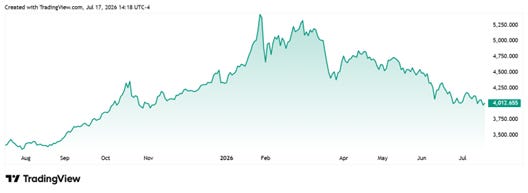
The price of gold has continued to trend downward, a very positive sign for the value of the dollar:
Source: TradingView.com
Further improvement in the dollar price of gold would be an important sign that the Fed is on the right course.
The production sector of the economy continued to expand. The Institute for Supply Management reported last Friday the manufacturing PMI measure was 53.3 percent in June (break-even is 50) as manufacturing expansion slowed a little from its pace in May:
The U.S. manufacturing sector expanded in June for the sixth straight month following a 10-month period of contraction, registering 53.3 percent, a decrease of 0.7 percentage point compared to May. Of the five subindexes that directly factor into the Manufacturing PMI®, four (New Orders, Production, Supplier Deliveries and Inventories) were in expansion territory, one more than in May. The Employment Index stayed in contraction but improved compared to May.
Production of services continued its upswing as well, the ISM reported:
Economic activity in the services sector continued to expand in June, say the nation’s purchasing and supply executives in the latest ISM® Services PMI® Report. The Services PMI® registered 54 percent, the 24th consecutive month in expansion territory.
The positive trend in services was broad-based in June. “All of the four subindexes that make up the composite PMI® were above their 12-month moving averages,” the chair of the ISM’s Business Survey Committee stated.
With production doing all right, unemployment remains low, and in fact came in lower than expectations. Trading Economics reports:
The number of people claiming unemployment benefits in the US fell by 8,000 to 208,000 on the week to July 11th, well under expectations that it would increase to 217,000, to mark the lowest initial claim count in over two months. Continuing claims, which are seen as a gauge of outstanding unemployment in the US, fell by 16,000 to 1,805,000 on the week to July 4th, under expectations of 1,820,000.
All in all, the data show good economic progress resulting from the ongoing return to pre-pandemic inflation and interest rates and first-term Trump regulatory easing, plus the crucial tax cuts in last year’s One Big Beautiful Act.
Though the production sectors of the economy are responding well, further progress is much-needed. The federal policy reversal began only a year and a half ago, after all, and has been hampered by all sorts of obstacles in the Congress and the judiciary. New Federal Reserve Chair Kevin Warsh’s hoped-for monetary policy turnaround and asset-holdings reforms have yet to begin.
As those observations indicate, we are by no means in the clear just yet. June retail sales were all right but mediocre, up 0.2 percent from May and 6.7 percent over the last 12 months, on top of a 0.1 percent upward revision of the May number, the U.S. Census Bureau reported.
Similarly, “New home building remains seriously depressed,” Genetski writes in his newsletter. “The July Homebuilders’ survey fell to 34, remaining well below the breakeven level of 50.”
Warsh has said all the right things about monetary discipline and inflation. Even leading inflation hawk David Stockman said “Bravo Kevin Warsh” in a recent edition of his Contra Corner Substack. Stockman opened his encomium with this:
Boy, did he get that right. In his semi-annual monetary policy testimony on Capitol Hill, new Fed Chairman Kevin Warsh didn’t pull any punches. Indeed, an anti-inflation message this resolute has not been delivered by a Fed Chairman since, well, Paul Volcker 39-years ago.
“The members of our committee have no tolerance for persistently elevated inflation,” Warsh said Tuesday in testimony he’s scheduled to deliver before lawmakers at 10 a.m. “And we share a resolute commitment to restoring price stability.”
“ …….If we get policy right — and we will — the inflation surge of the last five years will be a thing of the past,” […]
Stockman rightly characterizes Warsh’s statements on inflation as a full repudiation of the artificially low interest rates the central bank had imposed since the 2008 financial crisis:
In fact, the Fed has not hit its easy-peazy 2.00% inflation target since 2017, meaning that on a cumulative basis the general price level is now far higher than the Fed’s target would indicate: Instead of being up by +17% per it target since 2017, the inflation index is actually up by nearly +32%.
Stated differently, the actual CPI (16% trimmed mean version) has risen at a 3.50% annualized rate since 2017. Accordingly, after 10 years at that rate the purchasing power of a dollar earned or saved this year would be worth just 70 cents. And that surely is not “price stability” by any plausible meaning of the word.
Refreshingly, Warsh accepts the Fed’s responsibility for inflation and expresses determination in dealing with it. “Inflation’s a choice, meaning monetary policymakers need to choose lower prices” and not “pass it off to blame others,” Warsh told the House Financial Services Committee on Tuesday.
The Fed made a very poor inflation choice during the Biden administration, to say the least. Cumulative inflation between January 2021 and January 2025 was 21.17 percent. Cumulative inflation in the median price of a new house during those years was even higher, at 28.9 percent.
On the whole, prices are not going to come back down to where they were before the pandemic and the real inflation spur that was the appalling federal spending increases enacted during 2021 and 2022. Fuel prices are falling, however, and they were a big element of the Biden inflation. The effect of falling gas prices in cutting inflation in June is a preview of what energy expansion can do for the American economy.
The centrality of fuels and energy to the modern economy indicate that the current improvements are sustainable with proper government and Fed policies and the pace of expansion can and should increase.
The recent progress toward fundamental economic reform may mean that the affordability crisis is finally heading toward an end. It will not be a matter of general price levels coming down, though that would be a good thing and is achievable in economic terms; it is merely politically impossible.
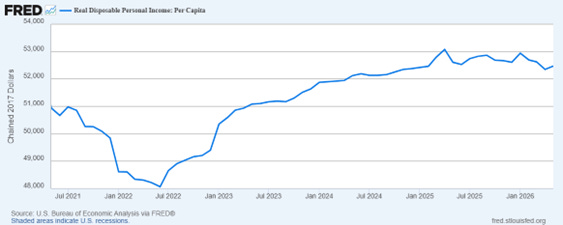
Instead, it will be a slower process in which wages and investment income rise to cover the past inflation, as the productive side of the economy expands in response to an easing of the government’s squashing of Americans’ production of goods and services. After-tax, inflation-adjusted personal income per capita is on the rise again after taking a brutal beating during the high-tax, high-inflation Biden years:
The positive effects of the recent policy changes could create a virtuous circle in which economic reforms bring improvements that reduce social distress, political turmoil, and rising support for radical fringe ideas such as democrat socialism and its endgame, communism.
The millennials and Gen Z have been hit particularly hard by the affordability crisis brought on by the big spending and high regulation by the federal government in 2021 and 2022, which sparked incredible inflation.
Inflation is coming down now. The Fed chair seems determined to ensure that it does not return. Congress and President Trump have disappointed on spending reductions, though their performance has been strikingly better than the 2021-2022 Congress and president. Real, after-tax personal per capita income is rising as a result.
Though federal welfare spending remains grossly excessive and the programs are rife with fraud, and a Social Security crisis is just a few years down the road, government policy is at least moving slowly toward a steady, long-term reduction of the enormous weight of government spending and regulation on the American people and our production of goods and services.
A positive end to the Iran conflict would improve the U.S. economy further. Right now, the biggest threat to the nation’s future is a lack of patience as the government, central bank, and entrepreneurs, workers, and investors all across the nation turn the United States around from a government-dominated, inefficient, cronyist economic system toward a restoration of free markets.
Let’s be smart about this, for once.
Sources: The Wall Street Journal; Classical Principles; The Institute for Supply Management; The Institute for Supply Management; U.S. Census Bureau; Contra Corner
Video of the Week

The Democratic Socialists in America have one of the most extreme platforms of any rising political group. They identify some real problems, but their solutions would be catastrophic. The team breaks down the most dangerous elements of the DSA’s stated goals, and presents what would ACTUALLY help the poor and working classes in America.
We also discussed the unexpected positive consequences of investment in AI: natural gas and other major energy infrastructure is being improved in anticipation of the need for stable power, it may even spur on an energy revolution.
On UNHINGED: A crazy Canadian lady attacked a girl for wearing MAGA gear… and was promptly detained by ICE. And for our America @ 250 segment, As the Declaration was distributed through the colonies and the danger of British forces loomed, frontier life hundreds of miles away was even more wild and dangerous.
The Heartland Institute’s Linnea Lueken, Jim Lakely, Chris Talgo, and S.T. Karnick talk about all of this and more on Episode #545 of the In The Tank Podcast.
Hot off the Presses!
‘Today’s crisis is a product of government errors, not greedy landlords, institutional investors, and so-called market failure.’
Utah’s Housing Affordability Reform Effort

The state of Utah is taking a major step in dealing with its housing affordability problem. With the state’s population having risen by a half-million people since 2016, now totaling 3.55 million, Utah must increase its housing supply.
The state legislature and Gov. Spencer Cox established a new Division of Housing and Community Development headed by former Cox advisor Steve Waldrip, who emphasizes cutting regulations to increase the supply of housing.
The affordability crisis is a strictly a supply problem, Waldrip told Governing magazine in an extensive interview:
Fundamentally we have a supply problem, and it came about as a result of the Great Recession. We stopped building housing. In Utah particularly, more than half of our homes, 60 to 70 percent, used to be built by small contractors. And we’re now the opposite. Most of the small contractors went out of business during that period when capital was scarce, so we lost that fundamental base of our housing infrastructure and we stopped building.
We’re 30,000 or 40,000 housing units short in our state. Nationally we track with everybody else.
Deregulation is the key to rebuilding the housing stock, Waldrip told Governing:
Intervention in the markets is taboo here. We’re a non-interventionist state. We’re very much rooted in free-market principles. But housing is the most regulated thing that we have in our country. Everything from Congressional intervention, which we just saw more of earlier this month, national housing policy, financing regulations that are promulgated by Fannie and Freddie, through the state to the county to the city to the homeowners’ association—we’re regulated heavily at every single level.
If you look at the history, over the last 40 to 50 years, our level of regulation has increased dramatically. If you take a zoning ordinance from a city in Utah, like Salt Lake City, the zoning ordinance in 1980 was a lot smaller than it was in 2000 and what it is now. These have been well-intentioned but misguided efforts to preserve our communities. It’s all of the dog-whistle words you hear in housing talk: We don’t want to overload our communities, we want to preserve the community character, we want to protect our home values. All of those things have led to layers of regulation and red tape.
Importantly, Waldrip acknowledges that the state government must take control of these localities’ regulatory practices when they strangle the housing supply to keep things nice and roomy for current property owners, who vote in local elections, while keeping out potential new residents, who do not get to vote on those policies:
We’ve been very intentional about being partners in that process, but there’s an inherent tension there. Part of that is that the cities derive their power from the state. They aren’t independent city-states. This isn’t ancient Greece, where Sparta and Corinth and Athens are their own thing and then they decided to come together and join up. Their power comes from the state of Utah. There are some cities that are doing an amazing job. We have cities and councils and mayors that are like, “hey, we’re all-in, and we are going to create opportunities for affordable housing and we’re leaning into providing the solution because we know it’s the best thing for our kids and grandkids and we need to provide that for their future.” There are other cities that are much more reticent to that.
We’ve done significant things with requiring cities to do station area plans. This was an effort that started back when I was a legislator in 2021. We said, if you’ve got a transit station, whether it’s light rail or commuter rail or bus rapid transit, you have to draw a circle around that, a quarter to a half-mile, and you have to plan for density and growth and urbanization around that asset. That was a hard conversation. We’ve put some planning dollars with it. But I just heard this morning that we have over 100,000 units planned around these stations.
That was a very collaborative approach, because we said, “we want you to do this, let’s create a set of rules that gives you cities some flexibility in doing it.” You have to address density, you have to address traffic, you have to address walkability, you have to address livability. And then they have to create a plan and then they present that plan to a council of their peers and the regional council is the one that actually approves the plan. They do have accountability in a regional structure, which I think is a really good model.
Ultimately the state is the sovereign so we do have the hammer kind of behind our back in a certain respect, but we also have to get the Legislature to agree with it. We’ve been pretty limited in those interventions.
Waldrip expresses a laudable consideration for these restrictive policies’ outsized effect on young people:
I think the key to really addressing this issue is to go back to that foundational social contract we have with our kids and our grandkids. We expect you to do these things, we expect you to go to school, we expect you to get an education and go into the workforce. And if you do those things, we’re going to provide for you a path to prosperity, which includes homeownership, the generational wealth creation opportunity, and the generational stability that comes with that.
Instead of the government actively and directly providing a path to prosperity (which no government can do), Waldrip’s plan is to get the government out of the way so that the people can create prosperity. That’s the American Way.
Home Construction Activity Reinforces ‘Renter Nation’ Trend
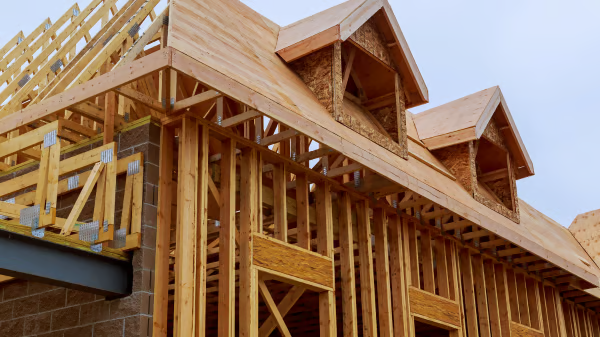
Home construction increased significantly in June in the United States, although the increase was exclusively among multifamily units, with single-family home construction contracting slightly. Trading Economics reports:
Housing starts in the US jumped 19% to a seasonally adjusted annualized rate of 1427 thousand units in June 2026, the highest in three months, compared to forecasts of 1310 thousand. It follows a revised 15.4% jump in May that sent housing starts to a six-year low. Multi-family starts soared 76.3% to 513 thousand, following a 41% plunge in the previous month. Meanwhile, single-family starts edged down 0.2% to 895 thousand, a third consecutive month of falls, as high prices and mortgage rates are weighing on demand.
Three consecutive months of decreasing single-family housing starts and a large increase in multifamily building are not exactly the American Dream, ZeroHedge observes:
It seems recent rises in the mortgage rate (and inventories already at over-stuffed levels, given the slowness of sales) has finally dented the homebuilders’ self-satisfying confidence … and the lack of affordability leaves the American Dream fading into Renter Nation …
The only solution to the undersupply and unaffordability is lower taxes and deregulation at all levels of government. Be it ever so humble, there’s no place like home when the government is small and refrains from interfering in the economy.
Sources: Trading Economics; ZeroHedge
Contact Us
The Heartland Institute
1933 North Meacham Road, Suite 559
Schaumburg, IL 60173
p: 312/377-4000
f: 312/277-4122
e: [email protected]
Website: Heartland.org



S. T. Karnick is a senior fellow and director of publications for The Heartland Institute.