Forward this issue to your friends and urge them to subscribe.
Read all Life, Liberty, Property articles here, and full issues here and here.
In This Issue:
Life, Liberty, Property #162
- New Orleans Housing Failure Confirms Limits of Government Mandates
- VIDEO OF THE WEEK: Kevin Sorbo — Hollywood Blacklisted Me for Telling the Truth
- Obamacare Fraud Indicts the Entire System
- States’ Ballot Initiatives, Elections Vulnerable to Foreign Influence
New Orleans Housing Failure Confirms Limits of Government Mandates

The New Orleans City Council is rolling back an affordable-housing mandate that “failed to produce a single apartment complex since being passed in 2020,” The Center Square reports.
“Housing affordability in the city has only gotten worse” since the city imposed the mandate, the story states.
The idea of the mandate, of course, was to lower housing costs to consumers by increasing the supply. The City Council’s brilliant idea for how to increase supply was to make it too expensive to construct an apartment complex without charging below-market prices for a specific percentage of the units.
The ordinance set the percentage of “affordable” apartments at a suspiciously round number, indicating that it was not based on any kind of serious economic analysis or perhaps any inquiry of any kind:
[T]he city gave developers a choice: build affordable housing or pay a fee for every required affordable unit they did not provide on site.
Under the mandate, a 100-unit apartment complex in the city’s Core mandatory inclusionary zone would generally have to reserve 10 units as affordable housing. If the developer chose not to, the alternative fee could total about $3,000,000.
The program failed, as anyone with basic arithmetic skills could have predicted. Instead of repealing the mandate, however, the city government is now decreasing the fine to a round number that the lawmakers have apparently decided builders will find tolerable. The Center Square reports:
Now, six years later, the City Council has unanimously voted to sharply roll back the policy, cutting the fee from $304,810 to $10,000. The mandate remains in place, but developers can now avoid the set-aside requirement at a much lower cost.
The Center Square story suggests that the failure to spur apartment construction is at least partially attributable to overall economic weakness and other factors:
In weaker markets, or during periods of high construction costs, the additional city requirement can push a project from feasible to infeasible.
“Housing development is fundamentally a math equation. If developers are required to sell or rent a portion of units below market rates, the lost revenue must be absorbed somewhere else in the project,” Dan Mills, CEO of the New Orleans Home Builders Association, told The Center Square.
Developers responded positively to being paid to provide apartments, the story notes: “Other affordable housing projects have seen more success, especially those subsidized with federal dollars. Those projects have produced 260 individual units since 2021.”
That is to be expected. Of course, the money came from taxpayers across the country, who certainly received no benefits from the spending.
The City Council is retaining the much-smaller fine with the intention of jacking it back up later, when different economic conditions will presumably cause the policy to generate an effect diametrically opposite to what it has produced thus far:
“We are preserving the structure of the Mandatory Inclusionary Zoning program, so that higher fees in lieu and more robust requirements can be reinstated when the City’s real estate market is stronger and more able to bear them,” Council member Lesli Harris said in a statement.
The council members thus insist on holding on to their cherished illusion that governments can force people to act against their self-interest. They cannot. Governments can only punish people for not cooperating, or pay people to cooperate. Human nature does not accommodate any other course, except for appeals to conscience, which generally give way when they conflict with people’s profit-and-loss arithmetic.
Harris’s explanation for retaining the program shows the incoherence of the mandates-and-fines approach: the requirements do absolutely nothing but punish people for building apartments in New Orleans, and they have no effect at all on people who do not build multiunit residences subject to the mandate. Hence, the only possible effect of the requirements is to keep people from building apartments, if the mandate is “robust” enough to affect builders’ decision-making at all.
The only thing such a mandate can do is suppress building. Cutting taxes and unnecessary regulation is the only reliable way for a government to spur economic production, which is the only way to solve an affordability problem.
Source: The Center Square
Video of the Week

Actor, director, and producer Kevin Sorbo spoke at The Heartland Institute’s 42nd Anniversary Benefit Dinner on September 3, 2026, at the Palmer House Hilton in Chicago.
Sorbo traces the whole arc: a Minnesota school teacher’s son who decided at 11 to become an actor, the seven auditions that landed him Hercules, the three strokes at the height of his fame that took years to recover from, and the phone call from his agent and manager telling him the studios had blacklisted him. He talks about leaving California for Florida, losing 4.1 million Facebook followers during COVID, founding Sorbo Studios with his wife Sam, and why he keeps making faith and family films — plus a few golf jokes and a run-in with a former president at a charity tournament.
Obamacare Fraud Indicts the Entire System
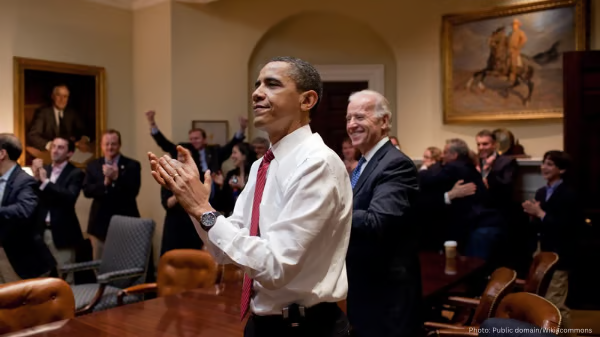
Poll after poll shows Americans are almost universally dismayed over the high cost of health care, as well they should be. Supporters of socialism have regularly exploited the troubles in the nation’s health care system to call for a government takeover in the form of so-called Medicare for All.
Given that the cost of health care has risen very suspiciously in lockstep with ever-greater government spending and regulation in this sector, skepticism toward salvation-by-government is amply warranted and grossly underrated by the public.
The latest news on Obamacare fraud buttresses the argument against additional government interventions into health care. The White House Task Force to Eliminate Fraud found 760,000 fraudulent accounts in the system, the cancellation of which will save the nation’s taxpayers an estimated $2.2 billion.
“We are announcing $2.2 billion in American taxpayer money that we’re saving by doing what should have been an obvious thing,” task force leader J. D. Vance wrote at X last week. “We’re actually making sure that the people receiving Obamacare subsidies are actually entitled to receive them.”
The phony Obamacare accounts are just a small portion of the total amount of fraud in federal health care programs. Estimates of annual fraud range from $100 billion to more than $300 billion, according to the National Health-Care Anti-Fraud Association.
Fraud, the high cost of health care, and public dissatisfaction with supposed market failure are related products of the same unforced error: government intervention. Government policies have vastly increased the incentives for people to use health care while suppressing the supply. That has driven prices up while transferring money from health care providers to health-care financers: insurance companies.
Proponents of the Affordable Care Act, which established Obamacare in 2010, promised it would lower prices for everybody. “But that law’s command-and-control regulations drove industry consolidation and pushed up prices instead,” the Wall Street Journal editorial board notes. “Premiums for employer plans have roughly doubled since 2010, rising at about twice the rate of inflation.”
Obamacare also drastically expanded the number of people on taxpayer-funded Medicaid by loosening eligibility standards. Medicaid cost U.S. federal and state taxpayers $949 billion in FY2024, having risen by 51 percent since 2019.
Meanwhile, in establishing a parallel insurance system beside the existing one and pushing people into it, Obamacare managed to double the price of supposedly unrelated and unaffected employer-provided health insurance premiums. As if that were not enough pain, the average deductible for those health plans doubled over just the past 10 years.
While transferring money and buying power to giant insurance companies and away from consumers, the supposedly compassionate and market-friendly government incursions of Obamacare suppressed innovation by erecting an enormous thicket of new mandates on health care delivery and payment systems, supposedly to keep costs down. Instead, prices and fraud skyrocketed.
The public is justifiably outraged about the effects of these policies. Unfortunately, politicians, the media, and advocacy groups have deceived the American people about the cause of the problems. It is government, not the free market.
The health care market is anything but free, and the socialist left intensifies the government’s destruction of health care every time it takes power in Washington, DC. Congress and President Joe Biden expanded Obamacare enrollment radically beginning in 2021, even though the nation’s poverty rate has been falling since 2014.
Unsurprisingly, the enrollment hike reflected massive fraud, as Vance’s announcement indicates.
“During the Biden administration, Obamacare enrollment increased from about 10 million people to more than 22 million,” The Western Journal reports. “A Department of Health and Human Services report issued this year estimated that nearly half of new Obamacare enrollments during Biden’s time in office were fraudulent.”
That means there are as many as five million additional Obamacare fraudsters yet to be identified from the Biden expansion alone.
This amount of fraud is obviously disgraceful and ought to be a huge embarrassment to the American people, who are ultimately responsible for these programs.
Government spending invites fraud: the rewards for theft are high, and the payoff to government bureaucrats for exposing fraud is more likely to be harassment or termination of employment than a pat on the back or a promotion.
The structure of the system further incentivizes fraud: the money comes from the federal government but is administered by the states. Events since January 2025 have vividly demonstrated that many states are in the habit of letting ineligible people receive that money from taxpayers across the country.
The nation’s founders understood those temptations fully, having read the lessons of history. That is surely one reason they authorized federal government spending only to “provide for the common Defence and General Welfare of the United States,” not of individuals.
That is a crucial point. All federal health care spending is unconstitutional. The Constitution does not grant specific authority for this purpose, and the spending does not promote the general welfare, instead promoting the individual welfare of those designated to receive the benefits. The Constitution does not authorize this kind of spending.
Let that sink in for a moment, as it completely contradicts everything the American people have been propagandized into believing for well over a century.
As a practical matter, the federal government’s intrusion into the provision and purchasing of health care has corrupted the system completely and made it inefficient and unfair by diverting gargantuan amounts of money into it while piling on new rules every year to correct its mistakes, thereby creating further problems.
Ending the direct fraud the task force found is only a start toward reestablishing constitutional rule of law and repairing our rapidly deteriorating health care system. The entire government health-care apparatus is a destructive fraud. An honest Supreme Court would strike it down as unconstitutional, an honorable Congress would repeal it, and a law-abiding president would refuse to administer it.
This article was published by American Thinker last week.
Sources: The Western Journal; The Wall Street Journal
States’ Ballot Initiatives, Elections Vulnerable to Foreign Influence

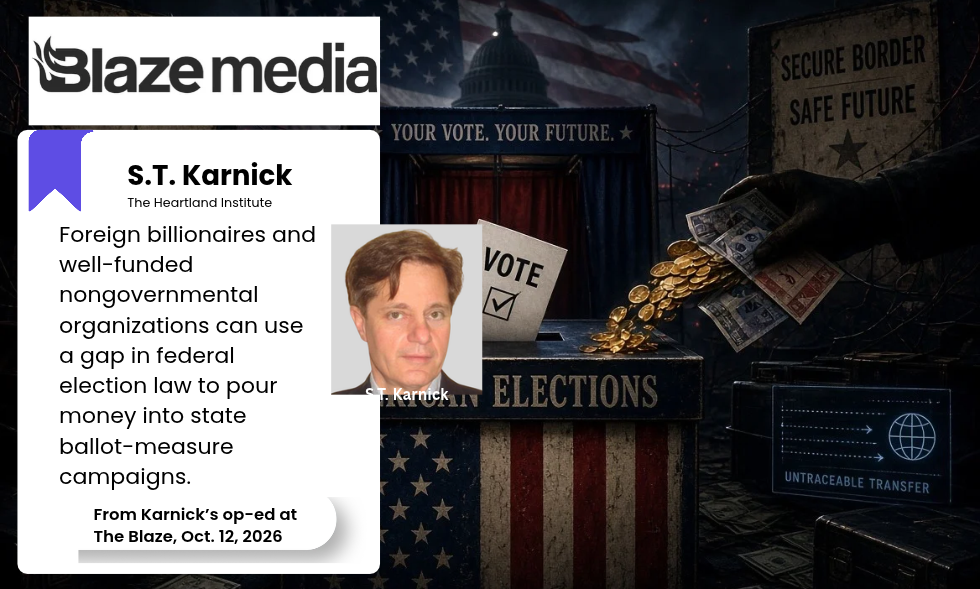
Foreign billionaires and sinister, well-funded nongovernmental organizations are using a loophole in federal election law to snatch power from legal residents of states across the country. Half the states have yet to do anything to stop this, and there are further escape hatches for foreign political interference in many of those that do have laws aimed at limiting the practice.
Under the U.S. Supreme Court’s interpretation of federal election law, foreign nationals are allowed to spend large amounts of money to influence ballot issues in states across the country, using their financial power to override the will of the voters and manipulate elections of candidates for public office, the latter of which is explicitly illegal. Foreign billionaires use loopholes in our federal election laws to change state laws and public policies and affect elections as a way to undermine American power.
“As the watchdog group Americans for Public Trust uncovered, a Swiss billionaire named Hansjörg Wyss has contributed at least half a billion dollars to liberal political causes in the U.S., despite being a noncitizen,” the Honest Elections Project notes in regard to one notorious example. “That huge sum includes $243 million given to an organization called the Sixteen Thirty Fund, a left-wing dark money group that has spent a staggering $130 million on ballot issues to push late-term abortion, skew election laws for liberal advantage, and even decriminalize drugs in 25 states.”
Through the ballot measure loophole, “foreign nationals directly influence everything from abortion to energy policy, affect the makeup of state legislatures and Congress through redistricting amendments, and back measures partisan groups acknowledge they are using to drive turnout and impact key races,” the organization states.
The U.S. Supreme Court ruled in 2012 that the Federal Elections Campaign Act does not prohibit foreign nationals from “issue advocacy,” as opposed to contributing money to candidates for public office. The Federal Election Commission (FEC) ruled in 2015 that “the Act ‘does not bar foreign nationals from issue advocacy’ or other forms of civic engagement in this country, such as lobbying,” because a state or local ballot initiative does not “constitute an ‘election’ under the Federal Election Campaign Act of 1971, as amended.”
The FEC is unlikely to consider requests for reconsideration. The commission’s website specifically states that “election-related laws” other than those dealing with “the financing of elections for federal office” “are not within the FEC’s jurisdiction.” The FEC has determined that the definition is a policy matter and hence, “The Commission has no authority to otherwise interpose itself as arbiter of who can participate in state and local ballot initiatives,” though it regularly rules on the most minute details of election activity.
Further lawsuits against the practice could encourage courts to rethink and reverse the FEC’s decision, in hopes that the current Supreme Court might be more open to reform. Unfortunately, such litigation faces a big hurdle in getting to trial, as judges are reluctant to grant standing in cases of what they want to consider settled law.
States, however, are free to limit or ban funding of referenda or ballot initiatives by foreign nationals, including any “partnership, association, corporation, organization, or other combination of persons organized under the laws of or having its principal place of business in a foreign country,” the FEC ruled in 2021.
Currently, 25 states have full or partial bans on foreign nationals’ or governments’ funding of referenda. In several of those states, however, the laws have loopholes that allow foreign funding. California’s law, for example, allows foreign funding unless “the decision to contribute to a ballot measure campaign is made by a management employee of the foreign corporation who is neither a U.S. citizen nor a U.S. permanent resident,” a limitation which is very easy to evade.
Arkansas’s law is an example of a complete ban. It applies to all “[p]ersons who are not citizens or lawful permanent residents; foreign governments; foreign political parties; and entities organized under the laws or with principal place of business in a foreign country,” according to Ballotpedia. The statute “prohibits foreign nationals from donating directly or indirectly to ballot measure committees and requires these committees to affirm in campaign finance reports that they have not knowingly received contributions or expenditures from prohibited sources,” Ballotpedia reports.
In July 2026, the U.S. House of Representatives passed the Stop Foreign Funds in Elections Act, which would prohibit “contributions or donations by foreign nationals in connection with state or local ballot initiatives, referenda, or recall elections” throughout the United States. The Senate version is under consideration in the chamber’s Committee on Rules and Administration.
Speaking in support of the congressional legislation, cosponsor Rep. Brian Fitzpatrick (R-PA) said, “The ballot is the instrument by which a free people govern themselves,” in a statement reported by Ballotopedia. “No foreign government, foreign national, or foreign interest should have a hand in deciding the laws Americans live under. Today’s unanimous vote is an important step in our broader bipartisan work to protect the integrity of our elections, preserve the sovereignty of the American voter, and strengthen public faith in self-government.”
Instead of waiting for federal action, state lawmakers can protect voters from being overruled by foreign money in referenda and ballot initiatives that would not pass without this outside interference. Concerned citizens and members of the press can review Ballotpedia’s chart outlining states’ laws curbing the practice and any pending legislation and urge state legislators to take action as needed.
Foreign funding of referenda and ballot initiatives regularly overthrows the will of the American people and the judgments of our elected representatives in states all across the country. States should exercise their power to curb the practice, and the public should insist that they do so.
Sources: Ballotpedia; The Stop Foreign Funds in Elections Act
‘The CSDDD is the greatest threat to America’s sovereignty since the fall of the Soviet Union.’

Contact Us
The Heartland Institute
1933 North Meacham Road, Suite 559
Schaumburg, IL 60173
p: 312/377-4000
f: 312/277-4122
e: [email protected]
Website: Heartland.org



S. T. Karnick is a senior fellow and director of publications for The Heartland Institute.