Forward this issue to your friends and urge them to subscribe.
Read all Life, Liberty, Property articles here, and full issues here and here.
In This Issue:
Life, Liberty, Property #163
- Yes, the Debanking Was Real After All
- VIDEO OF THE WEEK: The Free Market Case for AI Data Centers
- Is America a People or a Proposition?
Yes, the Debanking Was Real After All
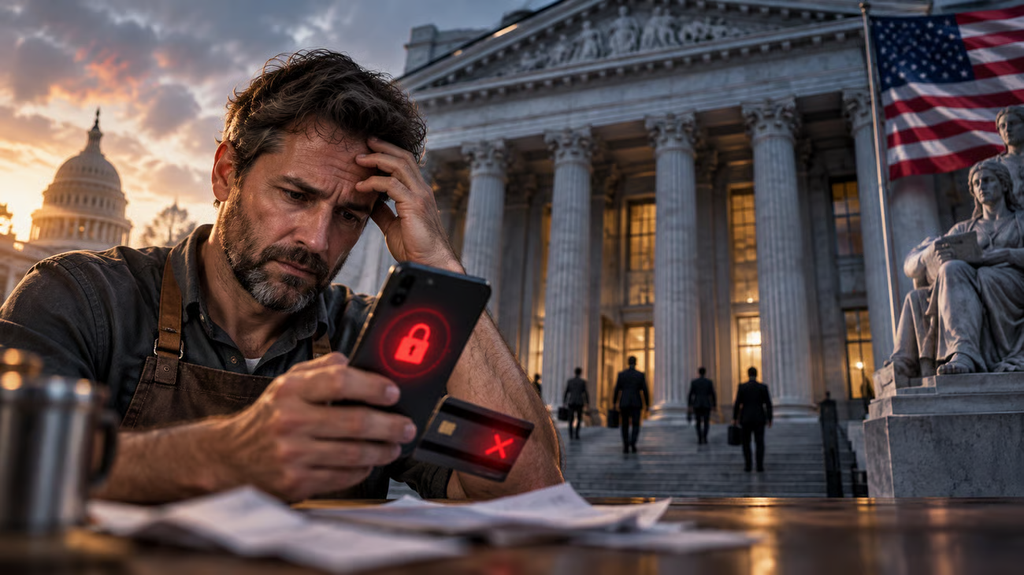
In yet another case of a supposed conspiracy theory becoming established fact, the U.S. Treasury Department confirmed decisively last week that the nation’s nine largest banks consistently discriminated against customers based on political and social considerations beginning in the chaotic 2020 election year.
In addition to being a reprehensible element of a political mass movement that attempted to punish half the nation’s population for their political beliefs, the debanking campaign constitutes a thoroughly staggering and shameful misuse of government power, a scandal of historic proportions.
In a 47-page report titled “Debanked: Guaranteeing Fair Banking for All Americans,” the Treasury Department’s Office of the Comptroller of the Currency documents consistent and often partisan or anti-Christian economic suppression of businesses and nonprofit organizations across the nation, under the guise of preventing “reputation risk”:
Through this review (Debanking Review), the OCC sought to determine whether bank policies or practices may have required, encouraged, or otherwise influenced banks to deny or limit access to financial services to Americans because of their political or religious beliefs or affiliations or their lawful business activities. The Debanking Review focused on the period between 2020 and September 2025 (Review Period). In total, the OCC reviewed nearly 100,000 complaints, hundreds of individual bank decisions, and about 420,000 pages of bank documents.
… [T]he OCC found that broad reputation risk policies—which lacked clear standards and objective, risk-based criteria—disadvantaged certain Americans based on their political, religious or social views or based on their lawful business activities. The results of the Debanking Review also reaffirmed the OCC’s ongoing concern with the use of reputation risk in bank decision making. Despite attempts to impose internal rigor, the continued use of reputation risk not only distracts institutions from devoting resources to managing core financial risks but also provides a structure for them to refuse clients based on even the slightest public perception risk or potential stakeholder biases in contravention of the foundational principle of fair access.
The banks regularly made subjective decisions to refuse services based on a dislike for prospective customers’ political or positions or social beliefs, and often covered up those decisions, the report states (paragraph break added for readability):
The OCC found that, in response to general reputation risk policies, bank employees escalated customers or prospective customers that held potentially contested viewpoints outside the perceived “mainstream” and that those views were often equated with higher potential reputation risk. The OCC found that decisions related to such escalations were not universally consistent across transactions the OCC sampled, illustrating the subjective nature of the banks’ ambiguous and open-ended reputation risk policies and the risks those policies present in denying Americans fair access to financial services.
This report highlights several, non-exhaustive examples of Americans that had accounts closed or that were otherwise denied financial services seemingly because of the perceived reputation risks associated with their constitutionally or statutorily protected beliefs, affiliations, or political views. For example, one bank’s payments subsidiary, working with bank reputation risk employees, closed the account of a customer that employees characterized as a “[r]ight wing religious conservative non profit with strong anti LGBTQ rhetoric.” A reputation risk employee later removed references in the internal bank tracking system to the nonprofit organization being “right wing” and “religious.”
Banks made decisions based on rumors, “whims of public opinion,” “negative press,” and, importantly from a public-policy standpoint, “value judgments and assumptions regarding the current views held by elected officials and policy makers,” most notoriously the Biden administration. The banks spent “considerable time discussing … the views of government entities (including the banks’ own regulators).”
Sometimes the Biden administration’s political pressure was explicit. In 2024, for example, “employees at Wells Fargo labeled lending to the firearms industry as ‘a controversial and highly partisan issue’ and noted that ‘[u]nder the Biden administration, banks could face greater supervisory pressure to move away from lending to the firearms industry,’” the report states.
On top of all that, the Biden administration threatened banks with retaliation by regulatory agencies, and officials even directed banks’ operations in excluding politically unfriendly enterprises, the report notes:
Financial institutions have engaged in unacceptable practices to restrict law-abiding individuals’ and businesses’ access to financial services on the basis of political or religious beliefs or lawful business activities. Some financial institutions participated in Government-directed surveillance programs targeting persons participating in activities and causes commonly associated with conservatism and the political right following the events that occurred at or near the United States Capitol on January 6, 2021. The Federal Government suggested that such institutions flag individuals who made transactions related to companies like “Cabela’s” and “Bass Pro Shop” or who made peer-to-peer payments that involved terms like “Trump” or “MAGA,” even though there was no specific evidence tying those individuals to criminal conduct.
Bank regulators have used supervisory scrutiny and other influence over regulated banks to direct or otherwise encourage politicized or unlawful debanking activities. “Operation Chokepoint,” for example, was a well-documented and systemic means by which Federal regulators pushed banks to minimize their involvement with individuals and companies engaged in lawful activities and industries disfavored by regulators based on factors other than individualized, objective, risk-based standards.
As a result, individuals, their businesses, and their families have been subjected to debanking on the basis of their political affiliations, religious beliefs or lawful business activities, and have suffered frozen payrolls, debt and crushing interest, and other significant harms to their livelihoods, reputations, and financial well-being.
Examples highlighted in the report include “a payment processor owned by one bank clos[ing] the account of a merchant that sold merchandise promoting President Trump and the Make America Great Again (MAGA) brand” in February 2021, a “bank declining to provide financial services to a public education organization due to its partisan leanings—namely, the organization’s political arm’s endorsement of solely Democratic candidates,” and a bank refusing customers that did not align with the company’s opposition to firearms.
Those are just a few of the abundant examples documented in the report.
Some of these actions were blatantly illegal, as President Donald Trump noted in his Executive Order 14331, “Guaranteeing Fair Banking for All Americans,” issued on August 7, 2025:
Such practices are incompatible with a free society and the principle that the provision of banking services should be based on material, measurable, and justifiable risks. Such practices, when wielded to discriminate against customers and businesses in credit transactions due to their religion, are also unlawful under the Equal Credit Opportunity Act (15 U.S.C. 1691 et seq.). They further undermine public trust in banking institutions and their regulators, discriminate against political beliefs and free expression of those beliefs, and weaponize a politicized regulatory state.
The debanking campaign increased the financial power of wealthy people and large corporations: banks appear to have been willing to accept “reputation risks” for “high-net-worth” individuals while rejecting “ordinary customers,” the report states. In addition, the banks often refused to explain to customers why they were being rejected, or they “pointed to reasons that would be difficult for an ordinary customer to decipher,” the report notes.
Banks began to reverse these policies in the period leading up to President Trump’s issuance of his executive order: “banks moved more rapidly to bring their operations closer in line with principles of fair access to financial services,” the report states.
By that time, state laws had begun spurring banks to reconsider their imposition of political, social, and religious litmus tests, the report notes:
During the Review Period, several states enacted “fair access” laws. Passage of these state laws, which included attestation requirements, likely served as a catalyst for many banks to re-think industry-specific restrictions, or at least to update their policies and procedures to “clarify” how business lines should implement them. Many banks revised their policies in late 2023 and 2024 to eliminate any indication that employees should categorically prohibit access to banking products and services on an industry-wide basis. Whether and to what extent the banks in fact complied with state fair access laws is beyond the scope of this report and the OCC cannot rule out the risk that industry status continues to weigh heavily on bank decision making, even after the passage of these laws.
These actions indicate that the banks perceived the “reputation risk” to be a vulnerability to bullying by the government, the corporate media, activist groups substantially financed and directed by foreign billionaires, and the general unleashing of busybodies and crazy people wielding megaphones and Molotov cocktails beginning with the 2020 election season.
The banks’ retreat from their debanking campaign is still incomplete in important respects, and a reversion to those policies remains possible. “Few, if any banks, though[,] could articulate when pressed what objective, measurable, or quantifiable standards authorized employees would use to assess the nature and scope of reputation risk or how that risk should be weighed against more quantifiable measures of risk to the banks,” the report states.
Given the limited nature of the banks’ efforts thus far and the possibility of backsliding, the OCC is considering or has already taken several steps discourage the banks from wielding their enormous economic power in pursuit of political and social agendas. The new policies include removing debanking from the government’s arsenal in various regulatory activities and making it easier for people to identify and report debanking actions.
These policy changes do not constitute greater government control over the banking system, and they will enhance the protection of the American people from banks’ exercise of arbitrary power and fraud. In addition, it is reasonable for the government to require banks to make fair and equitable decisions in a very small payback for the great benefits it gives them, such as the guarantees backing their deposits and the grant of access to the Federal Reserve’s discount window.
Until the federal government stops giving banks hugely lucrative privileges, it is only right that it should require those institutions to treat the American people fairly and stop using its public benefits to exert unearned political and social power. Ending debanking is not much to ask.
Sources: Office of the Comptroller of the Currency; Administration of Donald J. Trump
Video of the Week

Should America hit the brakes on AI? Anthropic’s Dario Amodei says yes. Elon Musk agrees. Sam Altman wants to pace the frontier. JD Vance called the whole thing a possible Trojan horse.
Heartland Institute president James Taylor joins Victory News to push back on the growing chorus calling for a slowdown in AI development. With Dario Amodei, Elon Musk and Sam Altman all urging caution, and Rep. Anna Paulina Luna floating a kill switch, Taylor’s position is blunt: a low tech America is a losing America, and falling behind China is the worst outcome on the table.
From there the conversation covers his free market case for data centers, and why the arguments against them keep collapsing. Taylor argues the public pressure is actually producing innovation in how tech companies source power and manage water and explains why Heartland backed the US withdrawal from the UN climate treaty, why “hottest ever recorded” is doing a lot of quiet work when the record only runs 100 years, and why cooling periods, not warming ones, historically brought failed crops and extreme weather.
Is America a People or a Proposition?
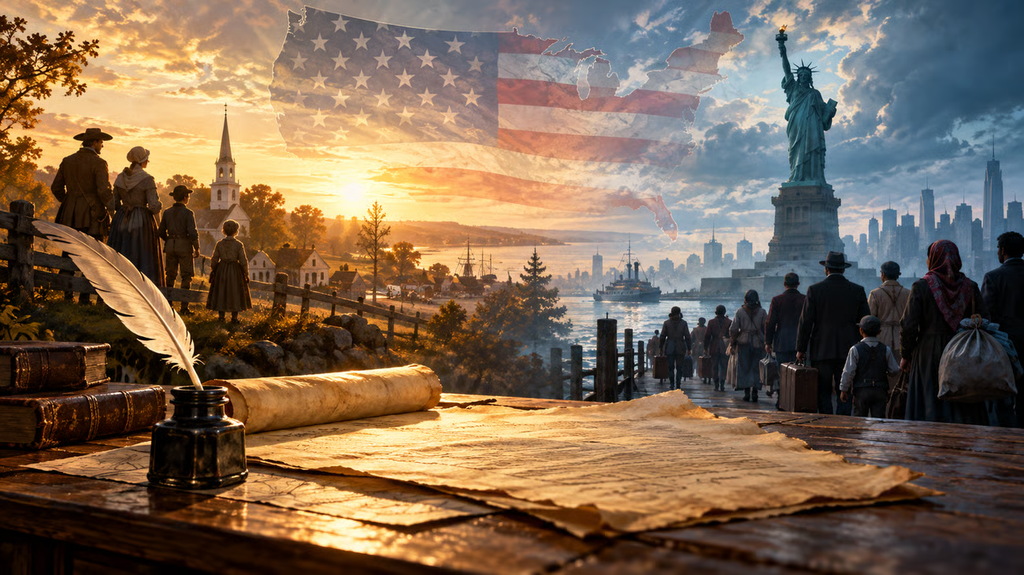
The 250th anniversary of an obscure bill the Virginia Generally Assembly rejected illustrates how difficult and vitally important the definition of the American identity has been since before the nation was even founded. It casts a revealing light on one of the most contentious issues of our time.
Edmund Pendleton, the author of the bill, titled it “Naturalization of Foreign Protestts.,” meaning Protestants. His draft of the bill explicitly and repeatedly specified that its benefits would be provided to Protestant Christians and no one else.
Pendleton’s draft would have granted full citizenship to “all foreign Protestants … who shall take an Oath of Fidelity to the Common Wealth and subscribe to be Obedient to the Laws thereof.” In addition, it would have directed the Virginia Treasurer to give “the sum of 20 dollars to every foreigner who shall come to settle in this Commonwealth for the purpose of defraying his passage hither over sea, and that there shall also be granted to him fifty acres of unappropriated lands wherever he shall chuse the same to be held.”
Founding Father and Virginia resident Thomas Jefferson revised the bill to remove all mention of Protestants, universalizing its scope. Jefferson was passionate about the expansion beyond Protestants, the National Archives notes in its comments on the bill:
It is clear from this brief outline of an argument, whose abbreviations suggest that it may have been made during debate, that full rights of citizenship for Jews, Catholics, and other non-Protestant groups were strongly advocated by TJ, who must have been able to convince his colleague Pendleton on the committee, but failed to convince the Assembly.
Jefferson’s title for the legislation, “Bill for the Naturalization of Foreigners,” illustrates that the purpose of his revisions was to universalize the invitation to prospective immigrants and the proposed encouragements and benefits in the bill Pendleton proposed.
Pendleton’s bill was aimed at the expansion of a people, Protestants, whereas Jefferson’s was directed at universalizing a proposition: America as a country to which anyone could belong by accepting the proposition (or, to be fully accurate, merely claiming to agree with it).
The real dispute, then, now, and at all points in between, has always been what the universality of the principles of equality and natural rights mentioned in the Declaration of Independence means in practical terms. The answer to that question drives the definition of what it means to be an American.
The difference between the two positions is stark, pitting a vision of America as a “shining city on a hill” demonstrating the rightness of the American Way, against a belief that the nation is the repository for the “wretched refuse” of other nations regardless of what fundamental ideas they may adhere to and how much they could influence the nation to deviate from the very proposition under which they were admitted.
Consequentialist arguments about the degree to which immigrants benefit the incumbent population, typically in promises of economic bounty, tend to drive the discussion, yet the strongest passions consistently arise over whether America is a people or a proposition. That makes good sense in light of the above-noted threat to the sustaining of the defining national proposition, if in fact there is such a thing.
Those arguing that the nation is a proposition offer a variety of candidates for that proposition, such as the Declaration of Independence, the Gettysburg Address, the “Second Founding” established by the abolition of slavery, and a general acceptance of the importance of individual liberty.
Despite that lack of specifics or perhaps because of it, the proponents of the idea of America as a proposition usually appear to occupy the moral high ground in the debate, regularly characterizing the America-as-a-people position as bigoted and small-minded, the domain of jingoists, religious zealots, and racists.
It has been a highly effective rhetorical tactic. An indication of that success is the tendency of proponents of nationalist sentiments to argue that they are as propositional as anybody and they only want to ensure that immigrants truly accept whatever the proposition is that makes America American, and that all they are asking is that migrants be admitted only to the degree that the population can sustain the proposition by ensuring the newcomers’ adherence to it.
The universalists, for their part, have consistently disregarded even that commonsense limitation. Such is the advantage of the moral high ground.
Writing at his PostModernConservative Substack, the conservative cultural commentator Titus Techera addresses the rhetorical disadvantages inherent to nationalist policies in such a cultural environment. In a short item titled “NatCon on The Spiritual Crisis of The West,” Techera identifies an enormous difficulty in acting in line with America’s founding values when responding to attacks on those values and their observance in present-day politics, policy, and culture:
My friends Rusty Reno & Nathan Pinkoski gave a wonderful pair of speeches at NatCon Jerusalem last week, speeches that bring out the great political drama of the MAGA era. We would like to know what we’re talking about when we’re talking about America & at the same time we’d like to be able to talk about America with confidence. Nathan described the danger within, the multicultural delusion & the anti-immigration solutions we’re implementing. He sketched a very interesting picture of the political & technological changes we have witnessed—to come to recognize ourselves in this picture is to recognize not only that we have to oppose people who want to degrade American character, but that the way in which we oppose them itself must change.
The problem, in short, is the asymmetrical cultural warfare that collectivists and other universalists can deploy in redefining America in their own image. Progressives, socialists, and communists do not accept an obligation to respect other people’s freedoms of speech, religion, association, enterprise, and so on, because they do not accept those rights as unalienable.
The only unassailable value for collectivists is equality, and they observe it only rhetorically, as the means of inducing social approval of their proposed expansions of government coercion with themselves at the helm.
Techera indicates the effectiveness of their tactics in his admission that the does not even know what America is: “We would like to know what we’re talking about when we’re talking about America.” His brief commentary expresses deep concern about America’s current moral condition, citing Reno’s “speech about the deeper issues of loss of faith & the more private issues concerning family, especially family formation.” This obviously reflects dismay about the nation’s diminishing birth rate in addition to the significant reduction in observance of Christian faith.
In light of those and other trends, Techera sees a need for a thorough change in America’s regnant cultural and spiritual notions, calling for a sort of new “Closing of the American Mind,” this time around traditional American values: “If the 20th c. was based on a dream of openness, we now need some kind of closedness,” Techera writes.
Techera thus acknowledges the great discomfort inherent in taking forceful action to assert the founding values of a nation formed explicitly to defend and preserve liberty in thought, word, and deed. Conservatives, traditionalists, and libertarians have struggled with that conflict for decades in response to the Left’s asymmetrical-warfare advantage.
I find Techera’s moral dilemma interesting because it is obvious that there is nothing un-American about upholding the nation’s basic values. Pendleton’s legislation was explicitly intended to reinforce those values. It was pro-American and pro-immigration. Jefferson changed the bill’s purpose by universalizing it, and the legislature rejected it.
Nor is there anything un-American about implementing an “anti-immigration solution” to perceived economic and social problems. Any particular American may or may not personally approve of immigration restrictions for a variety of reasons, but there is nothing un-American about having a preference for some specific level of immigration, even if it is zero.
In fact, opposition to the Biden administration’s policies of open borders and active importation of immigrants from so-called developing countries and insertion of them into small and mid-sized towns in election swing states is the only coherent attitude for an actual nation, as opposed to a mere geographic area arbitrarily defined. Even the most intense opposition to such policies poses no threat to decency. Danger invites a robust response.
Techera’s post expresses intuitions which he may intend to work out in detail in other writings. It seems aimed at expressing a need for the Natcon movement to figure out how to campaign in a Christian manner and avoid the dreaded accusation of bigotry. That is a reasonable aspiration.
It is not the real goal, however, which is the protection and reinvigoration of respect for the nation’s founding values. Arguing more winsomely will not achieve that goal. Techera and the Natcons will not make a persuasive and coherent case for immigration restrictions until they forthrightly answer the question of whether America is a people or a proposition.
Pendleton’s bill would be a good place for the Natcons to begin contemplating that question and work toward an answer that accords with the nation’s present demographics or forthrightly deems them a mistake that resulted from policies antithetical to the America’s founding values. That may well be the only possible resolution of the matter.
Sources: Founders Online; PostModernConservative
‘The CSDDD is the greatest threat to America’s sovereignty since the fall of the Soviet Union.’

Contact Us
The Heartland Institute
1933 North Meacham Road, Suite 559
Schaumburg, IL 60173
p: 312/377-4000
f: 312/277-4122
e: [email protected]
Website: Heartland.org



S. T. Karnick is a senior fellow and director of publications for The Heartland Institute.