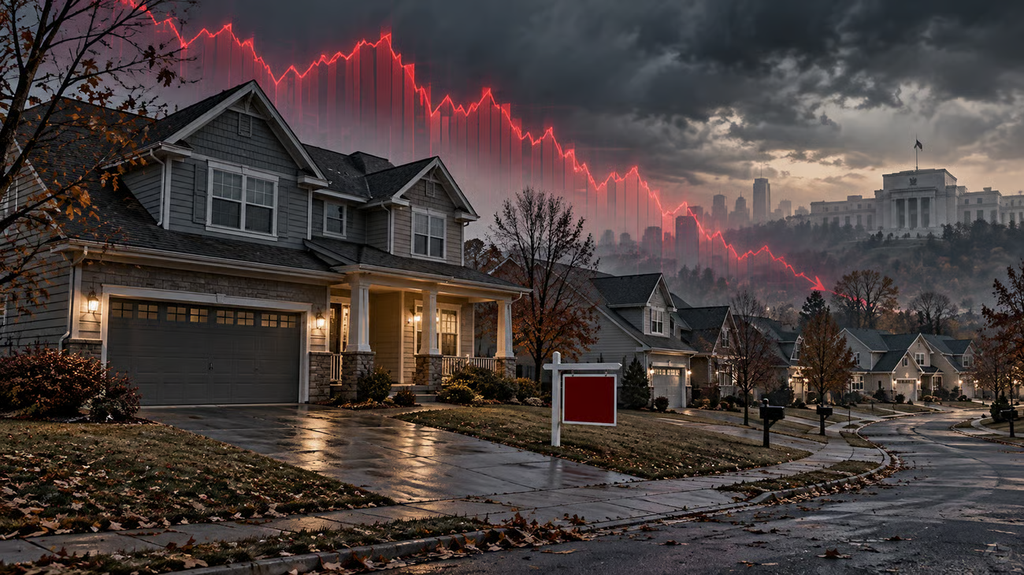
The housing market in the United States is contracting rapidly, indicating that the Federal Reserve’s (Fed) money-tightening regime is artificially suppressing economic growth. “The cracks in the U.S. housing market are becoming increasingly difficult to ignore,” writes the anonymous author-editor of the Fringe Finance webzine.
He’s right, and his commentary is important because the Fringe Finance writer is no loose-money fanatic who denies the role of monetary expansion in inflation. He strongly opposes loose money, as do I.
Where we both differ from the conventional wisdom is in rejecting the notion that raising interest rates is an effective, efficient way of controlling inflation, and in my opinion it is not even a possible way of doing so.
The flaw in the Fed’s interest-rate manipulation theory is the false assumption that raising interest rates slows inflation by increasing unemployment and thereby reducing workers’ demand for goods and services and thus holding prices down—the old Phillips Curve idea in which inflation and unemployment always rise and fall in opposition to each other.
What really happens is that the higher interest rates suppress economic activity, thus reducing employment and punishing workers by forcing wages down as business enterprises find it more difficult and more expensive to borrow money to expand or even maintain their operations.
Thus the Fed’s interest rate increases do not help the consumer by cutting inflation, they harm people by forcing wages down and reducing the supply of goods and services, with the latter actually exacerbating inflation, making it “stubborn,” as the media often describe the problem, by forcing consumers to compete for a smaller supply of things to buy.
As regular readers of this newsletter know, I have consistently argued that the Fed is fighting an inflation war that it cannot win and is starving the U.S. economy of desperately needed capital by suppressing liquidity.
The central bank cannot win the war against inflation, because its actions are not the fundamental cause of inflation. Massive deficit spending by the federal government is what causes the inflation, through the Fed’s monetization of that debt via Federal Reserve purchases of U.S. government debt, which creates new money in the process.
The Fed does this because the alternative is a crushing recession or depression caused by skyrocketing interest rates on federal debt pushing all interest rates into the stratosphere. That occurs because the lack of enthusiasm (aka demand) for federal government bonds increases the yield, or interest rate, that the bonds have to offer in order to entice people to buy them.
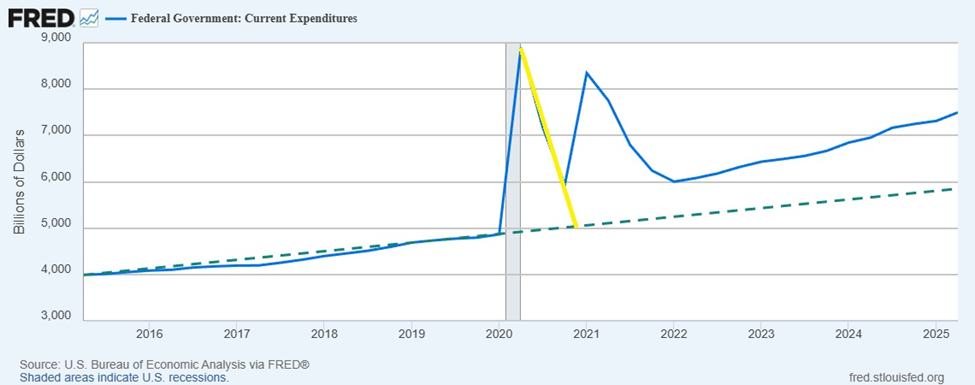
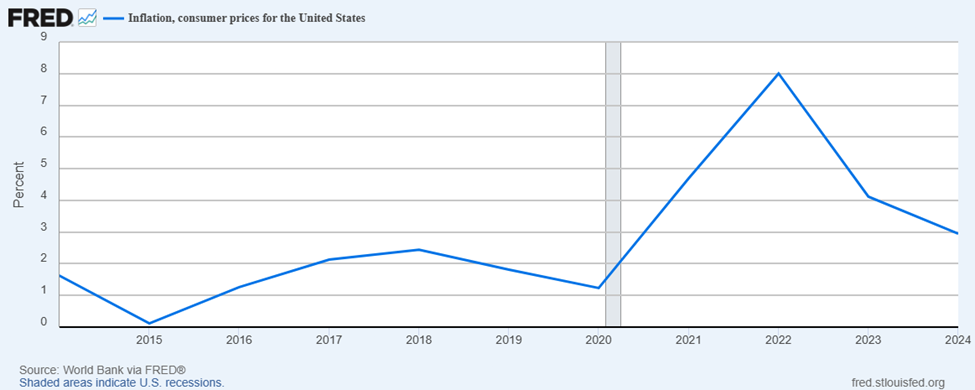
The unhinged deficit spending by the federal government gives the Fed two choices: inflation or recession. The Fed generally chooses inflation first, then recession. That is exactly what has happened since President Joe Biden and the Democrat-controlled Congress raised government spending by well over a trillion dollars above the pre-Covid long-term trendline in 2021 and 2022:
Source: Federal Reserve Bank of St. Louis, with author-generated yellow markup line
Source: Federal Reserve Bank of St. Louis
The solution to inflation is a sharp reduction of federal spending. Raising interest rates merely punishes Americans for the sins of Congress and presidents.
The damage the Fed’s elevated interest rates are doing is ominously evident in the housing market, Fringe Finance observes:
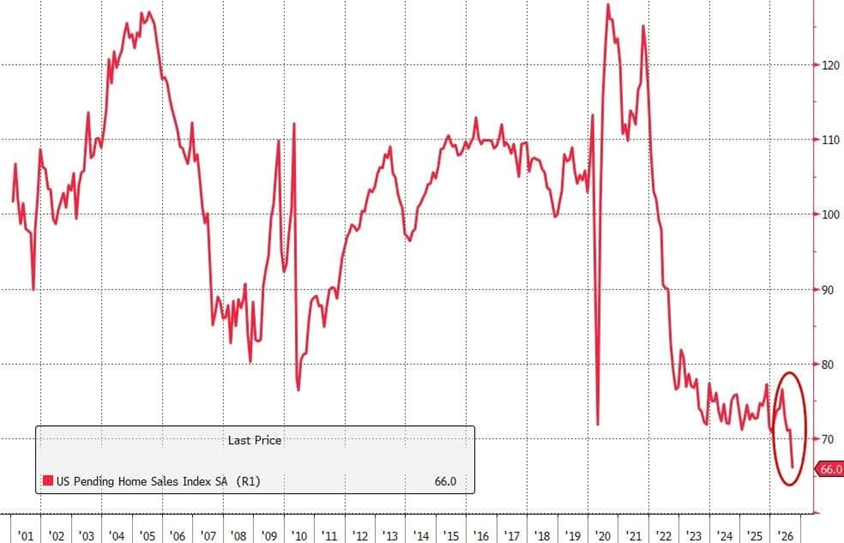
Pending home sales plunged 7.3% in September, dramatically worse than economists expected, pushing contract signings to their lowest level since records began in 2001.
According to ZeroHedge, the deterioration was widespread across the country, with pending sales falling 9.2% in the West, 8.2% in the South, 6.5% in the Midwest, and 4.2% in the Northeast. Every major region experienced a decline, suggesting that the weakness is not confined to a handful of overheated housing markets.
Given that pending home sales generally precede actual sales by a month or two, “September’s collapse could translate into additional weakness in existing home sales over the coming months,” Fringe Finance notes. That means there is worse to come.
In addition to those very bad signs, housing starts fell by 5.2 percent in September, with construction permits for single-family homes falling to their lowest level since 2023, Fringe Finance reports. “The weakness has carried into October,” he writes, citing a sharp decline in mortgage purchase applications and “deeply depressed” refinancing activity.
A slight easing of interest rates failed to arrest the decline:
The numbers represent a broad deterioration across multiple parts of the housing market, from prospective buyers and existing homeowners to builders and lenders. What makes the latest figures particularly revealing is that mortgage rates actually declined last week, from 7.50% to 7.41%, yet demand continued to weaken. Even a modest reprieve in borrowing costs wasn’t enough to bring buyers back.
This deterioration of activity in the housing market is evidence of long-term damage by overly high interest rates the Fed has chosen to impose, Fringe Finance notes:
At this point, the problem isn’t simply whether rates are rising or falling from one week to the next. It’s the cumulative burden of rates remaining elevated for an extended period. Similar to how I have said that high rates eventually wear away on the economy and the consumer, despite having more liquidity and savings coming out of the pandemic than I think anyone expected.
The housing crunch is a leading indicator of a generalized liquidity crunch throughout the economy and a major portent of much-wider economic distress approaching unless the central bank eases interest rates, Fringe Finance argues (emphasis in original):
On housing, what I think investors are missing is where housing sits in the hierarchy of household liquidity. Housing is generally one of the last places financial stress becomes visible, not the first. When consumers begin feeling pressure, they don’t immediately put their homes on the market. They first draw down savings, reduce discretionary spending, lean on credit cards, take out personal loans, or seek other sources of liquidity. They exhaust the easier and more accessible options before turning to their largest, most illiquid asset.
Selling a home is expensive, disruptive, and often emotionally difficult. In other words, it’s a decision most households will postpone for as long as possible.
Nearly all current mortgages—95 percent—are below today’s market interest rates, and around 65 percent are two percentage points lower than today’s rates, the writer notes.
That reduces current homeowners’ ability to sell their residences, thus cutting the available supply drastically. Meanwhile, high interest rates add even more to the projected costs for buyers, suppressing activity across all sectors of the market and rippling the damage out to builders, developers, mortgage lenders, contractors, real estate brokers, moving companies, furniture retailers, all workers in the housing industry, and on from there throughout the economy as a whole.
In addition (subtraction, really), the high interest rates reduce household cash flow by suppressing refinancing (such as home equity loans), as noted above, further squashing economic growth.
With Goldman Sachs forecasting further declines in residential investment for the next three quarters and predicting 2027 sales of existing homes about 27 percent below the 2017, pre-pandemic level, another year of economic damage by the central bank appears to be baked in already, Fringe Finance notes.
Meanwhile, Wall Street seems oblivious to the danger of a broad-based economic contraction, the writer observes:
My concern is that housing weakness eventually spreads into consumer spending, employment, and corporate margins, forcing analysts to revise [U.S. businesses’] earnings expectations lower. If that happens while valuations remain elevated, stocks face the prospect of both declining earnings estimates and contracting multiples. That combination can become particularly unforgiving when market breadth is already fragile.
Big losses in the stock market would greatly increase the economic damage resulting from the overly high interest rates.
Analysts expect the Fed to raise interest rates again in December, after an anticipated pause in the increases in its decision to be announced later this week. A year-end interest rate hike would prolong the suffering and expand it further. It might be just the thing to spark a stock market crash.
Fringe Finance offers a dismaying metaphor that is all too accurate:
That brings me back to the broader thesis I’ve been emphasizing: positive real interest rates are a wood chipper, steadily grinding away at the economy. They don’t necessarily produce an immediate recession or a dramatic financial crisis. Instead, they work incrementally, making credit more expensive, reducing the incentive to invest, pressuring household cash flows, and slowly eroding economic activity. The damage accumulates over time, often beneath the surface of otherwise resilient headline economic data.
Housing is now providing a particularly clear illustration of how restrictive monetary policy is slowly grinding down economic activity.
The Fed appears intent on rescuing the American people from inflation by crushing the nation’s economy. The American people are in for some very trying times unless the Fed’s Open Market Committee miraculously reverses its decades-long assumption that the way to kill inflation is to squeeze the U.S. economy to death.
Should America hit theEighteen years after California voters approved high-speed rail, the state has spent more than $15 billion without laying a single mile of high-speed track. More than $677 million of that went to environmental paperwork alone: over 130,000 pages of review materials that would stand 40 feet tall and weigh 1,300 pounds if stacked together.
What’s in those reports? Proposals to have biologists count bumblebees one by one, $480,000 to dig small mammal burrows by hand, $352,490 for lizard surveys, and a $119.4 million overhead tube partly to limit noise for waterfowl and shorebirds.
On this segment of The Climate Realism Show, the panel — Heartland’s Jim Lakely, Linnea Lueken, Anthony Watts, Sterling Burnett, and guest Lois Perry — look at how environmental red tape and well-connected contractors turned California’s “train to nowhere” into a black hole for state and federal dollars, and why the same rules that were supposed to make it green are the ones keeping it from being built.
The (Probably) Last Temptation of J. D. Vance
A rather embarrassing incident last week illustrated a big fault line on the political right in leaders’ opinions of economic freedom. President Donald Trump sidestepped a reporter’s invitation to endorse Vice President J. D. Vance as a potential Republican nominee for president in 2028, while Vance was standing behind the president in the Oval Office. The event occurred a day after Vance told journalist Mark Halperin he thought Trump would endorse him if he decided to run.
Trump’s reluctance to endorse the vice president for a promotion by the voters is surely motivated in great part by Vance’s sometimes lukewarm support for market freedom, evident in the vice president’s prominent association with the National Conservative movement and its Common Good vision approving extensive government management of the economy and social values.
National Conservatives are often (and even generally) just as critical of big business as of big government. Natcons advocate government intervention to remedy social ills they attribute to the influence of the free choices of large institutions, especially big corporations.
That preference has emerged even though the founders of the movement originally made it very clear that liberty was central to their goals, although the individuals involved in starting the movement had a wide range of levels of approval of government action and its necessary element of coercion. Natcons as a whole are willing to consider government interventions that hardcore free-marketers (such as I) would not.
I believe that Vance and the Natcons are wrong to believe in the possibility of a deeply benevolent government. On the contrary, the biggest threat to human happiness today is government itself, armed with its monopoly on the legitimate use of force. It is by no means the only threat about which we should be concerned, but it is the biggest by far.
What makes government such a great threat today is the enormous power it has already accumulated. Other institutions and individuals also pose great dangers because of the power that they can wield. Government, however, is stronger than all of them put together, and it has the legitimate use of force at its command.
The United States was established to resist and reverse the massive power of government, and our founding documents reflect this fact. Our founders, it is important to remember, greatly respected the need for government while remaining intensely aware of the hazards its great power poses.
Their solution, the separation of powers both horizontally (within the federal government) and vertically (among the central government, the states, and the people), was ingenious. It was subject only to the great flaw of all governments: human weakness, as they themselves noted.
As a result of this correctly observed need to divide authority, a central pillar of our system is the right of individuals to form communities with their own rules underneath the authority of the states and that of the national government. This is the principle of federalism, and it incorporates the concept of subsidiarity, which holds that decisions should be made at the social level closest to where they will take effect. The more local, the better.
In the ensuing quarter-millennium, governments have rampantly overridden those principles. Remedies, then, will be found in reforms that restore liberty on the national and state levels and the inalienable right to make our own rules on the local level and within families, with the higher levels of government there to thwart local efforts toward imposition of injustices and tyrannical local rule.
With that in mind, it seems clear that the NatCons’ emphasis on national action will achieve their desired results only if their efforts are directed at reining in the federal government, limiting it to its central duty of protecting the people’s lives, liberty, and property.
This approach accords with the principle of subsidiarity, which has long been an important element in Catholic political thought. Catholics are a large contingent of the Natcon movement, and Vance is among them, it is worth noting.
Subsidiarity recognizes that institutions of different sizes vary greatly in the scale of problems they are able to solve. The federal welfare state has undermined the family enormously, for example. Similarly, states tore apart tens of millions of families by implementing no-fault divorce starting in the 1960s, as they abrogated their responsibility for enforcing valid contracts and ensuring both parties to a marriage, and their children, are protected from abandonment.
There is a reason the “nanny state” is an insult. Building families is the job of parents, relatives, churches, and voluntary efforts of community members, not governments. Governments’ job is to protect the members of those families from force and fraud. That is all that governments are fit to do.
Reversing the myriad of laws at all levels of government that have damaged families, faith, and other institutions the National Conservatives want to restore should be the first step in any action plan they develop. There may not need to be any further actions of government thereafter.
The belief that a comprehensive national industrial policy will restore jobs and industries is likewise misguided. Industrial policy is an invitation to increase the already ungodly amount of crony capitalism in the United States and expand gigantic multinational corporations’ use of government to hamstring potential competitors, including other American businesses.
The way to create productive jobs is for government to get out of the way. Start there. That should be all that is necessary to reestablish the nation’s economic vitality.
Devolution of government to the lowest level in every case is the only course of action that can conserve what remains of the American Way and begin to restore it. The goals the National Conservatives seek cannot be accomplished through government action—such as industrial policy and direct interventions into family issues—because those actions fail to respect the realities of scale and always result in political capture by powerful interest groups that pervert the system to their own advantage.
Subsidiarity, by contrast, builds on a profound respect for individual rights, the reasonable and moral limits of federal and state authority, and the critical importance of the freedoms of association and enterprise. A return to that vision is the way to achieve the National Conservatives’ fundamental goal of restoring “the traditional beliefs, institutions, and liberties underpinning life in the countries we love,” as their statement of principles puts it.
Subsidiarity, not big government, enables people to develop and maintain the institutions, activities, and values that establish “a proper public orientation toward patriotism and courage, honor and loyalty, religion and wisdom, congregation and family, man and woman, the sabbath and the sacred, and reason and justice,” the NatCon statement calls for.
If Vice President Vance and other National Conservatives want to strengthen families, churches, and other traditional institutions, they should join the liberty movement in trying to push governments as far away from them as possible.
‘The CSDDD is the greatest threat to America’s sovereignty since the fall of the Soviet Union.’
Contact Us
The Heartland Institute 1933 North Meacham Road, Suite 559 Schaumburg, IL 60173 p: 312/377-4000 f: 312/277-4122 e: [email protected] Website: Heartland.org