Forward this issue to your friends and urge them to subscribe.
Read all Life, Liberty, Property articles here, and full issues here and here.
In This Issue:
Life, Liberty, Property #165
- The Tragic Marriage of Democracy and Serfdom
- VIDEO OF THE WEEK: The Truth about Data Centers and Your Electric Bill
- Can the GDP Growth Last? Yes, If …
The Tragic Marriage of Democracy and Serfdom

This issue of Life, Liberty, Property will be delivered on Election Day. As I write this essay, prospects in the upcoming elections look poor for those of us who support free markets, individual liberty, natural law, natural rights, and good, limited government.
Anything can happen in American politics, and the unexpected often does, yet it is difficult these days to see much support for the American Way of free enterprise, self-reliance, community, faith, property rights, and individual liberty. Support for socialism is rising, with many more candidates embracing the label.
“[M]ore than 200 socialists are running for political offices at the national, statewide, and local level who generally support the Democratic Socialists of America’s 2026 midterm platform called the Workers Deserve More Program,” my Heartland Institute colleague Chris Talgo writes at TownHall.
A new poll from The Economist and YouGov reports 50 percent of registered voters in the United States would vote for a Democratic Socialist candidate. Half of all voters would consider casting a ballot socialism.
The Heartland Institute has been documenting the rise of socialism since before the pandemic, establishing our Socialism Research Center to track the movement’s increasing inroads into American politics and culture. (Please support this work by donating, if you can.) Heartland has commissioned several widely cited national surveys showing young people are especially enthusiastic about socialism. Talgo writes,
[O]ver the past few years, socialism has become more popular than ever in America.
Overall, 43 percent of American adults view socialism “positively,” according to a recent Gallup survey. Among young adults, 57 percent of those aged 18 to 34 view socialism more “positively” than “capitalism.”
A vast majority of young voters want socialism. Based on a 2025 Heartland/Rasmussen poll, 76 percent supported nationalization of major industries “to give more control and equity to the people.” More than half of young voters also want a democratic socialist to win the White House in 2028.
The socialist temptation has received a big boost from the nation’s recent affordability crisis, which is receding but perhaps too late to rescue us from a collectivist surge in today’s elections and thereafter.
The expansion of government over the past 125 years in the United States has steadily undermined free enterprise, replacing it, to an alarming degree, with a zero-sum system that inexorably drives people to fight one another for favors from the authorities instead of consistently and impartially rewarding productive activity as only markets can do.
The French philosopher and social observer Alexis de Tocqueville described socialism with outstanding accuracy in his 1848 speech to the French Constituent Assembly:
[T]he first characteristic feature of all systems that bear the name of socialism is an energetic, continuous, immoderate appeal to the material passions of man. …
There is a second feature: an attack, sometimes direct, sometimes indirect, but always continuous, upon the very principle of individual property. From the first socialist who said, fifty years ago, that property was the origin of all the evils of this world, to the socialist we heard from this tribune who, less charitable than the first, passing from property to the property-owner, told us that property is theft, all socialists, all of them I dare say, attack individual property in one way or another, directly or indirectly. (That is true! that is true!) I do not claim that they all attack it in that frank and brutal manner that one of our colleagues has adopted. But I say that all socialists, by more or less roundabout means — if they do not destroy the principle on which it rests — transform it, diminish it, obstruct it, limit it, and turn it into something completely foreign to what we have known and been familiar with since the beginning of time as individual property. (Excited signs of assent.)
Now, a third and final characteristic feature, which in my eyes best describes socialists of all schools and shades, is a profound opposition to individual liberty and a scorn for individual reason, a complete contempt for the individual. They unceasingly attempt to mutilate, curtail, and obstruct personal freedom in every way. They hold that the State must not only direct society but must be the master of each man, and not only master but keeper and trainer. (Excellent.) For fear of letting him go astray, the State must place itself forever at his side, above him, around him, the better to guide him, to sustain him — in a word, to confine him. They call, in fact, for the forfeiture, to a greater or lesser degree, of human liberty, to the point where, were I to attempt to sum up what socialism is, I would say that it is simply a new form of serfdom. (Lively assent.)
That is what Our Democracy means. The catch phrase of Biden-era authoritarianism and its current-day spawn have brought to life the terrible yet apparently inevitable union of democracy and socialism that de Tocqueville saw as incoherent and self-contradictory, as he made clear in his speech to the Assembly:
Democracy and socialism are not interdependent concepts. They are not only different, but opposing philosophies. Is it consistent with democracy to institute the most meddlesome, all-encompassing and restrictive government, provided that it be publicly chosen and that it act in the name of the people? Would the result not be tyranny, under the guise of legitimate government and, by appropriating this legitimacy assuring to itself the power and omnipotence which it would otherwise assuredly lack? Democracy extends the sphere of personal independence; socialism confines it. Democracy values each man at his highest; socialism makes of each man an agent, an instrument, a number. Democracy and socialism have but one thing in common—equality. But note well the difference. Democracy aims at equality in liberty. Socialism desires equality in constraint and in servitude.
Despite his hopeful words to the Assembly, Tocqueville fully understood the potential for democracy to devolve into what he called soft despotism, which in fact he feared was its likely outcome. Tocqueville’s pessimistic conclusion in Democracy in America accords with an observation attributed to the eighteenth-century Scottish judge and historian Alexander Fraser Tytler:
A democracy cannot exist as a permanent form of government. It can only exist until the voters discover that they can vote themselves largesse from the public treasury. From that moment on, the majority always votes for the candidates promising the most benefits from the public treasury with the result that a democracy always collapses over loose fiscal policy, always followed by a dictatorship.
The average age of the world’s greatest civilizations has been 200 years. These nations have progressed through this sequence: From bondage to spiritual faith; From spiritual faith to great courage; From courage to liberty; From liberty to abundance; From abundance to selfishness; From selfishness to apathy; From apathy to dependence; From dependence back into bondage.
The promised gifts of government largesse never arrive, of course, because governments do not create abundance but can only redistribute what the people produce, Talgo writes:
In total, the Workers Deserve More Program includes up to “$212 trillion in new spending over the next decade,” the Cato Institute noted to little fanfare. …
[But] even if you confiscated every penny from every billionaire and soaked corporations, it would “cover only a fraction” of the $200 trillion.
Instead, “The dirty secret is that the DSA agenda means high taxes for the middle and working class … and Weimar-like hyperinflation,” Talgo notes.
The promises are as empty as the debt-ridden U.S. Treasury’s coffers. The Democratic Socialists’ goal is political power, not improvements for the masses. The promise of equality in abundance is a scam designed to use democratic means to impose authoritarian rule.
That is what socialism is all about, always, Talgo writes:
Power attainment, by any means necessary, is the code of socialism. The ends always justify the means.
Offer them “free” stuff; hope they buy it. That is the DSA strategy. Caveat emptor, America.
Beware indeed. Today, America is well past its two-century “sell by” date. The sale is always a simple deal: exchanging liberty for serfdom.
The American people may express Our Democracy today by voting us all “back into bondage,” as Tytler rightly describes the process. Our one hope, in that case, is that it will not be too long before the people of this nation return to spiritual faith and great courage.
That, I am convinced, is the only way back from Democratic Socialism, if in fact the path home is not already impassably overgrown or swept away by a flood of disasters.
Sources: Townhall; YouGov; Law Is Dead
Video of the Week
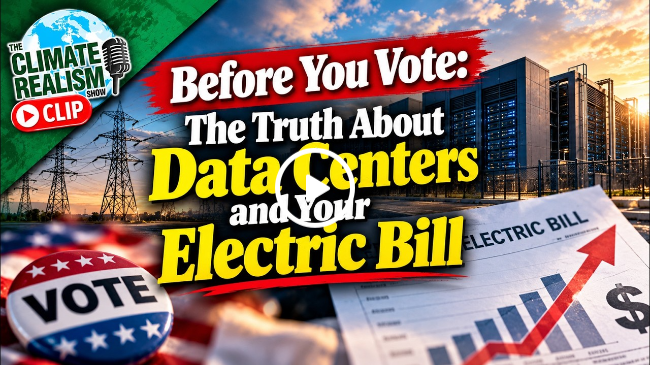
Candidates for governor in Florida, Georgia, Ohio and Texas want to pause or even ban new data centers, and some Republicans are on board. In Florida, Democratic nominee David Jolly says he’d halt new hyperscale data centers on his first day in office. The pitch: data centers will drive up your electric bill.
On this segment of The Climate Realism Show, the panel asks whether that’s true. Linnea Lueken explains why many data centers build their own power plants and why communities should judge each project case by case instead of reaching for a blanket ban. Anthony Watts describes how data centers are reviving struggling rural towns with jobs and tax revenue. And Craig Rucker of CFACT explains why states packed with data centers, like Virginia and Texas, don’t pay more for electricity. What drives your rates is how your state makes its power, not whether there’s a data center down the road.
In Virginia’s Loudoun County, data centers pay about a third of the county’s tax revenue.
Can the GDP Growth Last? Yes, If …
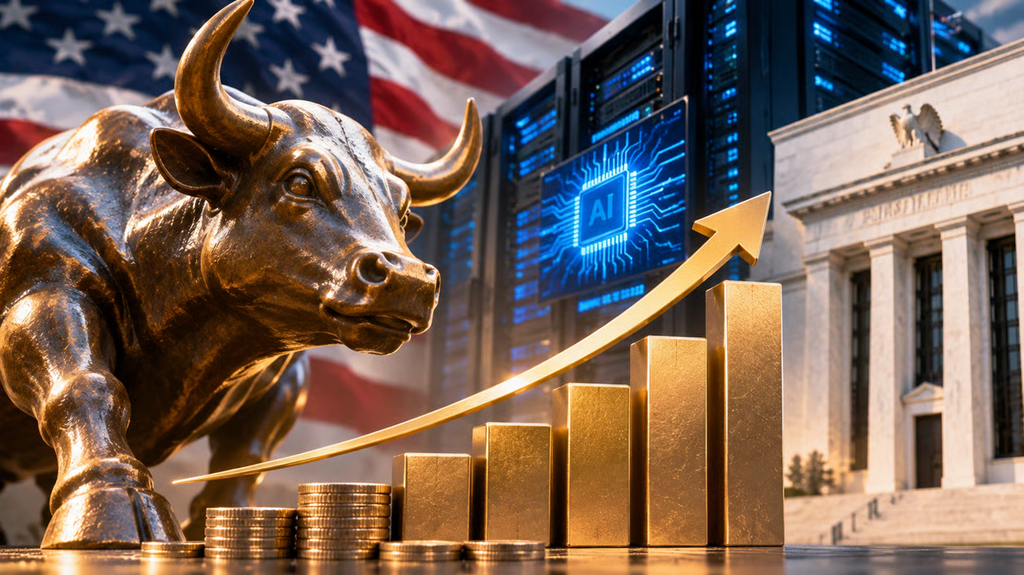
Real gross domestic product in the United States grew by a very healthy 3.4 percent in the third quarter of the year, driven by capital spending in the private sector, which was led by computer purchases for artificial intelligence systems. That marks the fastest pace of growth in a year and was 1.2 percentage points higher than in the second quarter of the year.
Consumer spending was also stronger than expected, at 3.8 percent, same as in the second quarter, “even amid historically low consumer sentiment tied to cost-of-living concerns,” ZeroHedge reports.
Most notably, the investment boom was the strongest in 15 years, with AI driving the expansion. ZeroHedge reports:
While personal spending came in stronger than expected, rising an annualized 3.8%, above estimates of a 3.4% print, the biggest driver behind the world’s largest economy continued to be relentless business spending (which has resulted in a massive debt bubble to go along the AI stock bubble). Outlays for equipment contributed more to GDP in the third quarter than at any time since 2011 outside of the pandemic rebound.
Government spending also increased, by just under 1 percent. That raises the official GDP number even though government pulls resources away from the productive private sector and includes much borrowed money, which pushes up interest rates and thus makes investment more costly.
On the other hand, the GDP number was suppressed greatly by a large decrease in net exports, which is calculated as a reduction of GDP. A surge in imports drove the net export/import balance down, cutting a full 3.3 percentage points from the GDP number, The Wall Street Journal reports.
A more direct measure of economic activity is real (inflation-adjusted) final sales to private domestic purchasers, which “combines consumer spending and fixed private investment,” ZeroHedge notes. At just a shade under 5 percent, that number indicates very strong economic growth in the quarter, up three-tenths of a percentage point from Q2. The Wall Street Journal story reports:
A measure of underlying demand that carves out more volatile government, inventory and international trade numbers also strengthened. Called final sales to private domestic purchasers, this measure rose at a 4.9% rate in the third quarter. That was the fastest pace since the second quarter of 2021, when the economy was bouncing back from the pandemic.
The Unleash Prosperity Hotline credits President Donald Trump and the Republican Congress for what it calls “America’s Amazing Investment Boom” in the quarter, citing the incentives in last year’s One Big Beautiful Bill:
We’re most excited about the blockbuster blowout number in investment, which jumped 12.7%. Equipment investments were up 20.9%, led by computer purchases.
Investment is the mother’s milk of productivity growth and higher incomes. It is absolutely on fire and growing at the fastest pace in 6 years, clearly accelerating since full business expensing was reinstated and made permanent last year in the Big Beautiful Bill.
The investment boom is certainly impressive, though we have yet to see much net profit from the enormous investment in AI. Meanwhile, the Federal Reserve seems intent on stifling the economy with another interest rate increase in December. The Wall Street Journal reports:
The reports on Thursday reinforce the widely held belief that the Fed will need to raise rates in December as it seeks to bring prices under control. The economy is powering ahead, consumers are spending more, and at the same time inflation is well above the Fed’s target. That suggests current interest rates may not be high enough to cool prices.
“From an interest rates point-of-view, it’s a bad news / bad news story—rates need to be higher because of higher inflation and higher growth,” said Chris Zaccarelli, chief investment officer at Northlight Asset Management.
This is an odd conclusion given that Fed chair Kevin Warsh said on Wednesday that neither he nor his colleagues believe the economy is overheating:
Fed Chairman Kevin Warsh said Wednesday that he didn’t view current financial conditions as restrictive, pointing to strengthening growth.
At the same time, Warsh said he didn’t view demand from an overheating economy as the driver of inflation, arguing that rising productivity means the economy can now grow faster without causing runaway price growth.
“Is the economy running too hot? That isn’t the judgment of most of my colleagues,” he said Wednesday.
Warsh is right about economic growth not being inflationary. I argued last week that the Fed should lower interest rates, not raise them, because there is no good reason to stifle economic growth. It is good to see that Warsh does not indicate any great passion for strangling the economy, though the fact that he does not see the current interest rates as restrictive is dismaying.
Yes, overall economic growth is quite good at present. That will not last, however, if the Fed continues to raise interest rates.
Sources: ZeroHedge; The Wall Street Journal; Unleash Prosperity Hotline
‘The CSDDD is the greatest threat to America’s sovereignty since the fall of the Soviet Union.’

Contact Us
The Heartland Institute
1933 North Meacham Road, Suite 559
Schaumburg, IL 60173
p: 312/377-4000
f: 312/277-4122
e: [email protected]
Website: Heartland.org



S. T. Karnick is a senior fellow and director of publications for The Heartland Institute.