The trouble with saving families and industry from Washington is asking Washington to do the saving. The resulting power won’t always belong to politicians that conservatives trust.
An awkward moment in the Oval Office on October 20 illustrated an unresolved question about the political right. President Donald Trump declined a reporter’s invitation to endorse Vice President JD Vance for the 2028 Republican presidential nomination while Vance stood behind him.
Trump said it was too early to discuss 2028. He gave no indication that his hesitation concerned economic policy. Still, the episode raises a question about what sort of conservatism Vance would bring to the presidency.
Vance’s lukewarm support for free markets is evident in his criticisms of the late free-market economist Milton Friedman, his sympathy for certain economic positions associated with the Democratic Socialists of America, and his calls for raising the minimum wage. His economic outlook is a departure from the free-market consensus that once dominated the Republican Party.
Vance’s ambivalence toward economic freedom is especially clear in his prominent association with the National Conservatism movement and its common-good vision of government action to promote traditional values and ways of life.
“Natcons” regularly advocate interventions that free-marketers like me reject outright: a national industrial policy, government subsidies for favored industries, and taxpayer-funded incentives for having children.
Although Trump’s economic policies are hardly free-market orthodoxy, the president frequently argues that he is trying to undo government practices that have created a “rigged” economic system. I agree with the premise that America’s economic system is badly distorted and that government made it so.
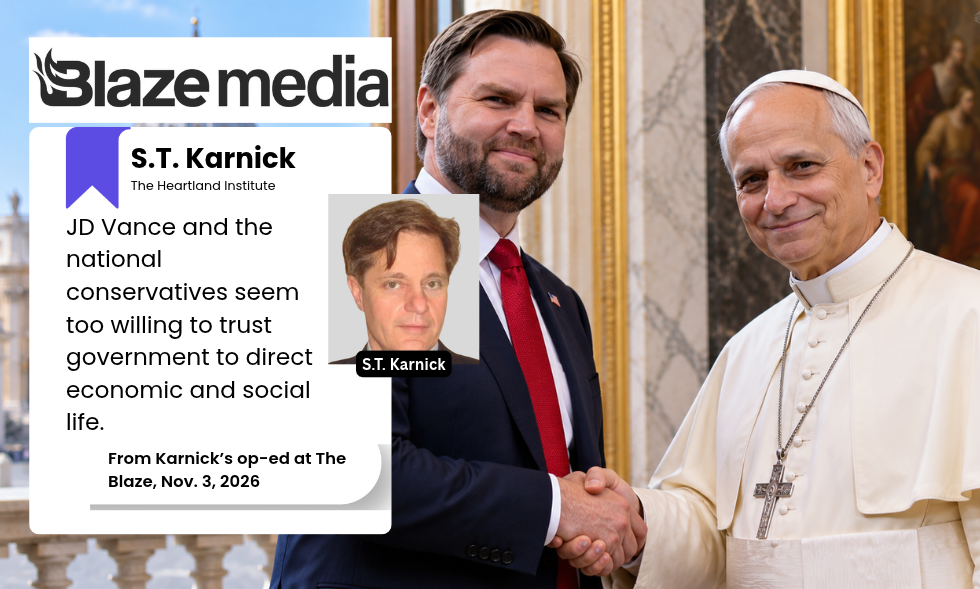
Vance and the national conservatives, by contrast, seem too willing to trust government to direct economic and social life. Socialists place a still greater faith in government management, but the temptation to use centralized power for ostensibly benevolent ends is one the American founders understood.
The United States was established to limit the power of government, not merely redirect it toward other ends. Our founding documents reflect this fact. What one administration builds, another can repurpose.
The founders’ solution was ingenious: separation of powers horizontally, among the branches of the federal government, and vertically, among the central government, the states, and the people. The latter is federalism. Subsidiarity, a related but broader principle, holds that decisions should be made at the social level closest to the people they affect.
Subsidiarity is crucial to a free society. Institutions of different sizes vary greatly in the problems they can address. The federal welfare state, for example, has undermined the family by penalizing marriage and discouraging family formation, even subsidizing childbirth outside of marriage.
However well-meaning, a distant government cannot manage tens of millions of households in accordance with their individual needs.
States have likewise weakened marriage by adopting no-fault divorce, beginning with California in 1969, instead of fulfilling their duty to enforce valid contracts and protect both parties from abandonment. Nearly one-third of Americans born between 1988 and 1993 experienced their parents’ divorce before adulthood, according to the U.S. Census Bureau. Divorce was far more common among children from lower-income families.
The damage has been catastrophic. Census Bureau researchers found that, compared with siblings whose parents divorced after they reached adulthood, children who experienced divorce in early childhood had roughly 60% higher teen birth rates, a 45% greater mortality risk at age 25, a 40% greater likelihood of incarceration, and lower incomes as adults.
These and other government-caused disasters are why the term “nanny state” is such an insult. Fostering families is the job of parents, other relatives, churches, and community members, not governments. Government’s job is to protect people from force and fraud, enforce valid contracts, and provide strictly necessary public works. Those duties often prove far beyond its capabilities.
The belief that a comprehensive national industrial policy will restore jobs and industries is likewise misguided. Industrial policy invites an increase in the already ungodly amount of crony capitalism in the United States and allows gigantic multinational corporations to misuse government to hamstring competitors, especially smaller American businesses.
Read the rest at The Blaze.

S. T. Karnick is a senior fellow and director of publications for The Heartland Institute.