The Department of Health and Human Services (HHS) drastically reduced the recommended vaccines on the childhood immunization schedule.
Deputy Secretary Jim O’Neill announced in a January 5 X post that he updated the schedule to recommend immunization against 11 diseases, down from the 17 that had previously been on the schedule. The total number of recommended childhood vaccines will be pared down from 88 to 30.
In the post, O’Neill wrote that the change came after President Donald Trump asked him to “review the immunization schedules of other developed nations and consider their best practices.” O’Neill says he made decisions regarding updates to the childhood vaccine schedule following conversations with scientists across multiple HHS agencies and bureaucrats in the health ministries of Japan, Denmark, and Germany.
Several decisions on vaccines led up to the change in the childhood vaccination schedule.
In December, at the recommendation of the Advisory Council on Immunization Practices, the Centers of Disease Control and Prevention (CDC) revised its longstanding advice to administer the hepatitis B shot to newborns within the first day of birth.
In November, the CDC changed its long-held stance on vaccines and autism, acknowledging the possibility of a link and calling for further research.
‘Game-changer’
O’Neill said parents who declined vaccines in the past “may now consider giving their children the ten vaccines in the international consensus of 20 nations, plus the varicella vaccine.
The new guidelines remove six vaccines— hepatitis A, hepatitis B, meningococcal disease, rotavirus, influenza, and respiratory syncytial virus—which are now under new recommendation categories for high-risk groups or “shared decision-making,” meaning recommended after consultation with a health care provider. The six vaccines are no longer recommended universally.
There is also a category for vaccines that are not recommended at all, but no vaccines were moved to that category.
Insurance for the removed vaccines is unaffected, whether a child is covered by private insurance or federal coverage. States may also mandate certain vaccines.
Notably, the six vaccines that are now under the “shared decision making” category will no longer be able to receive liability protection, writes Jeff Childers, an attorney who has litigated cases involving vaccine mandates.
“The hiccup is that the 1986 Childhood Vaccine Act, which protects vaccine makers from legal liability for injuries, tracks the CDC-recommended schedule,” wrote Childers on his Coffee and Covid substack. “If a shot isn’t recommended, it isn’t covered, and injured folks can sue vaccine makers directly. That is a game-changer.”
Insurance Incentives
The Trump administration will also no longer require states to report immunization status information.
Shortly before the announcement of the new schedule, the Center for Medicare and Medicaid Services sent a letter to state health officials about the change, which included language “strongly discouraging” states from tying vaccine compliance to payment arrangements, such as those between Medicaid and a provider.
Why Change the Schedule?
“Critics of the new childhood vaccine schedule argue that America should not align with the reduced dose vaccine schedule maintained in Denmark because we have a different childhood population with greater health risks,” said Barbara Loe Fisher, the co-founder and president of the National Vaccine Information Center (NVIC).
“It is true that over the past 50 years, America’s children have become the most chronically ill and disabled and likely to die prematurely compared to other developed countries,” Fisher said, citing a CNN report on the subject. “That decline in infant and child health coincides with the tripling of the number of doses of vaccines given to infants and children.”
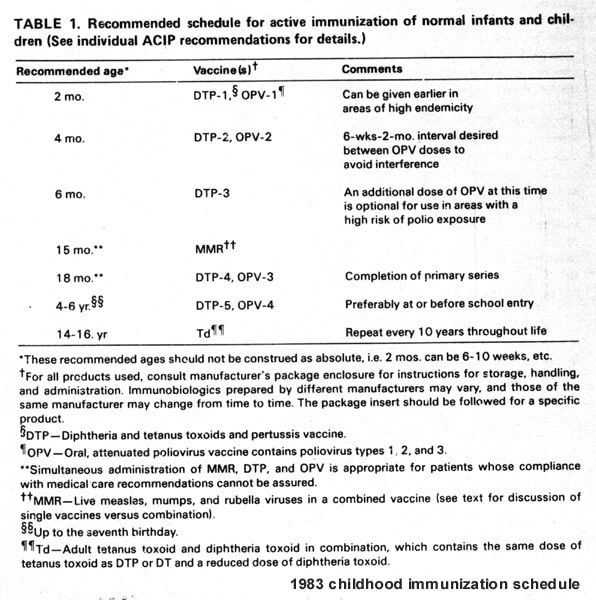
The 1983 schedule included 11 doses of four vaccines through age 18. Depending on how you count them, the 2025 schedule included more than 70 doses of 14 vaccines, including yearly influenza and COVID shots.
“It is reasonable to take a different approach to protecting the health of infants and children in America, which includes allowing parents to make informed, voluntary decisions about which vaccines their children will receive,” said Fisher.
“Federal health officials at HHS make vaccine use recommendations, and state officials create vaccine mandates, so whether the vaccine is placed in the ‘recommended’ or ‘shared decision making’ category is of greatest significance in terms of health freedom,” said Fisher
Free Market Vaccines
The argument is not pro-vaxx or anti-vaxx, but whether shots should be a personal choice, says Fisher.
“All biological products labeled vaccines should be subject to the test of the marketplace and the law of supply and demand so that those products consumers consider to be safe, effective, and necessary will be purchased and used, and the rest will require improvement or removal from the market.”
Fisher’s non-profit organization was established by parents of children injured by the DTP vaccine, the precursor to today’s DTaP (diphtheria, tetanus, and acellular pertussis) vaccines, and “launched the vaccine safety and informed consent movement in America in 1982,” said Fisher
Last year, NVIC called for an end to vaccine mandates in the United States.
The ‘Mass’ Vaccine Approach
While conventional media outlets such as the New York Times and NPR have questioned using Denmark as a model for the U.S. vaccine schedule because of its size and contrasting health care system, cardiologist and epidemiologist Peter McCullough, M.D. sees a more important difference.
“The U.S. operates under a maximal‑coverage philosophy—a regulatory legacy shaped by federal liability protections (National Childhood Vaccine Injury Act 1986) and commercial partnerships between vaccine manufacturers and federal agencies,” McCullough wrote on his Focal Points blog, posted December 26.
“The default assumption is mass administration, appealing to ‘herd immunity’ models and centralized compliance metrics,” wrote McCullough.
Modern Sanitation
Public health conditions are not what they were decades ago, says McCullough.
“It is important to remember that the most important factor controlling contagious illness is modern sanitation, hygiene, good nutrition, and clean water,” McCullough told Health Care News. “With most illnesses over ninety percent reduced BEFORE vaccination, we realize that immunization has played a relatively minor role in the battle against infectious diseases.”
In contrast to the United States, Denmark takes a minimalist approach has paid off, says McCullough.
“Denmark has better control over communicable diseases with less vaccination and is a reasonable model to follow going forward,” said McCullough. “Importantly, with fewer vaccines and doctors making decisions on administration, there has been no Danish resurgence of illnesses that plagued Americans in the mid-twentieth century.”
Harry Painter ([email protected]) writes from Oklahoma.

Harry Painter ([email protected]) writes from Oklahoma.