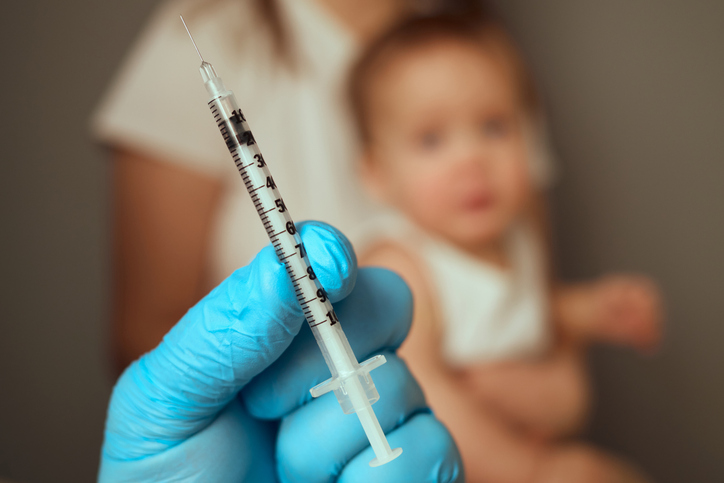
The U.S. Department of Health and Human Services (HHS) reinstated a federal task force on pediatric vaccine safety after a hiatus of nearly 30 years.
National Institutes of Health (NIH) Director Jay Bhattacharya, M.D., will chair the reinstated task force alongside senior members of the NIH, the Food and Drug Administration (FDA), and the Centers for Disease Control and Prevention (CDC).
“By reinstating this Task Force, we are reaffirming our commitment to rigorous science, continuous improvement, and the trust of American families,” Bhattacharya stated in the August 14 press release. “NIH is proud to lead this effort to advance vaccine safety and support innovation that protects children without compromise.”
The task force will make recommendations on the “development, promotion, and refinement of childhood vaccines that result in fewer and less serious adverse reactions” than those on the market and “improvements in vaccine development, production, distribution, and adverse reaction reporting.”
The task force will also support research to improve vaccine safety. Reports will be submitted to Congress every two years, beginning with the initial report, which is due within two years.
On February 13, President Trump established the Make America Health Again Commission (MAHA) to investigate, in part, rising chronic childhood diseases among other things.
Disrupted Safety Oversight
In response to the 1986 National Childhood Vaccine Injury Act, Congress created the Task Force on Safer Childhood Vaccines to provide oversight and increase safety and quality of pediatric vaccines. The Task Force was supposed to formally report to Congress every two years.
The panel disbanded in 1998 after it issued its first report. That report criticized the lack of “interagency coordination on vaccine safety,” and deferred the coordination of vaccine safety programs to the Vaccine Interagency Group, an organization within the Public Health Service that was formed in 1980.
A more recent 2008 report found that a “lack of coordination and oversight of vaccine-related activities” has impacted federal efforts. A 2010 publication determined that “the absence of broader NIH participation in vaccine safety research” may have “slowed…progress in vaccine safety.”
Growing Distrust
Rising rates of childhood disease and a lack of complete data defining the safety of increased injections on the pediatric vaccine schedule contributed to a record number of exemption requests filed by concerned parents in 2024-2025.
HHS Secretary Robert F. Kennedy Jr. has spoken out regularly on vaccine safety and efficacy. Kennedy’s removal of all members of the Advisory Committee on Immunization Practices (ACIP) in June, the cancellation of nearly $500 million in federal funding for mRNA vaccine development (see related article, page 5), and updated guidance on mRNA vaccines for healthy children have resulted in backlash from some major medical boards.
Kennedy’s activism on vaccines goes back to 2017 in his work as a private attorney. Kennedy filed a Freedom of Information Act request on behalf of the Informed Consent Action Network, petitioning for evidence of vaccine safety reporting by HHS. The request did not yield any reports, and the court dismissed a follow-up filing in 2018.
Former Allies’ Lawsuit
In May, Children’s Health Defense, the vaccine safety nonprofit Kennedy founded, sued Kennedy to force the reestablishment of the task force.
“If the Secretary is not performing a nondiscretionary duty, then a citizen has a right to bring a suit against him to have the court force [the issue], provided there is a 60-day notice and some personal harm,” attorney Ray Flores told Health Care News.
Flores filed the notice and lawsuit. Eventually, HHS asked for a two-week grace period to respond and explore a way to settle the case. The settlement included the reinstatement of the task force.
Flores says he blames HHS for all vaccine injuries that have taken place in the past 30 years.
“They never fulfilled their basic duty,” said Flores. “It’s not just about a MAHA task force or blanket safety task force. It’s about licensing, manufacturing, testing, labeling, warning, storage, administration, field surveillance. … If they already had an effective system in place, a lot fewer people would have died, but instead they allowed these second-rate, inaccurate under-reportings. They allowed these hot lots to stay in circulation, and they never did anything to make vaccines safer than when the 1986 Act went into effect.”
MAHA Criticism
Flores says he has not been impressed with the efforts of the MAHA Commission.
“The commission can talk about other things, but this is set into motion, and this is what’s going to matter to save children and [decrease] suffering,” said Flores. “I think the [lawsuit] put this discussion back in the forefront.”
Ashley Bateman ([email protected]) writes from Virginia.