Life, Liberty, Property #155: Hard Facts That Doom Every Proposed Social Security Fix
Forward this issue to your friends and urge them to subscribe.
Read all Life, Liberty, Property articles here, and full issues here and here.
In This Issue:
Hard Facts That Doom Every Proposed Social Security Fix
Video of the Week: Jail Anthony Fauci! — In the Tank Podcast Clip
Central Bank Policy and Rising Wealth Inequality
DON’T MISS THIS!
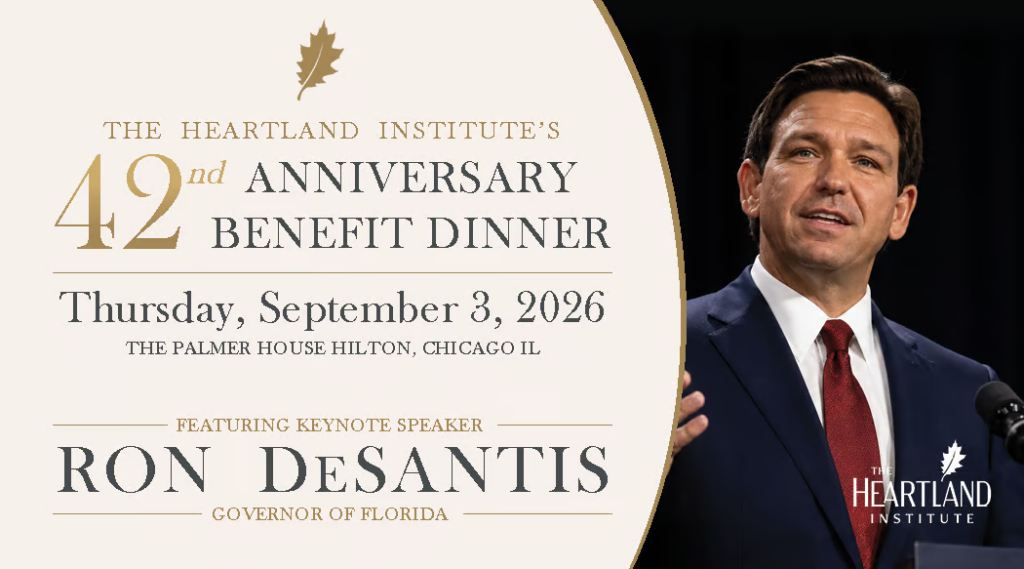
Heartland and Ron DeSantis
Join us on Sept. 3
Hard Facts That Doom Every Proposed Social Security Fix
As the United States careens ever-faster toward the day when the Social Security trust fund will run out, now scheduled for 2032, press reports of reform proposals have been arriving with greater frequency and mounting expressions of fear.
The government transparency organization Open the Books reported in March that the total amount of unfunded Medicare and Social Security obligations is now an unimaginable $193.6 trillion.
The most recent proposed fix comes from the Committee for a Responsible Federal Budget (CRFB). It includes a cap on the annual cost of living adjustment, which increases recipients’ monthly checks to make up for inflation. CRFB co-chair Tim Penny first introduced a similar cap in Congress in 1987, and it has never gone anywhere.
Penny’s plan would cap every Social Security recipient’s annual COLA increase to the dollar amount that applies to the 20th or 30th percentile beneficiary. It would amount to a highly progressive benefit cut.
“If set at the 20th percentile, the bottom fifth of lifetime earners would see their benefits fall by just 3% in 2065, versus 19% for the top fifth of retirees,” the CFRB states. “Set at the 30th percentile instead, the bottom quintile would enjoy a 1% benefit increase, while benefits for the top fifth would fall by 17%.”
The plan would be to combine that with other policies, such as their proposed Employer Compensation Tax, which would remove the $176,100 annual wage cap on the employer half of the Social Security payroll tax and apply it to all fringe benefits as well. That provision would raise an estimated $2.5 trillion over a decade and 0.7 percent of GDP over 75 years.
The CFRB estimates that multiple “Revenue Options,” meaning tax hikes, and “Spending Options,” meaning benefit cuts, could compose “a full solvency package.”
I appreciate any individual or organization that dares to touch the “third rail” by offering a plan to reform Social Security. These reform plans always raise furious objections, and for very good reasons: nobody wants his or her own taxes raised, and no politician is eager to become the star of political attack ads showing Senator Evil pushing Granny off a cliff in her wheelchair.
John Hart, president of Open the Books, recently told Fox Business News the only way to save the system is to means-test recipients and eliminate everyone but the indigent. Host Stewart Varney rightly pointed out that no politician could survive the firestorm that would result from that.
The big problem with all Social Security reform proposals is that they involve breaking a promise and infuriating millions of Americans. President Franklin Roosevelt sold the idea to Depression-era Americans as a savings plan in which the government would take 1 percent of an individual’s pay and an additional 1 percent “from the employer” and put it aside for that person’s retirement.
The government has raised the tax 15 times since then, to the current total of 15.3 percent. The Social Security trust fund is running out of money anyway, even though it pays off very poorly: individual, privatized Social Security accounts invested in good American companies would provide retirees with “benefits three to four times higher than the rip off that Social Security pays,” Unleash Prosperity reports.
Since 2005, the S&P 500 has risen by 844 percent, an 11 percent annual return on investment. Social Security pays a pittance compared to that.
Like nearly everything else the U.S. government does, Social Security is a grossly wasteful mess. Americans are dragooned into paying for it, and they ultimately get back whatever Congress and the president decide.
That is the entire problem with Social Security: it is run by the government. The government does not produce things. It only redistributes resources—and pain, which is the one thing it reliably creates. The plans to “save” Social Security all involve changing who pays how much and who gets how much in the coming years. They don’t expand the nation’s wealth, so there is no solution that works for everybody. Only market exchanges benefit both parties to a transaction.
The CFRB’s COLA Cap would redistribute the pain by using inflation to cut the benefits of the great majority of Social Security recipients. It would ease the burden on current workers by placing it on retirees. It would expand the burden on everybody, however, by rewarding the federal government for increasing inflation-inducing deficit spending. Funny how that works.
Meanwhile, raising the payroll tax would reduce employment by making it more expensive to hire people and pay them. That would reduce Social Security revenue well below the expected amount, and it would lower the national standard of living by reducing the production of goods and services. In addition, it would increase inflation by cutting tax revenues and causing even-bigger deficits, which are inflationary.
Social Security always was an income-transfer program sold via a phony “investment” public relations spin. The people who were forced to “invest” in the program believe the government should pay them their due dividend. The people who are forced to pay out that dividend don’t want to get ripped off like their parents were.
There is no magic solution to that dilemma. The only way around it is to expand economic output.
Those who call for privatization of Social Security are offering a sound long-term plan that is in fact based on economic expansion. We will never get there before 2032, however, because people are afraid to have the government “speculate” with their potential benefits. They prefer the assurance of a poor return and getting robbed by the system.
However, any plan to fix the system through fiscal maneuvers founders on the hard fact that displeasure at benefit cuts will not be limited to the 77.5 million current retirees and others who receive Social Security. Millions of people about to retire will be affected, and tens of millions of other Americans will feel the sting of watching their parents’ or grandparents’ incomes decline and make it more difficult to pay for desperately needed health care and other necessities.
No politician is going to want to be known for that. That is why we were always going to head for a fiscal collapse, now scheduled for 2032.
The Heartland Institute’s Linnea Lueken, Jim Lakely, and Chris Talgo go HULK MODE on Anthony Fauci after his pathetic Fifth Amendment performance in a Senate hearing. We go over some of his diary entries and wonder if he has actual human empathy.
The Latest Heartland Institute Report
‘Today’s crisis is a product of government errors, not greedy landlords, institutional investors, and so-called market failure.’
Central Bank Policy and Rising Wealth Inequality
As recent European visitors’ amazement at the abundance of enjoyable goods and services in the United States has reminded us, Americans’ wealth has increased greatly in recent years. This has occurred even as our rate of saving has collapsed, economist and former Office of Management and Budget director David Stockton notes:
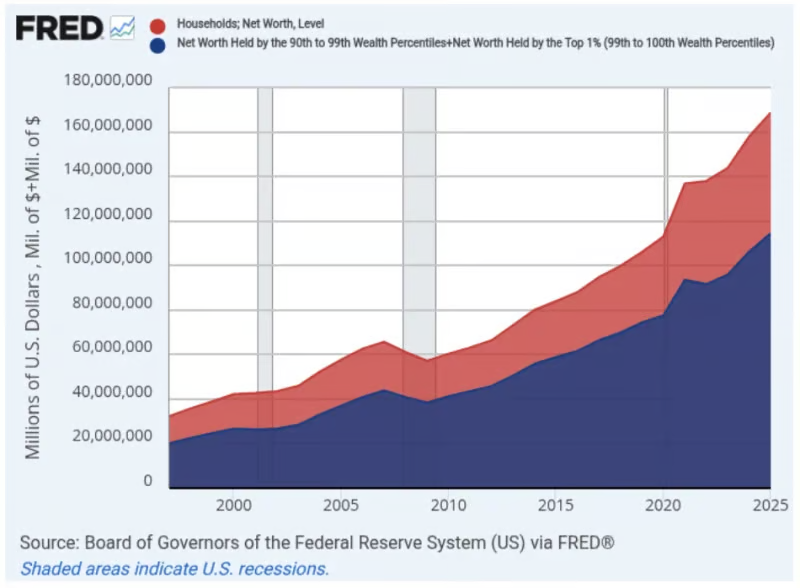
During the last three decades the national savings rate (red line) has essentially collapsed, having fallen from 6.3% of GDP in 1997 to 0.5% of GDP in 2025. Between the same two dates, however, the net worth of US households (blue line) has soared from 4.6X personal income to 6.5X personal income.
Household net worth “erupted from $32 trillion in 1997 to $169 trillion at present,” Stockman writes. “These figures amount to an average of $320,000 per household in 1997, which grew to an average of $1.250 million per household 28 years later.”
Although “some substantial part of that gain is reflective of inflation,” average net worth per U.S. household “virtually doubled from about $630,000 to the aforementioned $1.250 million” in constant 2025 dollars, Stockman writes.
As free-market economists regularly observe, wealth has increased among all income brackets. However, the distribution of those increases in wealth has been extremely skewed, Stockton notes.
As it happened, of course, the massive $136.4 trillion increase in net worth over this period went to the holders of financial and housing assets, less associated debts. Accordingly, with a lot of debt at the bottom income rungs relative to modest asset levels, the resulting wealth distribution skewed sharply to the tippy-top of the economic ladder.
To wit, $44.1 trillion of the gain was accounted for by the top 1% of households and fully $94.2 trillion by the top 10%.
The extremely skewed distribution of all the wealth expansion of the current century was not an effect of free markets, Stockman notes. It resulted from the uneven effects of monetary inflation caused by the money printers at the Federal Reserve:
And while Keynesians, statists, and stockbrokers would have you believe this was nothing more than Mr. Market at work, we beg to differ.
Under a regime of sound money and honest markets there would have been no soaring gains in net worth relative to the very modest gains in national income and savings. To the contrary, the former is the work of the money-printers at the central bank and the Cantillon Effect of monetary inflation.
That is to say, when the Fed prints money it effectively first deposits the receipts among the primary bond dealers, which sell government bonds to its open market desk and then send the proceeds ricocheting through the canyons of Wall Street. At length, the inflation gets to Main Street in the form of higher energy, food, and other everyday prices, but not before much of the inflation is absorbed by the leveraged gamblers on Wall Street.
This constantly excessive monetary expansion throughout the current century has diverted the normal movement of wealth away from the “most productive, capable, persistent, and enterprising households” to people who can afford to speculate in asset purchasess, because of “the capture of the Federal Reserve by Wall Street speculators.”
In its continual effort to boost Wall Street asset values, the nation’s central bank has direly undermined the America’s meritocratic foundations and fired up the rising support of socialism and outright communism we are now experiencing:
By embracing Greenspan-style monetary central planning in lieu of gold standard sound money, the modern day GOP has paved the way for the emerging Mamdani socialist coup in the Democrat Party.
That is to say, the wealth disparities shown below did not exist with nearly this much skew as recently as 1987, when Alan Greenspan’s pro-inflation, pro-wealth effects regime became official policy at the Fed. Then again, the Fed’s balance sheet stood at $250 billion in Q2 1987 after 73 years of a moderately tame printing press, which footings then ballooned to nearly $9 trillion by the peak in Q1 2022.
Yes, flood the free market with $8.75 trillion of fiat credits in barely 25 years, and you will indeed get a rip-roaring financial asset inflation. And you will also get a rekindling of socialist economics, which should have been finally left for dead by 1984.
Stockman goes on to explain in great detail exactly how all this was done. It is well worth reading in full. From a governance and policy standpoint, however, the lesson is a simple one: restore sound money. It is the job of Congress and the president to enact legislation forcing the Fed to do so. Stockman writes,
So the first step toward restoration of a True Golden Era is the opposite of the recipe of easy money, big deficits, high tariffs, and ceaseless Washington meddling in the process of investment, resource allocation, and growth on the free market.
Simply pass a law forbidding the Fed to own government debt or buy and sell any securities at all. In lieu of this mode of monetary central planning, instead, just restore passive Discount Window lending at a penalty spread above the free market rate of interest based on the presentation of sound commercial collateral by Member banks.
That’s all it would take to promote sustainable prosperity.
Stockman is correct, and I endorse his solution of forbidding the Fed to own government debt and other securities, having made that suggestion myself regularly.
The need for reform is intensifying rapidly as the Fed’s massive distortion of the economy is spurring a leftist uprising. Stockman writes,
Undertake these reforms else we will see the rage grow and the long knives of wealth slayers drawn and used in ways no one wants. An economy this top-heavy with paper wealth – as the poor and middle class get destroyed with persistent inflation, slow growth, and unstable labor markets pervasive with dropouts – is not sustainable. It’s not capitalism but rather corruption by the printing press.
This is indeed not free-market capitalism. It is crony capitalism on a national and global scale. Believers in free markets, property rights, and the American Way had better raise the cry for Congress to clarify the central bank’s mission as providing a sound dollar, full stop, and forbid the Fed to engage in the securities ownership and trading that has allowed all this distortion and destruction.
History shows that great empires have consistently declined and fallen after givng in to the temptation to debase their currency. Europe is on the way to completing that process. The United States could easily avoid that fate. However, the people who have been benefitting from this century’s enormous wealth transfer are extremely influential and will resist the necessary reform with all their considerable power.
‘The CSDDD is the greatest threat to America’s sovereignty since the fall of the Soviet Union.’
Contact Us
The Heartland Institute 1933 North Meacham Road, Suite 559 Schaumburg, IL 60173 p: 312/377-4000 f: 312/277-4122 e: [email protected] Website: Heartland.org