The general media narrative after the 2026 midterm elections is that voters “rebuked” Republicans and sharply shifted towards Democrats.
While that is a simple way of framing the outcome in stark political terms, a deeper dive into the exit polling data tells a more complex, nuanced, and disturbing story about where things stand and where they could be going.
Exit polls, unlike binary voting decisions, provide “a look at the thinking and motives of voters across the country.” Thus, exit polls “help the public better understand the makeup and motivations of the electorate.”
Exit polls are not perfect, but they provide a rare opportunity for a comprehensive snapshot into the minds of voters regarding numerous topics.
On November 3, 48 percent of the electorate self-identified as Democratic, 44 percent said Republican, and 8 percent said Independent.
Overall, the “economy” was the most important issue, followed by the “state of democracy,” and “immigration.”
Nearly nine in 10 Americans cast their vote for Congress based on the cost of living being a “crucial” or “major” factor.
Vast majorities cited high costs for gasoline, groceries, health care, utilities, and more as “concerning,” and most voters think Democrats will help bring these costs down.
Most Americans, 57 percent, still favor “capitalism,” whereas 32 percent “disfavor” it.
Among the majority who favor capitalism, Republicans far outnumber Democrats. Vice versa, Democrats far outnumber Republicans for those who “disfavor” it.
On socialism, 33 percent of voters find it “favorable” to 54 percent who consider it “unfavorable.”
Again, there is a glaring partisan gap.
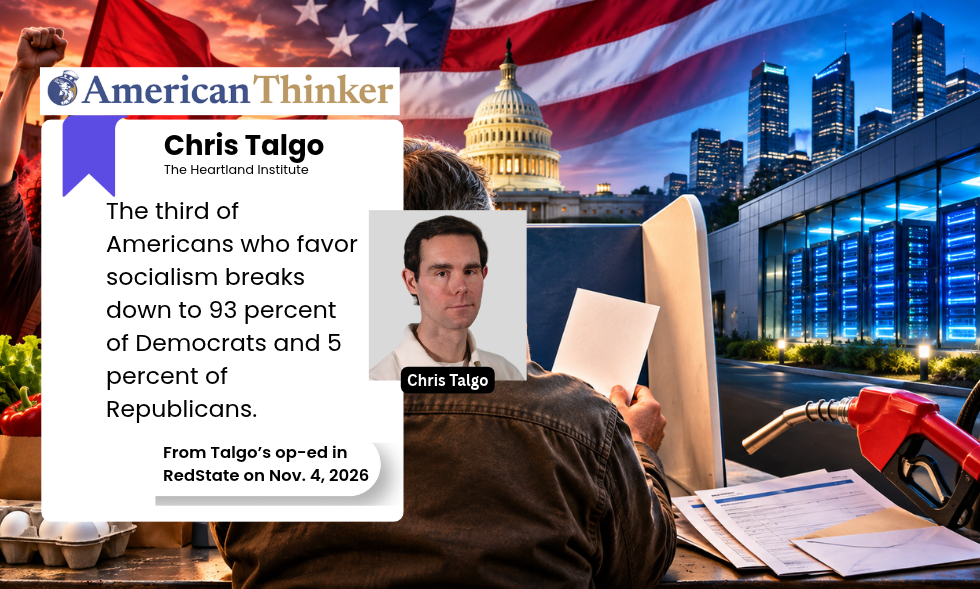
The third of Americans who favor socialism breaks down to 93 percent of Democrats and 5 percent of Republicans.
On the flip side, the 54 percent who disfavor socialism is dominated by Republicans.
The point is that socialism as a viable economic option is becoming more acceptable on the left as support for free enterprise wanes.
For now, slightly more Americans “favor” capitalism than “disfavor” socialism.
However, with young voters more prone to favor socialism, this is not guaranteed to last.
Regardless of their views on capitalism and socialism, about seven in 10 voters think the “economic system generally favors the wealthy” and 75 percent describe the economy as “not good” or “poor.”
Another concerning trend is that most voters, 57 percent, think the next generation will be “worse off” compared to only 22 percent who think the opposite.
That is a profound problem that neither party is adequately addressing, which has opened the door for democratic socialism.
Democratic socialism is not the same as socialism, or so says the Democratic Socialists of America (DSA).
The DSA performed better than expected in the 2026 midterms, winning House and Senate seats at the federal level, proving that democratic socialism has a firm hold on the far left.
But the DSA’s policies, as outlined in their Workers Deserve More Program, would destroy the economy as we know it.
Read the rest at American Thinker.

Chris Talgo is the Editorial Director for The Heartland Institute and a fellow for Heartland’s Glenn C. Haskins Emerging Issues Center.