IN THIS ISSUE:
- Countries and Industries Are Abandoning or Reducing Net-Zero Commitments
- Amid Moderate Warming, Hot and Cold Extremes Are Declining
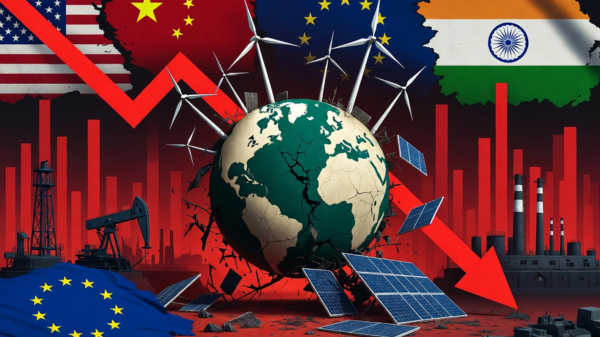
Countries and Industries Are Abandoning or Reducing Net-Zero Commitments
Since the swearing-in of Donald Trump as the 47th president of the United States, climate alarmism and the political machinations in the public and private sector it spawned have experienced the death of a thousand cuts, described for centuries as a favorite torture method of the Chinese.
Trump’s actions as president represent the deepest stab wound to elite promoters of the climate “hoax” or climate “scam”—take your pick of descriptors used by Trump to describe the false-alarm narrative of catastrophic climate change. I have previously described here at CCW some of Trump’s actions that are draining the climate swamp of resources, supporters, spirit, and momentum. These include defunding climate boondoggles across federal agencies, pulling the United States out of the Paris climate agreement, withdrawing the United States from dozens of climate-monitoring and wealth-transfer organizations (most importantly the UN Framework Convention on Climate Change), and rescinding the greenhouse gas endangerment finding. All these actions and more have left the progressive climate elite bereft and seeking solace and continued support, with said solace and support waning in both the public and private sectors in the United States and internationally. The cuts are coming fast and furious
Evidence suggests that with America no longer playing the fool, cast as a villain in the climate scam, other countries and companies around the globe are increasingly refusing to do so. Some entities are withdrawing from their climate commitments entirely and reembracing fossil fuels. Others, while still embracing climate alarm to a degree, are reducing their emission reduction pledges, cutting funding for wind and solar, pushing out the timeline for net zero, acknowledging the continued necessity of fossil fuels for a while at least, or some combination of the above. Of course, they would be doing none of these things if they really believed the hype that the world faces a pending climate catastrophe that can be stopped by eschewing fossil fuels. They are tacitly admitting Trump is right and climate change is a scam or hoax, and acknowledging the need to find a new and different way to profit through fear.
Examples of the rapid decline of the climate alarm narrative are all around us. For example, the UN IPCC recently had its 64th meeting of the science committee, at which it failed, once again, to set a date for the production of the next IPCC Assessment report. It’s not just that they can’t agree on who will write the report or what its scope will be: they can’t even decide on a deadline for when to produce and publish it.
Climate modeler Jozef Pecho described how dangerous and discouraging this impasse is for him and the climate science community in general:
As a climate scientist whose work depends on IPCC assessments, I find what’s happening in Bangkok hard to watch.
The disagreement is framed as procedural. It isn’t. A coalition including Saudi Arabia, Russia, China, India and Kenya wants the timeline pushed later. The practical effect is the same as if you delayed a medical diagnosis until after the surgery: the science arrives, but it can no longer guide the decision. UNEP [United Nations Environmental Program] warns the IPCC trust fund may run out before AR7 is even finished.
What we are watching is not a calendar dispute. It is a slow-motion erosion of the institution that translates climate science into political accountability—and it is happening at the moment that science is most needed.
Why would Saudi Arabia, Russia, China, India, Kenya, and other nations want the timeline extended if they really believed a climate crisis was in the offing? The answer is they wouldn’t, so they really don’t believe climate change poses an “existential threat” to humanity, in the words of former President Joe Biden. It is a tool to be wielded to gain geopolitical concessions, national advantage, and/or continued welfare money.
Another cut is described in one of the preeminent medical journals, The Lancet, in an article in which the researchers warn of public health consequences of the European Union truncating the reach and scope of its emission-reporting requirements. They describe the regulatory change thus:
On Dec 16, 2025, the European Parliament and the European Council reached a provisional deal on the Sustainability Omnibus Package of the European Commission in an effort to streamline and simplify the European regulatory landscape to promote the competitiveness of European undertakings. The proposed simplification exempts an estimated 80% of undertakings (organizations) that were within the previous scope of the Corporate Sustainability Reporting Directive (CSRD). The exemptions lead to lower or no data collection from indirect value chain partners, only requiring reporting from undertakings with a turnover exceeding €450 million generated within the EU or having more than 1000 employees (EU based).
Although modest in its environmental data requirements, the CSRD is considered one of the most comprehensive mandatory sustainability reporting initiatives in the world. However, the simplification of the Omnibus severely hampers the creation of an urgently needed data landscape to map and monitor corporate environmental impacts and might impede policies aimed at advancing planetary health.
Once again, researchers seem alarmed, but the governments not so much.
Then there is the case of Germany, where grim electoral prospects seem to be forcing the government to end its enforced adoption of certain green technologies and fuels, a mandate resulting from the country’s previous commitments to net-zero emission goals.
“In a shock move, the German government will allow citizens to use oil and gas to heat their homes again, even though this might increase global temperatures by a thousandth of a degree in 80 years time,” reports Jo Nova. “The government or rather, the taxpayers, will still be forced to subsidize 30 to 70% of the cost of a new heat pump, but won’t actually fine anyone or put them in jail if they buy an oil or gas heater. (Yay, ‘freedom’.)”
The response of the German left to this modest shift toward climate reality was entirely predictable, according to Euronews:
One critic has called the move “an unconditional fulfilment of all the wishes of the fossil fuel lobby”.
“This reform is a disaster,” Green Party parliamentary group co-leader Katharina Dröge told the German Press Agency (dpa).
“The CDU and SPD [Social Democratic Party] have today made it abundantly clear: climate protection is completely irrelevant to this coalition,” she added. “The federal government has abandoned the achievement of the climate targets.”
Moving on to the private sector, industries are quickly abandoning their emission-reduction commitments. As I have detailed in CCW, shortly after Trump was elected but before he took office, hundreds of banks and other companies began abandoning various UN-sanctioned or -endorsed climate groups setting reporting requirements for carbon dioxide emissions and goals for emission reductions. And by early in 2025, big tech companies, fearing a lack of energy for their AI hubs and server farms, began to cease lobbying for state governments and the federal government to embrace net-zero goals and ever-more wind and solar power. They began to embrace nuclear power, natural gas, and to a lesser extent even coal in some locations. They want whatever is needed to power the burgeoning AI industry and their tech reliably, climate concerns be damned.
More recently, the automobile and power industries have joined the stampede away from net zero. For example, MasterResource highlighted an article at Autoblog detailing 18 major automobile manufacturers’ decisions to scale back dramatically or abandon entire lines of electric vehicles. The Autoblog article states,
After years of rapid growth, the electric vehicle boom is hitting turbulence. With demand slowing and incentives fading, at least 18 automakers are now canceling, delaying, or scaling back EV plans in the U.S., including major brands like Ford, Honda, Nissan, and Volkswagen. …
After growing nearly eightfold between 2019 and 2023 [due to tax incentives and mandates], demand for battery-electric vehicles flattened out last year, then took a dive off a cliff after federal tax credits phased out at the end of September. That’s sent an array of automakers scrambling to rethink their EV programs and, by Autoblog’s count, at least 18 brands have now decided to drop existing models, scrap upcoming plans or, at the least, stretch their launches out, hoping to see demand rebound.
And it’s not just car companies. Oil companies (which never should have jumped on the suicidal climate-alarm bandwagon and instead should have been fighting it) and utilities are also reducing their emission-reduction goals. Seeking Alpha reports,
The world’s largest oil and gas companies ratcheted back investment in the energy transition in 2025, marking the first annual decline in eight years, according to BloombergNEF. Spending on low-carbon technologies by oil and gas majors fell by more than a third over the past year, to $25.7 billion from more than $38 billion in 2024, , according to a report published Wednesday.
Even with that reduction, the companies are spending $25.7 billion too much on unnecessary efforts to prematurely transition away from fossil fuels in a foolish and vain effort to fight climate change.
In the power sector, the retreat from net zero is even greater. Environment America has reported that as of March, 8.1 GW of coal capacity, consisting of 33 fossil fuel generating units across 15 power plants, that had been scheduled for closure by the end 2025 have been kept online to maintain grid reliability and power AI expansion. Most recently, it was announced in early April that the two largest coal-fueled power plants in Pennsylvania had agreed to stay in operation through 2032, four years beyond their planned retirement date, specifically to ensure grid stability in the face of growing AI data center demand. Even Gov. Josh Shapiro, a Democrat, approved of the plan to keep the plants open.
And academia has not been immune to the siren call of climate realism. While publicly maintaining its goal of reaching net zero emissions by 2050, Duke University announced it would no longer spend $4 million per year to achieve “short-term carbon neutrality,” nor would it dedicate staff time to figure out ways to offset ongoing carbon dioxide emissions.
In academia, government, and industry, climate alarm is in retreat. Net zero as an economic and political goal is not dead, but it is on life support, and The Heartland Institute will continue to advocate for pulling the plug.
Sources: The Lancet; Jo Nova; NorDotApp; MasterResource: Seeking Alpha (MSN.com); EnvironmentAmerica

Amid Moderate Warming, Hot and Cold Extremes Are Declining
A new study from John R. Christy, Ph.D., former Alabama State Climatologist, director of the Earth System Science Center, and distinguished professor of atmosphere and earth science at the University of Alabama at Huntsville, undertook a long-term accounting of temperature trends. The study, published in the peer-reviewed journal Theoretical and Applied Climatology, reports extreme temperatures, both extreme heat and extreme cold, have become less frequent and sustained across the continental United States since 1899.
Christy analyzed more than 40 million daily temperature readings from 1,211 weather stations. Where a weather station during that time discontinued operation or had incomplete records, Christy filled in data from nearby stations after filtering out possible sources of bias. Per the abstract,
Extreme temperature metrics for summer daily maximum temperatures and winter daily minimum temperatures were calculated. The general result is that metrics for extreme summer heat, e.g., hottest values, number of heatwave days, etc., show modest negative trends since 1899. Extreme cold temperature metrics also indicate a decline in their occurrences especially since the 1990s. In sum, instances of both hot and cold extreme metrics have declined since 1899.
“Knowledge of temperature extremes, and their potential changes within a climate system of increasing greenhouse gases, is of vital interest for humans and the infrastructure which supports them,” Christy writes in the study’s abstract, explaining the need for and importance of the study in the context of the scientific and public policy debate over climate change. “This dataset allows us to ask—and answer—questions about extreme heat and cold with more confidence, given the amount of data available now,” Christy writes in an article about the study.
“Understanding how extremes have changed over time is essential for interpreting (dispassionately) how today’s events actually compare with the past,” wrote Christy.
The data show the most intense heat events occurred between 1925 and 1954, particularly during the 1930s, the study states. Christy’s analysis found no long-term increase in extreme summer heat nationwide.
By contrast, periods of extreme cold have noticeably declined, especially since the 1990s, with fewer record-low temperatures and less-severe winter extremes. This is due to a modest warming at night during the winter, found in higher winter nighttime lows attributable in part to the urban heat island effect where development has taken place around urban, suburban, and even some poorly sited rural weather stations.
Because extremes of summer heat haven’t changed much and periods of extreme cold have declined, the study also found the difference between the hottest and coldest annual temperatures has narrowed by about six degrees over the full record, “suggesting less overall variability in temperature extremes,” as noted by Fox 54 Alabama’s report on the findings.
To demonstrate an application of this dataset, Christy compared the results produced by his analysis of the long-term data to claims made by U.S. Global Change Research Program’s National Climate Assessment (NCA) that heatwaves have increased since the 1960s. These claims are not borne out by the comprehensive temperature data Christy analyzed. Instead, there has been a small, statistically insignificant change, primarily in parts of the Western United States where population growth has been rampant. When the temperature data is extended back to 1899, it shows heat extremes have actually declined nationwide, and the trend identified by the NCA disappears. There is no correlation to greenhouse gas emissions.
Sources: Fox 54; Theoretical and Applied Climatology; University of Alabama at Huntsville