IN THIS ISSUE:
- It’s Hurricane Season, and Nothing Is New
- Anthropogenic Climate Change Isn’t Affecting Precipitation
- Southeast Asia Rejects Climate Restrictions, Expands Coal
It’s Hurricane Season, and Nothing Is New
It’s hurricane season again, and a few things about it are as certain as death and taxes. First, some named storms, tropical storms, hurricanes, and cyclones will form somewhere, sometime, in the Atlantic and Pacific oceans. Second, one or more of those storms will cause some degree of damage in some country or another. Third, at one point or another during the hurricane season some media outlet, mainstream or social media only, will claim one or more hurricanes were caused by or made more likely by climate change.
That last claim is patently false. Even the U.N. Intergovernmental Panel on Climate Change says it has been unable to find a measurable change in hurricane frequency or severity that it can tie to human greenhouse gas emissions. Despite that, people will make that claim, probably backed up by a dubious, quickly thrown together attribution study.
The National Oceanic and Atmospheric Administration (NOAA), the keeper of all official data and annual prognostications on hurricanes, has predicted a “below-normal 2026 Atlantic hurricane season.”
Specifically, NOAA forecasts that during the 2026 hurricane season, which runs from June 1 through November 30, there is:
- a 35 percent chance of a near-normal season;
- a 10% chance of an above-normal season, and;
- a 55% chance of a below-normal season.
Delving further, NOAA forecasts:
- a total of eight to 14 named storms (winds of 39 mph or higher);
- three to six of those storms to reach hurricane-strength winds of 74 mph or higher); and
- one to three of those hurricanes to have wind speeds of 111 mph or higher, making them “major” storms of category three, four, or five.
Rational people will hope and pray NOAA is right and we have a below-normal hurricane season and, as importantly, that as with 2025 no storms make landfall. Still, people in or near hurricane-prone areas should be prepared for even minor storms and for NOAA’s forecast to prove overly optimistic.
It’s not rare for NOAA to have to adjust its outlook up or down mid-season. My colleague Anthony Watts noted that since the inception of NOAA’s May Hurricane Forecast, the actual number of named storms fell within the forecast range in 16 out of 26 years, a forecast success rate of approximately 62 percent. NOAA’s preseason forecast success rate for hurricanes is about 58 percent. (See the chart below.)
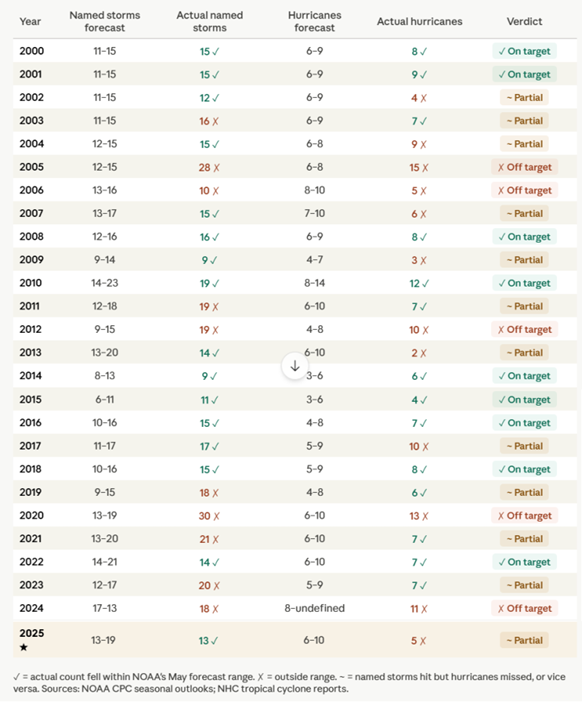
The much more dangerous underestimate was more common in NOAA’s forecasting failures than overestimating storms.
Since Atlantic tropical storms and hurricanes can affect the United States, my Heartland Institute colleagues and I pay more attention to the Atlantic Hurricane numbers than those for the Western North Pacific region. Still, climate change is a global phenomenon, so it is important to see if the “no real change” in hurricane frequency or intensity the Atlantic has experienced is similar to what other hurricane basins are seeing.
A new study published in the journal Natural Hazards examined the intensity of landfalling tropical cyclones in nations bordering the Western North Pacific, with the hope of identifying patterns tied to large-scale oceanic currents/systems. The researchers found “[l]andfall trends over individual nations are insignificant, but significant decreases are noted for the northern Philippines and parts of Micronesia, including for intense [major cyclones].”
By contrast, the southwest corner of Japan has experienced a more modest increase in intense landfalling hurricanes, although statistically the change is not considered robust.
In the end, the IPCC hasn’t detected discernable changes in global tropical storm frequency or intensity during the recent period of slight warming, and it makes no claims of any impact of human emissions on hurricane numbers or strength. And the IPCC isn’t an outlier. Data from different hurricane basins show no consistent sustained trends in hurricane formation or strength. Remember this as the 2026 hurricane season blows through and garners headlines: whether it is a devastating season or a mild one, climate change has nothing to do with it. Don’t let the media or attribution-study shills tell you otherwise.
Sources: Natural Hazards; NOAA; Watts Up With That

Anthropogenic Climate Change Isn’t Affecting Precipitation
Tree rings, like many forms of proxy data, are imperfect stand-ins for identifying various climate- and weather-related phenomena, such as temperatures, sea levels, and precipitation. At best they provide broad-range estimates of various climate trends and features for distant periods of time.
Tree rings are problematic for reconstructing past climates, because tree growth can be enhanced and/or limited by a number of factors, precipitation being just one of them. Still, tree ring patterns provide some of the best, if not only, proxy data available to work with for many locations, to understand past climate conditions for certain regions.
Recently a set of papers using tree ring data from scattered sites across the globe estimated precipitation trends over the past 1,000 (one study), 400 (a second study), and 300 years (a third study). Sampled trees from sub-Arctic Sweden, the Tibetan Plateau, and Greece all suggest the same trend: no significant changes in rainfall patterns or amounts in those regions amid several periods of climate change, including the most recent era.
A study published in the journal Climate of the Past examined “May–June precipitation reconstruction based on ring width from living and dead trees of Scots Pine … growing under drought-stressed conditions at 63° N, near Skuleskogen National Park, on the northern part of the east coast of Sweden. The oldest deadwood sample dates back to the mid-11th century.”
The research suggests rapid shifts from drought to abundant precipitation have been common in the region for at least the past 900 years or so, with a strong cyclic pattern evident over that period, emerging approximately every 64 years. While variability has increased somewhat in recent years, there is no apparent trend in increasing or worsening drought or precipitation in the record.
A second paper, published in the journal Dendrochronologia, compared tree ring reconstructions to independent drought records found in historical documents. The researchers found that although a much-publicized drought in 2009 was severe, attributing it to human-caused climate change is problematic because even more severe droughts are identified in the proxy records in 1915 and 1735. In fact, “seven megadroughts were detected between 1737 and 1998,” write the authors.
A study in the MDPI journal Forests examined tree ring data from eight different chronological data sets to reconstruct the hydroclimate of Greece since the mid-1600s. In general, the study found tree growth, unsurprisingly, strongly correlated with high spring and summer precipitation. It did not find any sustained precipitation trends linked to recent climate change. Instead, the researchers found multidecadal variability has been the norm for the past nearly 400 years, with several distinct multiyear cyclical patterns common across the region.
To sum it up: three studies, three different regions of the Earth, no identifiable climate change signal found in proxy precipitation reconstructions.
Sources: No Tricks Zone; Climate of the Past; Science Direct; MDPI Forests

Southeast Asia Rejects Climate Restrictions, Expands Coal
The Association of Southeast Asian Nations (ASEAN) is an intergovernmental forum for cooperation and economic exchange, formed in 1967 among 11 Asian nations: Burma, Burnei, Cambodia, Indonesia, Laos, Malaysia, Philippines, Singapore, Thailand, Timor, and Vietnam. ASEAN’s member states represent nearly 650 million people.
Under pressure from Western trading partners and development funders, with promises of aid, ASEAN countries agreed to reduce their greenhouse gas emissions under the Paris climate agreement, specifically by reducing energy intensity: emissions per unit of GDP. A report from MIT’s Center for Sustainable Science and Strategy estimated ASEAN nations are far short of meeting their pledges to reduce their emissions through 2030:
Under the unconditional pledges, the ASEAN region faces an emissions gap (i.e., the needed reduction to meet the Paris pledges) of around 400 MtCO2e, which indicates that the ASEAN region will have to reduce emissions by 11% by 2030 relative to its current trajectory. Under the conditional (i.e., subject to more ambitious global efforts and technology and financial transfers) pledges, the emissions gap is about 900 MtCO2e, which indicates a needed reduction of 24% by 2030.
Indonesia’s and Vietnam’s leaders set higher goals for themselves, with the help of foreign funding, to achieve net-zero goals by 2050, in part by ending coal use by 2040.
The war in Iran, particularly the sharply curtailed shipments of LNG and oil through the Strait of Hormuz, which is affecting supply chains worldwide, has led ASEAN governments to backpedal on their climate commitments, with coal being a large part of their future. Vijay Jataraj, a science and research associate with the CO2 Coalition, reported earlier this month,
Indonesia … approved higher quotas for coal production and delayed earlier phase-out schedules for coal plants … . Plans to eliminate coal use sit on the shelf. Affordable power for 280 million people comes first.
In Vietnam, coal-fired generation jumped 44 percent month-over-month in March, reaching 16 terawatt-hours. That accounted for 56 percent of the country’s total power output—the highest share in recent memory. Utilities negotiated extra coal imports to fill gaps left by expensive and scarce liquefied natural gas.
[In] Thailand … [a]uthorities restarted two decommissioned units at the Mae Moh coal-fired power plant and ordered existing coal stations to maximum capacity. The added 600 megawatts helped stabilize electricity costs after gas prices soared.
The Philippines declared a national energy emergency in late March after gasoline prices more than doubled. Coal already supplies about 60 percent of electricity. The government ramped up output from coal plants and considered easing restrictions on new capacity.
In Myanmar … the immediate crisis hits diesel and gasoline, [and] power utilities lean harder on domestic coal reserves to avoid broader blackouts. Malaysia and others eye similar steps to protect industrial output and rural economies.
As is true everywhere, wind and solar serve neither baseload nor peaking power needs—they are parasitic ancillary power sources. Despite bribes from developed countries overcome with fears of catastrophic climate change, wind and solar will never be a good fit for most of Asia, a region beset by seasonal monsoons and tropical cyclones, both commonly exhibiting wind speeds that would force any operating wind turbines to shut down. Such storms also limit sunlight reaching solar panels and rip out or send flying debris that can destroy solar panels and facilities.
Elsewhere, non-ASEAN Asian countries are also restarting coal plants and expanding coal use. Agence France-Presse recently reported that South Korea lifted its cap on power generated by coal and that Thailand is restarting operations at two coal power units it decommissioned in 2025. In addition, in India, already the second-largest coal-using country, coal is displacing gas for cooking.
Developing countries in Asia are not the only nations reembracing coal as a power source, carbon dioxide emissions be damned. Industrial Info reports Italy and Germany have both recently enacted policies to keep coal facilities previously slated for closure operational and online. Germany delayed its planned end of coal use from 2030 to 2038, and in Italy a large coal facility that was supposed have been decommissioned at the end of 2025 has had its government license to operate extended through 2038.
Sources: The Hill; Agence France-Presse