IN THIS ISSUE:
- National Academy Climate Bias Saga Continues
- Another ‘Coalition of the Willing’ Domino Falls
- Solar Farms Seem to Be Harming Pollinators
National Academy Climate Bias Saga Continues
In recent months, Climate Change Weekly has extensively covered the twist and turns of the saga of the National Academies of Sciences, Engineering, and Medicine (NASEM) efforts to bias the nation’s judiciary in climate lawsuits filed by dozens of cities and counties against fossil fuel producers for “climate damages” (here, here, here, and here, for example). The prime example of this effort was NASEM’s insertion of an extremely biased climate science chapter into the Federal Judicial Center’s (FJC) Fourth Reference Manual on Scientific Evidence. The chapter was written with and referenced and quoted attorneys and scientists actually involved in representing and/or advising the plaintiffs in those lawsuits.
Two new twists that have arisen in recent weeks merit coverage.
First, a letter sent to Congress and federal agencies by a coalition of 25 state attorneys general calls on Congress to investigate the NASEM and for Congress and the agencies to examine whether to contract with and fund further research by the NASEM and affiliated scholars in light of its apparent bias in climate science and legal matters.
The attorneys general allege NASEM’s climate-related work ignored substantial conflicts of interest in the FJC report and a subsequent report on “attribution science.”
The AGs argue these reports went through an opaque or murky peer-review process, with the reviewers seemingly comprising allies of those involved on the plaintiffs’ behalf in the climate lawsuits, and that the reports were timed specifically to influence the Supreme Court’s decision in Suncor Energy v. Boulder County, a case on the court’s docket for the fall.
In that case, Boulder County and the City of Boulder are suing Suncor Energy and ExxonMobil, seeking damages for alleged harms caused by climate change, under Colorado’s tort law. The companies argue states cannot use tort law to regulate alleged harms arising from interstate and international greenhouse-gas emissions, because energy and climate policy are governed by federal law, specifically Congress’ exclusive power to regulate interstate commerce and the federal government’s exclusive jurisdiction over foreign treaties and obligations.
Specifically, the AGs’ letter states,
[T]his review appears to be a sham, as demonstrated by NASEM’s secrecy around all aspects of the review process. A truly independent review would appoint an external panel; use reviewers who are not activists, litigation participants, or NASEM employees; publish the review process and findings; identify the review’s scope; and ensure the review’s scope addresses the material criticisms of the Chapter.
The timing of the Report’s release allowed plaintiffs’ amici in Suncor to cite the Report, but prevented critiques from defendants’ amici, whose filing deadline had passed.
Notably, one amicus organization supporting plaintiffs in Suncor bragged about the Report’s timing, cited the Report over and over on ten of its pages, and received $100 million to ‘accelerate climate action’ from the Bezos Earth Fund—which also funded NASEM’s Report.
Taxpayer money should not be funding NASEM’s biased actions, which warrant suspension or debarment. If NASEM continues to lend its imprimatur to litigation-driven advocacy, then Congress should find another source for objective analysis and consider revoking the 1863 charter that designates the Academies as an adviser to the federal government.
As I noted in previous CCW posts, the state AGs are not the first public officials to put direct or indirect pressure on the NASEM to disavow the climate chapter in the FJC manual, end its climate advocacy, and return to serving as a neutral conductor and examiner of science. Perhaps the AG letter served as the final push needed to make the NASEM reexamine its climate advocacy or at least take stock of its actions, to diplomatically cover its hind end should it still, as I suspect it will, endorse the “science” organization’s reports.
Why do I say so? The FJC was quick to drop the climate chapter from its report, unable to defend it. The NASEM, by contrast, having taken the lead in its creation and insertion into the document, not only maintained it on its website but its then-president, Marcia McNutt, defended it publicly in a letter to the Wall Street Journal, writing,
… critiques of the chapter inaccurately describes a chapter on climate science in our Reference Manual on Scientific Evidence as biased.
In fact, it was developed under rigorous procedures of the National Academies of Sciences, Engineering, and Medicine to ensure that the chapter, like all chapters in the manual, reflects the best available scientific evidence.
McNutt’s ill-considered, reflexive defense of the chapter and the opaque procedures that produced it were among her last actions as president, undercut in less than two months when the NASEM announced it was pulling the climate chapter from its website and initiating a formal investigation into the process by which it was written.
McNutt didn’t have a leg to stand on, and evidently the new NASEM president, Neil H. Shubin, recognizes that and wants to quickly distance the organization from the process that produced the document. I doubt this disavowal will extend to the scientific claims made in the chapter, but it’s a start.
During a podcast appearance, Shubin finally acknowledged that the chapters’ authors were closely “associated” with plaintiffs in climate lawsuits, giving people “good reason” to view the chapter as biased. “We know the outcome was perceived—and for some, in good reason—as one-sided, because the authors were associated more with the plaintiff’s side than the defense side,” said Shubin. “That outcome deserves a fresh look.” To be clear, none of the authors were affiliated with the defense side at all: they were all working with or advancing the plaintiffs’ position.
“This is a major admission from NAS leadership—and blows a hole in efforts to dismiss concerns about the chapter’s neutrality as nothing more than partisan criticism,” wrote a reporter for Energy in Depth’s (EID) coverage of the story.
“We looked at the process—just a very cursory look at the process behind this—and it turns out this was a book chapter that followed a very different process than the reports we do,” Shubin said, undercutting McNutt’s previous defense of the production process and peer review as in keeping with the NASEM’s standard procedures for its research. “The reports we do are—I hate to use the word ‘gold standard,’ but they’re our top-of-the-line sort of thing,” said Shubin.
“They have numerous committees that weigh in on conflict of interest, committees that weigh in on peer review,” Shubin said. “There’s a strong level of oversight that seeks to produce the most impartial, nonpartisan, free of conflict of interest … reports. [This] book chapter had none of that.”
Former Texas state Rep. the Hon. Jason Isaac, CEO of the American Energy Institute, was interviewed for EID’s story on the scandal, opining, “Accountability must go FAR beyond just a review.”
“To rebuild trust, the NAS needs to examine how this happened, how to prevent it from happening again, and how to stop critical resources from being hijacked by activist propaganda,” said Isaac.
That’s what we’ve been saying in CCW for months. Let the review begin, but to ensure credibility, as the AG’s letter suggests, it must be undertaken by outside researchers with unfettered access to the NASEM’s files and emails related to the FJC chapter and its study promoting climate attribution “science.” Its behavior until now instills no confidence that an internal review will be honest or at least be perceived as honest by those who rightly called for the climate chapter to be withdrawn from the start, the people Shubin acknowledges have good reason to believe it was biased in favor of a particular judicial outcome in a court case.
Sources: Daily Caller; Energy In Depth; Daily Caller

Another ‘Coalition of the Willing’ Domino Falls
Norway Minister of Energy Terje Aasland told Reuters his country will keep developing oil and gas in the Barents Sea. This announcement flies in the face of the European Union’s (EU) call for a ban on Arctic drilling.
“Although not an EU member, Norway is a close ally and Europe’s largest gas supplier, meeting about 30% of the demand across the European Union and Britain,” notes the CO2 Coalition’s Vijay Jayaraj in an article in PJ Media. “Last year Norwegian gas output ran near record levels, and oil production hit its highest mark since 2009.
“Without new fields, however, official projections show output dropping sharply after 2030,” Jayaraj writes in his examination of Aasland’s announcement. “But Aasland intends to hold production and exports near current levels until at least 2035, and he has said that the Arctic is important to Norway remaining a long-term supplier.
“In today’s geopolitical and security environment … I believe continued activity in the Barents Sea serves both Norwegian and European interests,” Aasland said.
Another interesting aspect of this story is the fact that Norway’s position on new North Sea and Arctic production seems to undermine the commitment it made less than six months ago in Colombia when it joined the “Coalition of the Willing” agreement to transition away from fossil fuels in the short term. As I discussed in Climate Change Weekly, Colombia, the host and one of the two lead sponsors of the coalition and the agreement they signed, had previously backtracked and committed to new oil, gas, and coal production and sales. With Norway now committing to new fossil fuel production, the whole enterprise seems more at risk of failure than it did at the time, as outside observers noted most large producers and users weren’t a part of the coalition at its inception.
Norway is a wealthy country, and as much as 25 percent of the government’s annual revenues flow from North Sea oil and gas production and sales. It has created a large social welfare edifice, including universal health care, free university, and pensions, built largely on revenue from its North Sea oil and gas operations. This revenue is critical if expected services are to be continued without the need for large tax hikes or rationing.
Clearly, the government has recognized that, so its commitment to end fossil fuel use was nothing but geopolitical posturing in the form of green virtue-signaling.
Given the EU’s dependence on Norway for energy, it is not clear that Europe truly objects to Norway’s plan, and Norway is not too concerned even if they do, Jayaraj notes: “Anders Opedal, CEO of Norwegian multinational energy company Equinor, has said that producers of Barents oil and natural gas will find buyers somewhere else if Europe refuses to buy.”
Sources: PJ Media; Climate Change Weekly; Reuters (behind paywall)
Solar Farms Seem to Be Harming Pollinators
A study published in the peer-reviewed journal Biological Conservation a little over a year ago garnered little media attention until recently when The Epoch Times and BGR publicized its important findings—important if one is concerned about the flourishing of the world’s pollinators, such as bees, other insects, and bats.
It seems that solar power, one of the technologies that have been touted as critical to the supposedly necessary energy transition away from fossil fuels to fight climate change, harms pollinators’ habitat and suppresses pollinator populations.
Climate alarmists have long claimed climate change is harming pollinators, especially bee populations, a claim that Climate at a Glance and multiple posts at Climate Realism have debunked on numerous occasions. There are threats, both natural and human-caused, to bees and other pollinators, but CO2 emissions are not among them. On the contrary, the fertilization effect of CO2 is causing a large greening of the Earth, including an increase in plants that pollinators rely on for nectar.
Now it appears a little-realized or -discussed human-caused threat to bees and other pollinators is a supposed climate change solution: solar power.
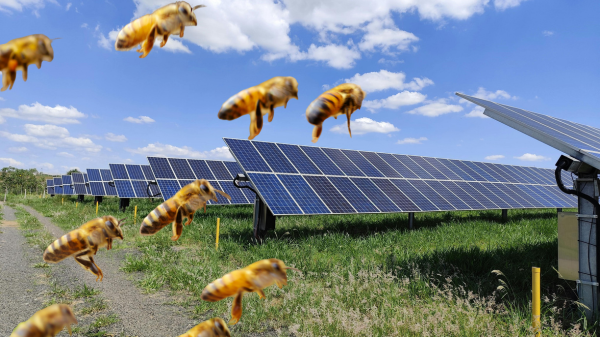
A team of French researchers examined the biodiversity around and under 20 industrial solar facilities in two separate regions of France. They found the composition of plants beneath the panels changed from the previously existing conditions.
Grasses grew, and in many locations livestock, goats, and sheep were used a natural means of preventing the plant life from getting too high and compromising the solar facilities’ energy production.
Irrespective of soil and relative climate conditions, the research team found pollinator activity was suppressed dramatically beneath solar panels when compared to the surrounding area and in rows between solar arrays:
- the number of pollinators in areas covered by solar panels dropped by 76 percent, and
- solar panels reduced the number of plant-pollinator interactions by 86 percent.
It seems that grazing made the problem even worse, meaning labor-intensive mowing would probably produce better conditions for pollinators.
The researchers found pollinators tend to avoid areas with lower temperatures and more shade, avoiding plants grown in the “microclimates” created by and beneath solar panels. The panels themselves suppress biodiversity because the flowering plants preferred by pollinators such as bees and butterflies typically flourish in sunlight, not the shade created beneath solar panels.
Other factors, yet to be fully explored, may also be at play in explaining depressed pollinator numbers and pollinating activity beneath solar arrays. Solar facilities disrupt habitat, resulting in fragmentation of populations as native wildlife is cleared to make way for them. Also, the panels block pollinator activity by restricting freedom of movement, a problem that may be especially acute for bats. In addition, moisture levels beneath solar panels are lower than in the surrounding area, so the flowering plants that do grow beneath the panels are stunted compared to the same species outside the array, and as a result probably produce less of the pollen and nectar needed by pollinators.
In short, if an apocalypse of bees, butterflies, hummingbirds, bats, and other pollinators is in the offing, climate change is not its source. Instead, the rapid expansion of industrial solar facilities poses the real threat. After all, as solar advocates regularly crow, solar power is the fastest-growing electric power sector, with new solar arrays covering hundreds, thousands, or tens of thousands of acres every day and year around the globe. That’s a lot of pollinator habitat being destroyed.
Sources: Epoch Times; BGR; Biological Conservation