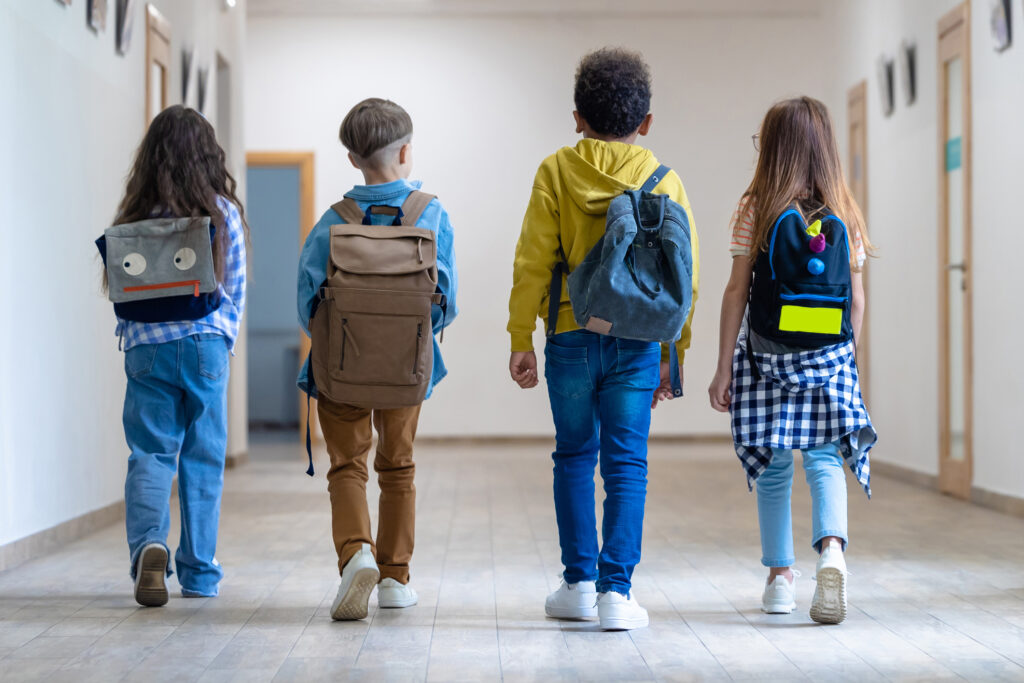
Born in 1947, I was a baby boomer and fortunate to grow up in the 1950s. I was raised in a traditional two-parent home in Queens, a residential part of New York City. I could walk out the front door of my garden apartment and be surrounded by many boys my age. I had a typical childhood for that time, playing football without a helmet, wrestling with friends, and staying out without parental supervision until it grew dark. In school, I learned the ABCs, the 1, 2, 3s, and unbiased American history.
But now, times have changed significantly for the worse—for both parenting and public schools.
These days, helicopter parenting is the norm. Mothers and fathers have become overprotective and overinvolved, often micromanaging every aspect of their children’s lives. While the smothering may be rooted in love, this hypervigilance severely hinders kids’ development, and government snoops often get involved.
In fact, things have become downright bizarre. According to a new Institute for Family Studies survey, an astonishing 58 percent of 6-year-olds aren’t allowed to play unsupervised in their own yards. Additionally, more than 50 percent of 14-year-olds don’t have permission to leave their own streets without an adult present.
Lenore Skenazy, an activist who advocates for free-range parenting and has been battling this mentality for years, is a true culture warrior. She recently shared a story that exemplifies the new normal.
“Being allowed to walk home from the park is not neglect. And yet, in 2015, Rafi Meitiv, then 10, and his younger sister, 6, were doing just that. Child Protective Services was summoned to the Meitiv home.”
Now 21 and a college senior, Rafi describes what happened. “They threatened multiple times to take us away. They thought that my parents were dangerous and we’d be better off someplace else.”
He thought he’d never see his parents again.
Rafi’s mother, Danielle Meitiv, had read Skenazy’s book, Free-Range Kids, and, as she does to this day, believes that parents deserve to “let their children have their freedom, and it’s developmentally important.”
Thankfully, the Meitivs were ultimately cleared of any wrongdoing.
In a recent Wall Street Journal op-ed, former U.S. Sen. Ben Sasse further details the problem. He writes that at age 11, 25 percent of children aren’t permitted to leave their homes without adult supervision.
Sasse further notes that for children trapped in America’s industrialized school system, too much of life is defined by passivity. Adolescence should be an exciting coming-of-age period, a gradual transition into adulthood. If we don’t give teenagers more responsibility, we’re failing to prepare them for the world they’ll soon lead. “Rather than introducing children to the world in an age-appropriate manner, we’re preventing them from developing imagination, resilience, and grit.”
While many kids are allowed to navigate the dark corners of the internet on their own, they are bizarrely prohibited from exploring their own neighborhoods. This overprotection, however well-meaning, “prevents children from learning valuable lessons like overcoming boredom, conquering fear, and taking risks.”
And now the federal government has entered the fray—this time in a positive way.
The Promoting Childhood Independence and Resilience Act, a bill introduced in May by Utah Rep. Blake Moore, would require states to clarify that ordinary childhood activities, such as playing outside or even staying home alone for a while, are beneficial for kids and do not constitute neglect.
At the same time that parenting has taken a bad turn, many schools have strayed far from their mission over the past several years, shifting from teaching basic skills to indoctrinating students with wacky, New Age, and Marxist claptrap that will not prepare them to be productive citizens.
Although reliable statistics on the prevalence of school-based, politically driven schemes are lacking, they appear to be reasonably common. “Equitable Math Instruction” is still widely used and continues to shape many states’ standards. Specifically, A pathway to Equitable Math Instruction, a controversial toolkit, has sparked significant debate since its implementation.
This radical drivel claims that addressing student errors, emphasizing getting the right answer, and requiring students to show their work constitute a form of white supremacy. Objectivity, you see, is now racist.
Social-emotional learning (SEL) remains in use and is utilized by an estimated 83 percent of K-12 schools. However, it has become highly politicized, with several states pushing back or banning specific programs due to concerns about overstepping into personal beliefs.
Then there is so-called restorative justice, which emphasizes “making the victim and offender whole” and involves “an open discussion of feelings.” This nonsense arose because black students are far more likely to be suspended than students in other ethnic groups. The suggestion here, of course, is that white teachers and administrators tend to be racist. But the racial bean counters never explain why the racial disparity persists even in schools where black principals and staff predominate.
Additionally, various sex-related themes persist in many schools.
A good example is California, where AB 1955 was enacted in July 2024. This outrageous legislation bars school districts from requiring staff to notify parents if a student decides to change their gender. (At this time, the law’s legality is being debated in court.)
In a similar vein, the San Francisco school district has determined that teachers don’t need to notify parents before teaching lessons on gender identity.
In America’s heartland, the Turner School District in Kansas City, Kansas, allowed a 4-year-old preschooler to take home Jacobs New Dress, a picture book in which “a little boy wears girls’ clothes and even competes with his friend Emily to be a princess.” (It’s no secret that LGBTQ groups are pushing gender-identity dogma on schoolchildren nationwide, and the government is often complicit.)
Children are the future of America. Unless we change course, the country’s future is imperiled. Parents must return to traditional parenting and stop constantly surveilling their children. Schools need to return to teaching the basics and abandon the harmful fads that have gained steam in recent years. And we must do so post haste.

Larry Sand is former president of the California Teachers Empowerment Network.