How to Achieve a Radical, Lasting Reduction in Federal Spending
Is the Fed Pushing the Economy in the Wrong Direction?
Regular readers of this newsletter will know my position on interest rates: they are too high now, not too low. That is certainly a minority opinion, and the Federal Reserve (Fed) made it clear that they think otherwise last Wednesday when the Federal Open Market Committee (FOMC) announced a 25-basis-point increase in the federal funds rate. The new target range is 3.75 to 4.0 percent. The vote for the rise was unanimous.
The FOMC is satisfied that the economy is doing well, and their interest rate decision reflects a concern that an expansion of economic activity will spark inflation. I do not believe that economic activity causes inflation. I believe the very opposite is true.
Markets had already priced in the rate increase, as the Fed’s decision was almost universally anticipated. What they had not priced in was the notion that the Fed was inclined to impose another rate increase later this year.
New Fed Chair Kevin Warsh passed the conventional-wisdom credibility test by presiding over the rate increase and showing openness to another.
“Kevin Warsh is an inflation hawk,” the Wall Street Journal editorial board stated in the headline of its Wednesday editorial after the Fed announcement. “Mr. Warsh is the most hawkish chairman since Paul Volcker, with a long record in our pages and elsewhere of explaining his views,” the editorial board stated.
Warsh has argued strongly that the Fed should follow the data in making its monetary policy decisions, and he is perfectly right about that.
The data, Warsh and the WSJ board agree, shows that inflation is on the rise:
Mr. Warsh was clear at his wonderfully brief press conference that the inflation evidence has moved in the wrong direction. The main inflation indicators are still higher than 3% after five years above the Fed’s 2% inflation target. Mr. Warsh also cited rising commodity prices as an important price signal, a welcome note not heard at the Fed since its glory days of the 1990s. He is paying attention to prices in the real economy.
The WSJ editors have been pressing for multiple interest-rate increases and were certainly happy to hear Warsh imply that the Fed would probably impose another rate hike before year’s end, as the paper reported in its story on the Fed chair’s press conference:
[Warsh] hinted that Wednesday’s move was merely the first step in a larger anti-inflation campaign, which—along with projections from other officials of more increases later this year—markets have interpreted as a sign of higher rates to come.
“Today’s action starts to show we’re serious about this, and we will deliver on the price-stability objective,” Warsh said. “And as the statement said, we’ll do it on a timelier basis.[”]
The WSJ editorial heaped special praise on Warsh for his oft-repeated statement that the Fed is completely responsible for inflation:
An important element on display at this meeting and in Mr. Warsh’s speech last month at Jackson Hole, Wyo., is his conviction that inflation is always the Fed’s problem. His Fed is less likely to cling to excuses such as supply-chain shocks as reasons to “look through” inflation above its 2% target. Wednesday’s rate increase is consistent with this view.
That is an honest position on Warsh’s part, and it is quite honorable of him to accept that responsibility so forthrightly. Few Fed chairs have been so candid about that.
However, the claim (or implication) that the Fed is solely responsible for inflation is false.
Federal fiscal policy is the main driver of inflation. When the federal government runs big deficits, the Fed inflates the money supply because it has a terrible Hobson’s choice between inflation and recession. Once the inflation becomes embarrassing, the Fed reluctantly raises interest rates and may reduce its asset stock to decrease the money supply, as it did after Congress and President Joe Biden raised spending radically and ballooned the deficit in 2021 and 2022 (with no Republican votes in favor, as it happens).
Inflation is a general rise in prices across all economic activities, and it can be very hard to measure. There is much interpretation involved, given that there are innumerable goods, services, commodities, properties, equities, bonds, inventories, and other things of value that have prices on them. A rise in consumer prices, for example, could be the result of a shift in the distribution of desirability among these categories, not a general price rise caused by excessive money-creation.
This is why it is crucial that analysts and the central bank recognize that “the inflation evidence” is a highly complex and expansive profusion of information and that the “main inflation indicators” might not be all we need to know, to use the Wall Street Journal editors’ words.
With that in mind, several highly insightful economists spoke up before the Fed’s interest rate announcement to argue the evidence does not indicate inflation is accelerating or in danger of doing so.
Writing at his Substack, The Central Banks’ Watcher, just before the Fed’s announcement, economist and former Federal Reserve Bank of New York Research Advisor Gianluca Benigno cogently argued that the present and recent increases in consumer and producer prices do not point decisively toward excessive monetary expansion. They reflect a temporary increase in oil prices caused by the Iran conflict, Benigno writes:
Renewed pressure on energy prices coming from the Middle East conflict complicates the inflation outlook. Markets are pricing in an almost certain hike. The inflation data, in my opinion, are not as clear-cut.
Benigno presents multiple data points that contradict the conventional wisdom that inflation is on a strong upward trajectory that requires central bank monetary tightening. Here are some of the key elements he cites (emphases in original):
Themonth-on-month reading of core CPI was key in the market repricing. The expectation was for a 0.2% versus a 0.3% print. Interestingly, as I learned following the release, one item, wireless telephone services, rose by 5.9% on the month, contributing about 0.1pp to the core reading.
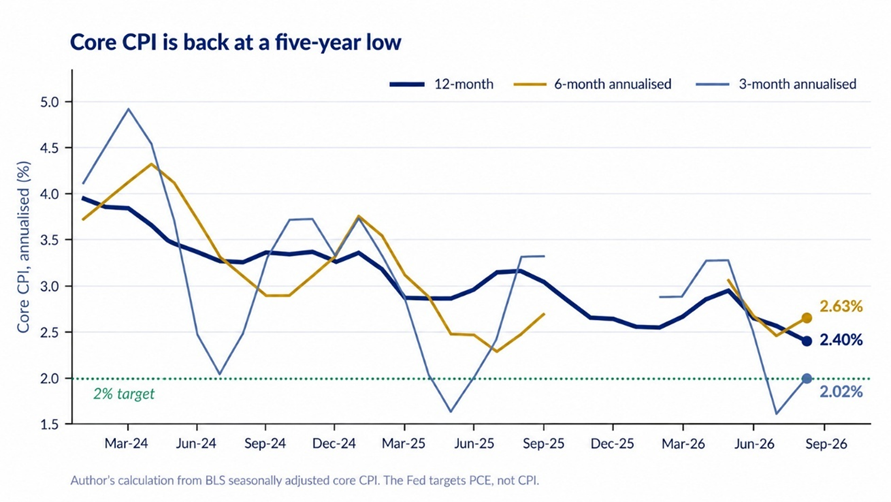
Core CPI printed at 2.4% year-on-year, the lowest reading since March 2021, and is at 2.02% annualised over the last three months. The headline at 3.4% is largely driven by direct energy components.
Producer prices were not benign: the Stage 1–Stage 4 gap widened to 4.5pp, a hawkish signal. But the cascade signal has not been activated, and core final demand is high at 4.7% year-on-year, though no longer rising. …
Hormuz transit stress remains elevated, signalling effective closure of traffic. On the other hand, the Global Supply Chain Pressure Index, while still high, has halved from its April peak, suggesting that supply chains have rerouted around the shock rather than transmitting it, for now.
The oversized effect of the increase in cell phone service prices is very interesting, as it pushed up the CPI though it is obviously not a result of generalized inflation:
Friday’s August CPI showed core rising 0.3% on the month against 0.2% expected. That tenth of a percentage point took pricing from 72% to 87%, and on to 93.5% by Monday.
The main driver of that one tenth was wireless telephone services, rising 5.9% on the month in August—a record monthly jump. Economists at Bank of America, Barclays and Pantheon attribute the move to plan changes and legacy-plan retirements at AT&T and T-Mobile.
That is a carrier pricing decision. It is not a demand signal, it is not a regulated price, and it is not evidence of broadening inflation. It is fair to note, though, that the larger increase in market pricing was led by energy and the wider inflation-risk narrative.
Meanwhile, Core CPI “is back at a five-year low,” Benigno writes:
Core CPI fell to 2.4% year-on-year, from 2.5%. This is the lowest since March 2021, after more than five years continuously above that level. Annualised over three months, it is running at 2.02%; over six, 2.63%.
That chart does not look anything like an accelerating rise in consumer prices that requires urgent central bank intervention to avert runaway inflation.
If consumer prices are rising because of an oil shortage caused by war, as is obviously the case at present, monetary policy is not the problem and will not be the solution. The Fed’s preferred indicator, the PCE, differs from the CPI and should not be assumed to be the deciding factor when the difference may very well be an artifact of data choices and weights, Benigno writes:
Headline [inflation] is a different story: 3.4%, with gasoline up 3.9% on the month and energy up 16.3% on the year. The divergence signals the direct energy price effect. While I run the analysis on CPI here, the Fed targets PCE, not CPI, and core PCE is running closer to 3%. This wedge has been persistent recently, reflecting differences in weights and coverage between the two indices, including several components treated differently in PCE. Whatever else one concludes about the need for another hike, the CPI data do not describe a renewed broad-based inflation acceleration.
It’s an excellent article with much more to it than what I can include here, and I recommend it highly.
Several days earlier, economist John H. Cochrane of the Hoover Institution suggested that the Fed should lower interest rates instead of raising them. Writing at his “The Grumpy Economist” Substack, Cochrane posed the question that almost no one is asking:
Is there a coherent story in which the Fed should lower interest rates now? Even more, is there a story in which the Treasury should deliberately shorten the maturity structure and then the Fed lowering interest rates reduces inflation?
There is.
Cochrane makes the case for the central importance of fiscal policy in the inflation story:
What happens if the Fed raises or lowers interest rates and fiscal policy does not change? Italics, as that is the important and usually overlooked part of the question. Most models and authors presume that if the Fed raises interest rates, Congress raises tax revenue or cuts spending to pay the added interest costs on the debt. And that usually happens. We ask now, what can the Fed do all by itself?
Not much, Cochrane observes. Although “[h]igher interest rates lower inflation, and with a lag[,] not just an instant downward jump,” those higher interest rates “eventually raise inflation,” Cochrane notes. As a result, interest rate increases by the central bank on their own make inflation worse over the long haul:
Without tighter fiscal policy, monetary policy can only rearrange inflation, buying less inflation now by more inflation later. Unless fiscal policy finally gets around to solving its deficit problem. Along the way, higher interest costs on the debt add to the fiscal pressure for inflation.
Working with economic models, Cochrane shows that the conventional thinking on interest rates is a product of short-term thinking:
In the short run you get the conventional story: lower interest rates raise inflation and boost output. However, that turns around in the long run. Lower interest rates eventually lower inflation. Rather than focus on the short run with the long run as an unfortunate consequence, maybe we should focus on the long run with the short run as a difficulty to overcome.
Of course, interest rates affect the cost of the federal debt, and lower interest rates decrease “the fiscal pressure” the debt creates, Cochrane notes. To create a situation in which lowering interest rates decreases inflation in both the short and long terms, the national government should replace long-term debt with short-term debt, Cochrane found:
In sum, in this model, the best I know of to address this sort of question, the government should first drastically shorten the maturity structure of debt, and then lower interest rates persistently. Inflation will come down directly.
Buying back all the long-term debt at low prices and then disinflating also makes a lot of money for taxpayers. It has all the benefits in reverse of the policy I was arguing for in the 2010s, rolling all the debt into long-term bonds to lock in low rates.
This would explain why the Treasury Department has been shifting from long-term debt to shorter-duration maturities lately. “Maybe [Treasury Secretary Scott] Bessent and Warsh are cleverly working together!” Cochrane writes, probably only half-jokingly. The Fed’s interest rate increase fights against this process, however.
Cochrane does not yet feel confident endorsing the conclusion of his debt-shortening model, though he confirms that he believes it and notes that he has no model that contradicts it. Economists, central bankers, and policymakers should exercise caution in applying economic models to real life, though using models that have been disproven or radically undermined is even worse. Cochrane summarizes his thoughts on all this as follows:
Two things I know for sure: Nobody else really knows. And the standard view of a mechanistic relationship between inflation and interest rates is wrong. Any power of higher rates to lower inflation is fleeting and contingent. Contingent on just what is an interesting question. It is a lot more possible that this model is right than you might have thought.
Turning to the current monetary policy question, Cochrane cites two other economists who have done innovative, contrarian research into the relationship between interest rates and inflation:
Both are, like myself, attuned to today’s crucial question, what can the Fed do without a change in fiscal policy, under the gun of large debt and deficits, in the face of a skittish bond market?
Bigio writes that “raising rates without any commitment from the Treasury to restrain deficits cannot resolve anything,” Cochrane notes. With that in mind, Bigio recommends reversing the central bank’s traditional approach: “The Fed should do quite the opposite: lower rates and front-load inflation into the present.”
If there would indeed be any additional inflation in the present, as Cochrane observes. The government might well be able to avert that by reworking the maturity rates of its debt.
What all this indicates is that the push for higher interest rates to stanch inflation may be completely misguided. The Fed’s past performance on hitting its interest rate targets does not inspire confidence that the central bank is operating on valid premises.
The critical questions are whether the recent inflation numbers suggest that the money supply is too big and whether raising interest rates reduces inflation. It seems to me that the Fed is wrong on both of these.
The Fed’s interest rate decisions should be based on the value of the dollar, specifically whether it is falling or rising. Increases in oil prices caused by outside events do not indicate that the value of the dollar is falling, only that an extremely important commodity has become scarce. Rising oil prices caused by international conflict are not a valid reason for raising interest rates, unless your goal is to suppress the economy at the very time when it is under stress by outside events.
On top of all that, raising interest rates may do the opposite of what the central bank intends.
The debate surrounding AI and whether or not (or even how) its development should be regulated is definitely heating up, with a flurry of mostly-Democrats coming out in favor of forcing a development slowdown in order to supposedly prevent a looming AI-apocalypse. Why are leaders from Anthropic saying they agree? Legitimate conspiracy and conspiracy theories abound, and the panel will discuss WHY this is happening, who might be responsible, and what the free market solution is.
New claims for unemployment benefits came in well below expectations in the most recent week of data, the Labor Department reported on Thursday. New jobless claims declined to 196,000, down from 206,000 in the previous week and were the least since the middle of July.
Consensus opinion had predicted jobless claims would rise by 1,500. The reported number was 11,500 better than that, marking a strong reduction in job losses.
The sturdy job market suggests a distinctly positive direction in the economy, especially in light of the current high interest rates and oil prices that are fighting against economic expansion.
It appears that recent changes in federal government policy have shored up the foundations of the economy. The tax cuts in last year’s One Big Beautiful Bill Act and the ongoing deregulation by the Trump administration are the most unequivocally positive factors, in my view.
How to Achieve a Radical, Lasting Reduction in Federal Spending
In last week’s edition of this newsletter, I argued that Congress could engage with President Trump to make his proposed $5,000 “dividend” payment for each adult U.S. citizen an opportunity to achieve lasting spending cuts that have been for decades simply impossible even to contemplate because of political headwinds.
In an article on Friday at Blaze Media, I laid out the specifics of the plan. My suggestion is this: agree with the president to pass a one-time tax cut of $5,000 for the 2027 fiscal year, paired with a permanent spending cap set at the 2019, pre-Covid level, and mandatory 2 percent additional reductions in the spending cap each year through 2040.
The tax cut would be payable immediately upon enactment and designated as refundable to all U.S. households that file a personal income tax return (whether they pay any income tax or not), thus fulfilling Trump’s promise.
Republicans would make a simple deal with the American people: $5,000 today for every adult citizen, in trade for serious, desperately needed cuts in federal spending beginning in the next fiscal year and continuing through the next decade. Any congressional Democrats who want to do the right thing will be welcome to vote for it as well, of course.
For practical reasons, the spending cuts would have to begin with the 2028 fiscal year in October 2027, but the 2 percent annual spending cuts thereafter would easily offset the increased interest costs on the additional federal debt that the delay would create.
Here is the key element of the plan: to implement the cuts, Congress would convert the federal portion of spending on Medicaid, SNAP, housing programs, higher education, and the like into block grants to the states, with the expenditures immediately scaled down to the 2109 level. (States could make up the difference if they wanted to.) The legislation would institute 5 percent annual reductions in those block grants for subsequent years through 2040, essentially phasing them out of the federal fisc.
The move to block grants with annual downsizing would steadily transfer responsibility for welfare spending to the states, where it belongs. It’s not in the Constitution, and the Supreme Court should never have allowed Congress to establish those programs.
These welfare programs account for about 24 percent of the $7 trillion-plus federal budget, around $1.7 trillion. In 2019 they comprised about $1 trillion. A return to that number would pay off a $1.2 trillion refundable one-year tax cut in less than two years, with a dozen years of vastly (and blissfully) lower federal spending on the way.
If a 40 percent cut in spending on federal welfare programs sounds draconian and cruel, remember that the 2019 spending level was far from stingy. We needed cuts then, and we need them much more badly now, even without Trump’s dividend payments. Investigations during President Trump’s current term suggest that elimination of entitlement fraud could lead to even greater cuts than what this plan would call for.
Though inflation has raised prices of goods significantly since 2020, the simultaneous sharp increase in entitlement fraud has drained money from the system, suggesting that the 2019 allocations should be enough to take care of the truly needy.
Congress should also consider cutting defense spending to provide further spending reductions.
In short, this is a temporary tax cut and permanent spending cuts—the very opposite of the way things are ordinarily done in Washington, D.C. The unique opportunity here is the political goodwill and appealing trade-off the $5,000 dividend checks would provide.
The only ways to reverse the spending cuts would be through legislation signed by the president or via a veto override. Trump would have every reason to refuse any attempt by Congress to restore the spending, especially given his track record of trying to implement limits on entitlement programs through executive orders. The same would be true for any Republican successors.
Moreover, the transfer of welfare responsibility to the states would eliminate congressional spending junkies’ ability to use these programs as a slush fund for buying votes. In addition, the money simply will not be there, given the rising cost of Social Security and Medicare.
This plan would allow Congress fiscal breathing space to develop a plan to transition Social Security and Medicare to private taxpayer accounts and transfer future responsibilities for those programs to the states. Social Security and Medicare are just as unconstitutional as the other entitlements, with the important difference that these were funded by people’s paychecks with the direct promise of repayment, a pledge the government must keep for current and prospective retirees while moving the future responsibility to the states.
The American people would be relieved to know that major Social Security cuts are off the table.
The plan should also make permanent all of Trump’s executive orders that have reduced federal regulations—and add further regulatory relief.
The large, one-year tax cut would spark an economic boom. The spending cuts would push down interest rates by greatly reducing the federal deficit and thereby raising the assurance that the federal government will be able to pay its debts, thus increasing the value of Treasury bonds and lowering interest costs.
This would reduce interest rates for all Americans, including for mortgages. That would help relieve the housing affordability problem.
The entitlement cuts would also put able-bodied people back to work and make them taxpayers instead of tax takers, raising revenues and cutting costs further. That would spur even more economic growth.
These would be impressive achievements. A political party that instituted this plan could create a permanent majority despite the inevitable mistreatment by the media and the opposition party, while returning the nation to constitutional rule. Most people dislike the current overspending, recognizing that far too much of it goes to cheaters, grifters, and government cronies.
For the good of the American people, Trump and the congressional Republicans should prepare legislation to implement this full plan in the lame-duck session, immediately after the election, regardless of whether they win House and Senate majorities this fall. They would be giving the American people a great gift of economic prosperity and better government, and the opposition party would not be able to reverse any of it, with a Republican president holding veto power.
‘The CSDDD is the greatest threat to America’s sovereignty since the fall of the Soviet Union.’
Contact Us
The Heartland Institute 1933 North Meacham Road, Suite 559 Schaumburg, IL 60173 p: 312/377-4000 f: 312/277-4122 e: [email protected] Website: Heartland.org