Jackdaw approval exposes contradictions in government energy policy as industry warns that uncertainty, punitive taxation, and political interference are threatening billions in investment and thousands of British jobs
LONDON (October 21, 2026) – Heartland UK/Europe has accused Prime Minister Andy Burnham’s government of delivering too little, too late following today’s approval of the Jackdaw gas field, warning that years of treating North Sea energy as a political football have undermined investor confidence and jeopardised Britain’s energy security.
The decision allows production to begin at Jackdaw, operated by Adura, the Shell-Equinor joint venture, with gas expected to reach British homes and businesses before the end of October.
According to the Department for Energy Security and Net Zero, Jackdaw is expected to increase UK domestic gas production by approximately 6 percent at peak output, contribute an estimated £2.9 billion to the British economy, and operate for up to 11 years.
The developer estimates that the project will create 27 new direct jobs and safeguard 273 existing positions.
Lois Perry, Director of Heartland UK/Europe, said:
“Andy Burnham has finally woken up to the reality that Britain needs British oil and gas. But this is too little, too late for an industry that has endured years of political hostility, regulatory paralysis and economic uncertainty.
“The North Sea has been subjected to political schizophrenia. One government encourages investment, another threatens its existence, and ministers simultaneously condemn fossil fuels while celebrating the jobs and revenues they provide.
“This endless political football has made the industry so nervous that investors cannot confidently plan for the future. Nobody commits billions of pounds to projects when the rules can change with every political headline.”
Britain’s £36.7 Billion Offshore Industry at Risk
The economic stakes extend far beyond a single gas field.
Offshore Energies UK’s September 2026 Economic Report estimates that Britain’s offshore energy industry:
- Supports approximately 245,000 jobs across the United Kingdom.
- Generates £36.7 billion annually in gross value added.
- Has a potential pipeline exceeding £105 billion in offshore energy projects over the coming decade.
- Faces mounting investment uncertainty caused by fiscal and regulatory pressures.
The organisation also reports that the UK imported more than 40 percent of its energy in 2025, while domestic oil and gas production has fallen approximately 40 percent over the past five years.
Perry continued:
“We are watching a strategically important British industry being slowly suffocated by contradictory policies.
“Britain possesses extraordinary offshore expertise, infrastructure and natural resources, yet politicians appear determined to make domestic production commercially unattractive.
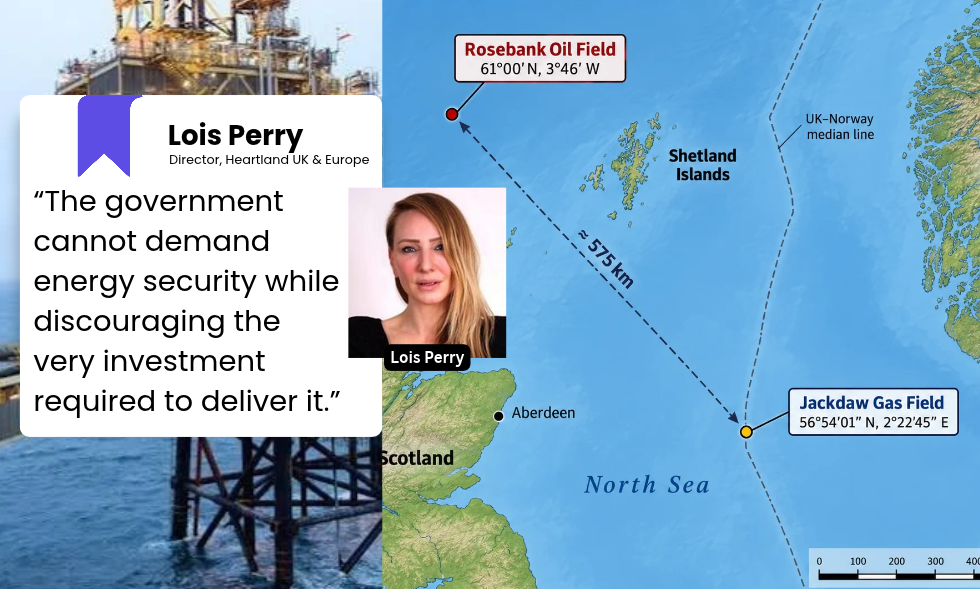
“The government cannot demand energy security while discouraging the very investment required to deliver it.”
Will Jackdaw Cut British Energy Bills?
Energy Secretary Miatta Fahnbulleh has acknowledged that approving Jackdaw will not directly reduce household energy bills because British gas prices are determined largely by international markets.
However, The Heartland Institute argues that focusing exclusively on immediate consumer prices ignores the wider economic benefits of domestic production.
Industry analysis cited by The Wall Street Journal suggests Jackdaw could supply gas equivalent to the heating needs of approximately 1.4 million homes and generate around £1.5 billion in tax revenue over its lifetime.
Perry said:
“Of course, one gas field will not suddenly halve household energy bills. But producing more of our own energy strengthens supply security, supports British employment and generates revenue for the Treasury.
“Britain cannot control global gas prices, but it can control whether it encourages domestic production or drives investment overseas.
“Families struggling with energy costs deserve serious economic policy, not ideological slogans.”
Rosebank And the Future of the North Sea
The government’s next major test will be the Rosebank oil field, which remains subject to a separate approval decision.
According to the House of Commons Library, North Sea oil and gas production has declined by more than 70 percent since its 1999 peak, with Britain a net importer of gas since 2004.
Perry concluded:
“Approving Jackdaw while maintaining hostility towards future exploration is not a coherent energy strategy. Andy Burnham must decide whether he wants a thriving British energy industry or continued managed decline.
“The North Sea is not a political football. It is a national economic asset, and Britain’s workers, businesses and households deserve better than this government’s contradictory approach.”
About Heartland UK/Europe:
Heartland UK/Europe promotes free-market solutions, economic freedom, affordable energy and evidence-based public policy. The Heartland Institute, a free-market think tank founded in the United States in 1984, and started Heartland UK/Europe in 2024.
###

Lois Perry is the Director of Heartland UK/Europe. She is a former leader of the UK Independence Party (UKIP) and the founder of Car26, an organization opposed to Great Britain’s headlong direction of Net Zero by 2030. Ms. Perry joined The Heartland Institute as the Director of Heartland UK/Europe in 2024.