IN THIS ISSUE:
- Major Nature Study Retracted After RCP8.5 Debunking
- Warmer Climate Is Resulting in Fewer Deaths, Studies Say
- Biden’s EV School Bus Boondoggle: High Costs, Poor Results
Major Nature Study Retracted After RCP8.5 Debunking
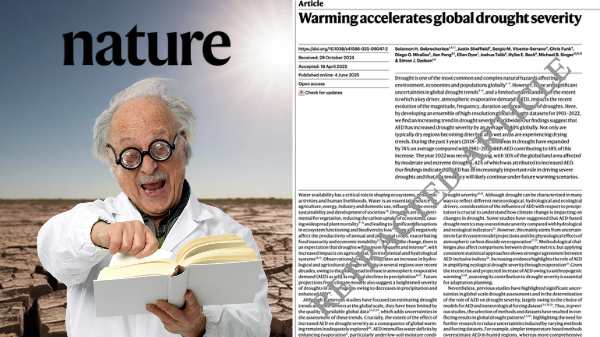
A major research paper that claimed to provide proof climate change was causing more-severe and -frequent droughts has been withdrawn by its publisher, the peer-reviewed journal Nature.
Nature published the study, “Warming accelerates global drought severity,” in June 2025. The authors claimed to find droughts on Earth have become more severe and intense since 1981. They stated specifically that climate change had made the atmosphere “thirst[ier],” resulting in droughts from 2018 to 2022 that were 40 percent more severe than in the 37 years prior, with the area affected by drought increasing by 74 percent, 58 percent of which they blamed on the increased “thirst of the atmosphere” they attributed to human-caused climate change.
In addition to receiving widespread media coverage, the paper was cited 337 times in other studies referencing climate change causing greater drought, in just over a year, by the time the report’s authors had to retract it.
Critics of the study pointed out significant errors in the data and calculations used in the study. Nature’s retraction notice acknowledges these and other errors:
The authors have retracted this article after being notified of errors in the paper and independently identifying further issues. First, area-weighted grid cells were not used when calculating study-wide averages, an error that affected numerical values in the main text, Fig. 1b, and Extended Data Figs. 4 and 8. Second, results based on GLEAM v3 instead of GLEAM4 were inadvertently used in Extended Data Fig. 4: the two datasets are largely consistent for 1981–2021, but the area weighting based on GLEAM4 resulted in a reduced drought-affected area in 2022. Third, the underlying code included a timestepping error in the computation of regional drought-affected areas, meaning that dates were not properly parsed when subsetting the data for the 1981–2017 and 2018–2022 periods. This misclassification of time steps affected the regional averages in Extended Data Fig. 8h. Finally, it was not clearly explained how masking was applied in calculations. … Although the authors are willing to correct and clarify the above matters, given the scope of the necessary corrections and the need for additional revision and peer review, the authors have decided to retract the paper and to resubmit a fully revised and corrected version for peer review. All authors agree with the retraction.
The retraction came none too soon: just nine days later, Nature published a new study that found just the opposite. The new study’s title speaks for itself: “Global drought shows no detectable recent acceleration under climate warming.” That paper shows a common method for calculating water evaporation used in estimating drought artificially inflates evapotranspiration used to calculate the Standardized Precipitation Evapotranspiration Index, resulting in drying trends at least six times stronger than is warranted when measuring drought severity, frequency, and duration.
“We find no significant acceleration of drought trends across ~99% of quasi-global land area under either PET type,” write the authors of that paper. “This finding remains robust across centennial timescales (1901– or 1950–2024).”
The second paper has yet to receive the widespread coverage the now-withdrawn paper got. Evidently the finding of no climate-change drought disaster doesn’t make for good headlines or riveting copy. It will be interesting to see how many scholarly, peer-reviewed studies will cite the second paper and its findings that there has been no climate-change-induced changes to drought trends. My suspicion is that the result will be well south of the 337 citations the now-debunked paper received in its first year.
This paper is a microcosm of a key problem in climate science research. We are constantly told—inaccurately once proper context is applied—that 97 percent of scientists agree humans are causing dangerous climate change. This is the so-called consensus. This figure is based on rapid, cursory literature reviews: a simple counting of published papers that don’t explicitly reject that claim. Leaving aside the fact that most of the papers cited as supporting the 97 percent consensus position never explicitly endorse it or even talk about climate change, and that authors cited as supporting the position have said their research explicitly rejects or at least questions one of more aspects of the claim, an important question remains: How many of the peer-reviewed papers that actually support the consensus view are based on or are themselves bad research? How many of those papers developed or used research that is faulty, flawed, or in error, yet received the gold-standard sanction of peer review?
As noted in a recent paper by independent researcher Jane Shaw Stroup, in recent years there has been a “surge in scientific paper retractions [that] exposes flaws in peer review, rising paper mills, and growing concerns about bias, error detection, and research integrity.”
“[T]housands of scientific papers have been retracted over the past decade, far more than in the past,” Stroup writes. “Ivan Oransky, co-founder of Retraction Watch, told an audience that in 2023 alone, there were 13,000 retractions!”
Of course, those are only the papers that have been discovered to be in error and retracted. One must wonder how many papers have false premises, conclusions, data, or calculations that remain undiscovered and have not been withdrawn.
In climate science alone, there is a huge problem with research citing the thoroughly and now officially discredited RCP8.5 and SSP5-8.5 climate model scenarios. As I noted in CCW 584, the Representative Concentration Pathway 8.5 (RCP8.5)—the high-emissions climate-model scenario—dominated climate research and policy and was treated as the “business-as-usual” pathway until the U.N. Intergovernmental Panel on Climate Change officially retired it in April 2026, despite its extreme implausibility, nay impossibility, being obvious for more than a decade.
Google Scholar has counted approximately 105,000 papers referencing, mentioning, or citing RCP8.5 and its successor, SSP5-8.5. A literature deep-dive by Roger Pielke Jr., Ph.D., and Justin Ritchie, Ph.D., estimated roughly 16,800 scientific papers published between 2010 and 2020 explicitly utilized the RCP8.5 scenario, with about 4,500 of those incorrectly or directly linking it to a “business-as-usual” trajectory.
I haven’t seen a flood of these papers being withdrawn, though it is likely many of them should be repudiated because the underlying climate model scenarios they relied upon or that served as a basis for their climate change claims is in error, as the results that flow from its use are unsupported. At the very minimum, thousands of papers relying on RCP8.5 or SSP5-8.5 should be reopened for review, questions, and/or revisions.
Don’t hold your breath!
In the end, the academic, industrial, financial, and political grifters who have benefitted in one way or another from the climate hoax are going to keep on citing the alleged consensus that a fossil-fuel-induced disaster is in the offing absent wholesale changes to the world economy, while the scientific ground beneath their claims (always shaky at best) seismically shifts. Data and evidence don’t sway those captured by a narrative that puts money in their pockets or prestige and power in their hands.
Sources: No Tricks Zone; Science Files; Nature; Nature

Warmer Climate Is Resulting in Fewer Deaths, Studies Say
Two recent studies confirm the findings of previous large-scale studies that have consistently shown cold weather causes more deaths than hot weather and that deaths attributable to temperature-related illnesses have declined as the Earth has modestly warmed.
A narrowly focused study published in the journal Public Health examined meteorological factors that influence cardiovascular emergency incidents, or heart attacks. The researchers looked at 114,830 cases of cardiac arrest across 1,584 days, reported by the Hungarian National Ambulance Service from November 2018 to December 2023, excluding the COVID-19 disruption period. They tracked these cases against various meteorological parameters on those days, such as temperature, wind speed, atmospheric pressure, humidity, and air quality. The researchers found that on the days with the most cardiac arrests, counts ran nearly one-third above normal, about 19 extra cases nationwide, and those days tended to be cold and calm. In fact, colder temperatures and lower wind speeds were consistently associated with higher cardiac arrest counts. Heart attack numbers were 18 percent lower in summer than in winter.
A second recent study, this one produced by the U.S. Congressional Budget Office (CBO), looked into the effects of changing temperatures on enrollees, and those likely to be enrolled, in Medicare. The CBO concluded ongoing modest warming will result in fewer deaths in older adults and a substantial net decline in emergency room visits and spending.
After accounting for adaptation such as expanded use of air conditioning and improved access to hydration, the CBO found cold days increase emergency department visits and spending in both the coldest and hottest regions of the United States, whereas moderate climates experience fewer hospital visits and deaths linked to temperatures.
The CBO estimated a continued slight warming would result in approximately $55 billion fewer dollars spent on temperature-related emergency room visits and about 2.5 million temperature-related deaths avoided among the Medicare population through 2075. Overall visits are likely to increase as the population ages, but spending will decline because the reasons for emergency room admissions will be less severe.
“The reduction in deaths is driven by warmer regions, which will experience fewer cold days and are projected to further adapt to hot days as their average climate gets hotter,” the CBO states. “ED visits are projected to increase even as ED spending decreases: as regions with hot climates adapt to higher temperatures, the composition of visits shifts toward lower-cost encounters.”
Sources: Just the News; Congressional Budget Office; Climate Realism

Biden’s EV School Bus Boondoggle: High Costs, Poor Results
President Joe Biden announced a “whole of government” approach to fighting climate change in a January 27, 2021 executive order. One part of that effort was the EPA’s Clean School Bus Program (CSBP), instituted in the 2021 infrastructure spending bill. Under the CSBP, the federal government would send $5 billion to local school districts over five years to get them to replace traditional diesel buses with new electric ones.
Like so many climate programs the Biden administration instituted, the CSBP has proven to be a bust, an expensive boondoggle, and a grift for electric bus manufacturers.
An audit carried out by the U.S. Environmental Protection Agency found fewer than 40 percent of the buses contracted for have been delivered, and of those that were, many have had persistent failures and breakdowns, leaving thousands of children scrambling for rides to school. The federal government has spent $2.7 billion dollars on electric school buses so far under the program.
Reporting on the EPA’s findings, the New York Post writes,
Of the 2,600 buses (and associated charging infrastructure) ordered, only 60 were propane, according to the EPA, which said “almost all” propane buses have been delivered to school districts.
The rest were EV buses.
Of those, around 1,100 have been delivered; 854 are behind schedule; and 140 will never be delivered, based on the EPA’s count, which was provided to The Post.
One electric-bus manufacturer declared bankruptcy in 2024 after pocketing $160 million in taxpayer money for EVs that were never delivered. A company that received $401 million from the CSBP program reports two-thirds of its electric buses are behind schedule for delivery to the 37 school districts that contracted for them.
Unit costs ballooned under the CSBP. The EPA pegged the average cost per bus purchased through the Biden-era program at more than $1 million, even though the average EV school bus sells for about $300,000 to $400,000. Talk about bureaucratic overhead! New diesel and propane buses typically cost less than $200,000. The difference between the costs of EV school buses and traditional buses could have been spent on other programs, including educational programs tied directly to student performance instead of ineffective green virtue signaling.
In addition to high costs and delivery delays, many of the buses that have been delivered have broken down, failing even under normal weather conditions and doing much worse in inclement weather. High costs, missed timelines for delivery, poor quality and inconsistent operation, and safety issues have resulted in approximately 33 percent of the school districts originally enrolled in the program pulling out.
In light of the persistent problems with the program, the Trump administration’s EPA has frozen the remaining funding for the CSBP while it examines other “clean” options such as natural-gas buses. Natural-gas and clean bus alternatives were supposed to make up 50 percent of the fleet deliveries, according to the law, but the Biden administration disincentivized and discouraged everything but electric buses.
“Instead of following Congress’ directives to effectively provide safe and reliable transportation for American school kids, the Biden-Harris administration rushed money out the door without enough thought or oversight,” current Environmental Protection Agency Administrator Lee Zeldin said in a statement. “This carelessness resulted in 90% of the money going to ‘buy’ electric school buses; yet over 5 years later, there are very few tangible buses to show for it.
“In essence, American taxpayer dollars vanished into thin air, and our children [46,000 by EPA estimates] were left without school buses,” Zeldin said.
Sources: New York Post; Lifezette