Life, Liberty, Property #148: The Bill of Rights and the Rise of Soft Despotism
Forward this issue to your friends and urge them to subscribe.
Read all Life, Liberty, Property articles here, and full issues here and here.
In This Issue:
The Bill of Rights and the Rise of Soft Despotism
Video of the Week: Socialists Want to Take Over Artificial Intelligence — In the Tank Podcast #539
Regulation Drives the Nation’s Housing Shortage, Study Confirms
Hot off the Presses!
‘Today’s crisis is a product of government errors, not greedy landlords, institutional investors, and so-called market failure.’
The Bill of Rights and the Rise of Soft Despotism
As the nation approaches what appears to be a rather weak and divided commemoration of the 250th anniversary of the signing of the Declaration of Independence, another important milestone has arrived to little acclaim. Today marks the 239th anniversary of the introduction of the Bill of Rights to the U.S. House of Representatives.
It should be a day of great celebration every year. The Bill of Rights is one of the most important documents in human history.
The central lesson of the Bill of Rights is Madison’s intention behind it: to ensure that the purpose and mission of the American union was to deploy all levels of government behind one goal: to protect the rights of individuals against majority tyranny. Here’s how the Bill of Rights Institute states it:
In early 1787, when Virginia Congressman James Madison was preparing for the Constitutional Convention, he wrote an essay entitled “Vices of the Political System,” detailing the flaws of the Articles of Confederation. One of the main problems with the Articles, in Madison’s view, was that tyrannical majorities in the states passed unjust laws violating the rights of numerical minorities. He had seen the oppression of religious dissenters in Virginia and became the leading advocate for the Virginia Statute for Religious Freedom. But injustice was occurring in all the states. As a result, Madison drafted the Virginia Plan, which greatly strengthened the power of the central government and laid the groundwork for the debates at the Constitutional Convention.
At the Constitutional Convention, Madison advocated for constitutional principles of separation of powers, checks and balances, bicameralism, and federalism, which would limit government and protect individual liberties. However, he lost one central feature of his plan of government—a national veto over state laws, meant to prevent majority tyranny in the states.
Now we are light-years away from the founders’ vision and Madison’s well-designed plan to implement it and protect it over the ages. Neither Madison nor anyone else, then or since, could force the American people and their governments to live within the letter and spirit of the Constitution and the common law. All that they could do was to encode their vision into the nation’s Constitution, laws, and judicial precedents, and hope for the best.
After having thus taken each individual one by one into its powerful hands, and having molded him as it pleases, the sovereign power extends its arms over the entire society; it covers the surface of society with a network of small, complicated, minute, and uniform rules, which the most original minds and the most vigorous souls cannot break through to go beyond the crowd; it does not break wills, but it softens them, bends them and directs them; it rarely forces action, but it constantly opposes your acting; it does not destroy, it prevents birth; it does not tyrannize, it hinders, it represses, it enervates, it extinguishes, it stupifies, and finally it reduces each nation to being nothing more than a flock of timid and industrious animals, of which the government is the shepherd.
I have always believed that this sort of servitude, regulated, mild and peaceful, of which I have just done the portrait, could be combined better than we imagine with some of the external forms of liberty, and that it would not be impossible for it to be established in the very shadow of the sovereignty of the people.
Tocqueville foresaw that individuals would voluntarily give up their sovereignty in a short-sighted trade for temporary economic benefits (and government largesse extracted from their neighbors). The people would give up the things that made the nation great: self-rule, protection against coercion by the majority, voluntary association, free enterprise, and, ultimately, each person’s dignity as a unique human being.
Restoring respect for the Bill of Rights and the vision of the nation’s founders is essential if we are to have any hope of rescuing the United States from the soft despotism into which the American experiment has devolved, as we hurtle toward a very hard totalitarianism.
Documents and laws will not achieve the desperately needed renewal. In our present state of decline, the only way to reverse the slide into despotism is to remove the temptation that feeds it: the ability of majorities at all levels of government to vote themselves ownership over other people’s property, liberties, and their very lives.
In a highly ironic turn of fortune, the United States is now on a path toward a resolution of sorts: a full collapse of the national government’s ability to pay for all the things that the Congress, presidents, and the courts have promised the American people over the past century and a half.
The costs of entitlements such as Social Security (1935), the Supplemental Nutrition Assistance Program (1964), Medicaid (1965), Medicare (1965), federal housing subsidies (1932 to present), and many other national bribes are already insupportable and will soon cause a doom spiral of federal debt as high interest rates and inflation tank the economy and obliterate the government’s tax base.
This is the inevitable outcome of tyranny of the majority. We have less than a half-decade to avert a fiscal collapse of the federal government and the widespread social and economic destruction that will inevitably follow. What would arise from such a cataclysm is anybody’s guess.
As history shows, the chances are very strong that what would replace our flawed yet hardy constitutional system would not look anything like what our forefathers founded in the 1700s, and that the nation our founders built on a basis of individual rights and self-government would vanish from the Earth. That is what we must confront as we approach another election season, the latest referendum on our founding values.
Bernie Sanders, in classic socialist form, is looking to nationalize AI. His argument is that human content was used to train the models, so the public should share in the profits made from that data. This will appeal to a lot of people, but getting government involved is rarely a net benefit to the public. On the other hand, some major models appear to already have an even stronger bias against organizations like The Heartland Institute than we previously realized.
Get the latest best-seller from Heartland’s Justin Haskins!
America’s economy is teetering on the edge of disaster. Hidden beneath record stock market highs and reassuring headlines lies a fragile system riddled with debt, reckless speculation, and decades of political negligence. When the next big crash strikes—and it will—the fallout could be unlike anything we have ever experienced.
Regulation Drives the Nation’s Housing Shortage, Study Confirms
Housing costs have been one of the most important drivers of the affordability crisis of 2025-2026, and perhaps the dominant one. People must live somewhere, after all, and housing takes up a large proportion of the average family’s budget: 33.4 percent in 2024, the Bureau of Labor Statistics reports.
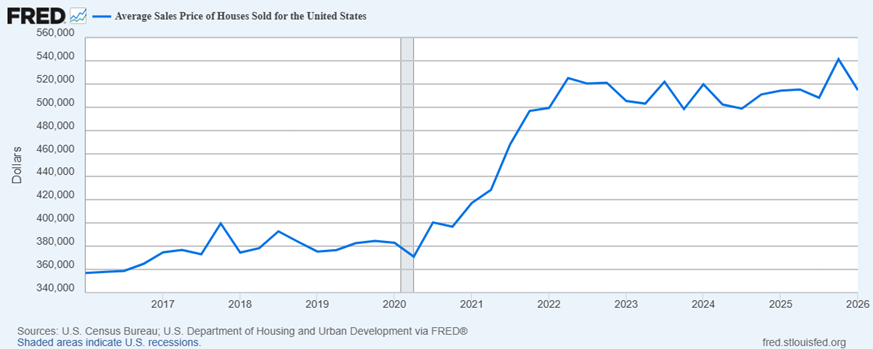
That is a huge rise from the $383,000 average price just before the pandemic—a whopping 34 percent—and it all happened in just two years: quarter two of 2020 through quarter two of 2022.
That is what created the housing crisis: a massive, wasteful, increase in federal spending. Full stop.
The crisis, however, simply exacerbated a long-term problem: many years of failure to expand the nation’s housing stock. The reason for that failure is excessive government regulation, as I indicate in my study. A new paper from the American Enterprise Institute (AEI) confirms that observation and provides strong additional evidence for it.
In their paper titled “Housing Supply Is Not Primarily a Financing Problem,” AEI Senior Fellows Tobias Peter and Edward J. Pinto refute claims that “land-use reform alone is unlikely to generate the scale or durability of construction needed to address the housing shortage,” as the authors put it.
This is an extremely important issue because the left-of-center organizations that make these claims are arguing for greater government intervention in the housing market to prevent what is essentially a predicted market failure. Downplaying the role of regulation deflects attention from government, the real cause of the problem (and the crisis), over to the market, which is entirely innocent of the charge.
Peter and Pinto demonstrate that the data show the production of new housing has struggled with rising regulation regardless of fluctuations in interest rates and financial access: “This study presents evidence that in many markets policy-induced costs and local feasibility barriers act as the primary constraint on new housing production and are more binding than capital availability alone, regardless of whether financial conditions are tighter or looser,” they write.
Digging into the housing data on local markets across the United States over time reveals the destructive force of government regulation on the nation’s housing stock, Peter and Pinto write:
If financing were the dominant constraint, we would expect construction activity to have risen broadly and relatively uniformly during the ultra-low-interest-rate period from 2020 to 2022, when both construction and take-out financing were unusually favorable, followed by a broad and similarly uniform collapse as rates increased. The evidence shows neither pattern. Instead, construction activity varied dramatically across markets even when the cost of capital was historically low cost, and many markets continued to build at or above pre-pandemic levels despite substantially higher interest rates.
The geography of construction points to a much more nuanced explanation: In certain markets, policy-induced costs, including permitting delays, land-use restrictions, inclusionary zoning and other regulatory requirements, and approval uncertainty, may be large enough to materially affect whether projects move forward, regardless of the cost of capital. The pattern does not prove that regulation is the binding constraint everywhere, but it is difficult to reconcile with the view that capital availability is the dominant barrier across markets. …
A project may or may not become viable at lower interest rates. However, a development’s viability almost certainly improves when costs, delays, uncertainty, and regulatory burdens are reduced. Policies that allow more density, shorten timelines, simplify approvals, and reduce compliance costs directly improve project feasibility in any rate environment and thus have the potential to expand housing supply.
That is not mere theory. The differences in housing production in various locales track with the amount of regulation imposed on the market, regardless of changes in the cost of financing, the authors note:
This report makes three points. First, recent national multifamily construction trends show adjustment to higher rates, not a collapse consistent with a binding national financing constraint. Second, metro-level construction patterns vary widely under the same interest-rate environment, suggesting that local feasibility conditions play an important role in determining where construction occurs. Third, evidence on development costs and timelines shows that in many high-cost or highly regulated markets, regulatory barriers, permitting delays, and land-use restrictions can affect project feasibility as much as, and sometimes more than, financing costs.
That is why “the same national interest-rate environment can produce very different construction outcomes across markets,” Peter and Pinto write. “In places where local feasibility conditions are favorable, lower financing costs can support large increases in construction. In places where development costs, delays, and uncertainty are high, easier financing may have a more limited effect.”
The authors present data showing housing production did not collapse when interest rates increased abruptly in the 2020s, and the amount of building today is in fact well above the low-interest-rate pre-pandemic level:
Nationally, multifamily construction surged during the low-rate period and then pulled back as rates rose. However, the pullback has not produced the collapse expected under a binding national financing constraint. Starts remain above pre-pandemic levels, and the under-construction pipeline appears to be stabilizing.
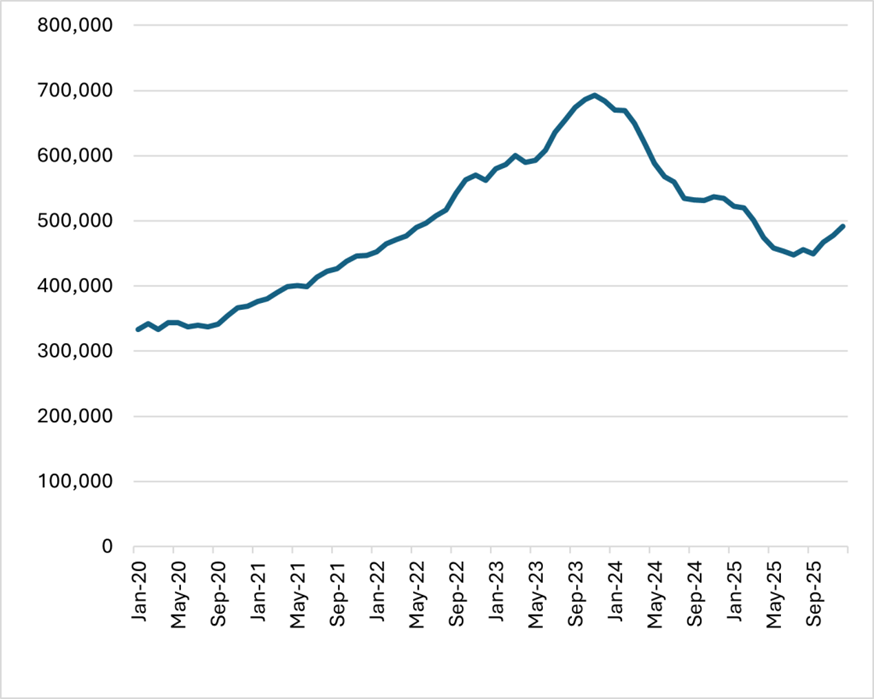
If financing constraints were preventing projects from moving forward, we would expect a sustained decline in construction activity or a sharp drop in starts. Instead, the data point to a more measured adjustment. Chart 1 shows that the number of units under construction has declined from its 2022 peak but shows signs of stabilization, with a modest recent increase reflecting a partial recovery in starts. Multifamily starts in 2025 also remain above pre-pandemic levels [see chart]. This pattern is hard to square with the claim that financing is the dominant constraint.
Chart 1: Number of Units under Construction
Source: Yardi Matrix and AEI Housing Center.
Instead of rising evenly across the nation as financing constraints eased, “multifamily construction responded very differently across metropolitan areas despite a common reset of the national financing environment,” the authors write. Ease of financing could not overcome the constraints of local regulation, they note:
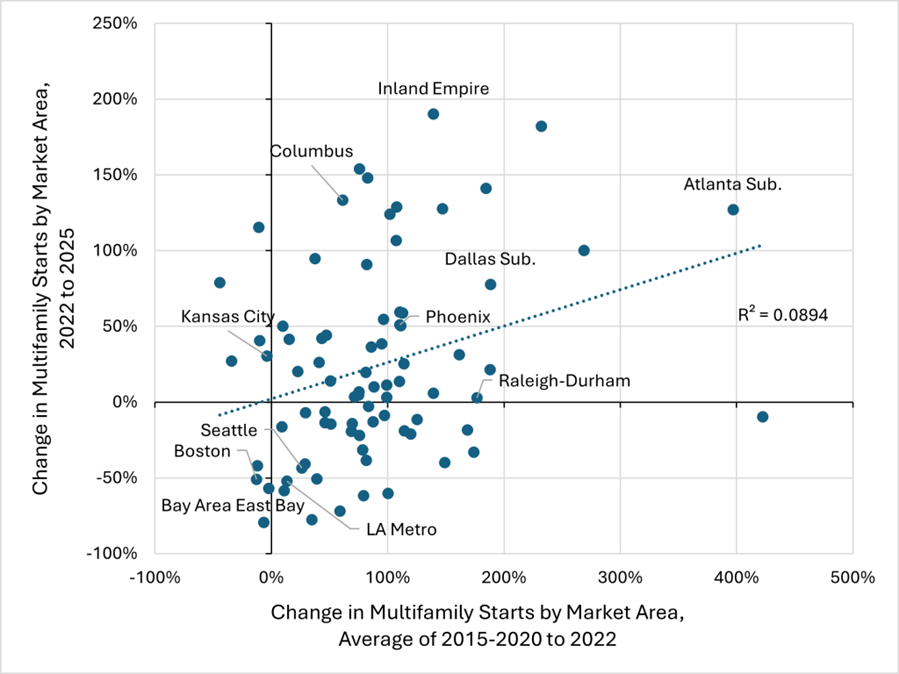
During the ultra-low-interest-rate period, multifamily starts surged in several Sun Belt and relatively supply-responsive markets, including Austin, Raleigh-Durham, Phoenix, Orlando, suburban Atlanta, and Dallas suburban markets. In many of these metros, starts more than doubled by 2022 relative to their 2015 to 2020 averages. By contrast, several high-cost and more supply-constrained markets, including Boston, Seattle, the San Francisco Peninsula, Los Angeles Metro, and parts of the Bay Area, experienced much smaller increases despite facing the same national financing conditions.
The authors provide a chart that shows how varied the responses to changing interest rates were:
The authors provide much additional data and analysis, all of which leads to a clear conclusion: financing is not “the primary restraint preventing housing construction.” Regulation is the major limitation, the authors conclude. “Policies that reduce delays, uncertainty, regulatory burdens, and land-use constraints therefore directly improve project feasibility and expand supply,” they write.
The solution is obvious: deregulation. That must be a project for the states, Peter and Pinto note: “local land-use authority ultimately comes from the states, and states can set limits on how that authority is used.”
Fortunately, state governments are starting to realize how much damage these largely local restrictions do in making housing less affordable:
According to the AEI Housing Center’s State Legislative Housing Reform Tracker, 25 states have introduced bills this year that could meaningfully expand housing supply by limiting exclusionary zoning, allowing more housing types by right, permitting smaller lots and more flexible building forms, or preventing local approval processes from becoming open-ended veto points.
There is also a role for the federal government: removing its own damaging regulatory policies instead of larding on more “fixes” for the shortage it has helped create. Peter and Pinto write,
[F]ederal policy can affect construction costs through program requirements, environmental review, labor rules, immigration policy, energy and accessibility standards, trade policy, infrastructure funding, and the conditions attached to federal financing. Federal policy should therefore focus first on reducing the costs and complexity it imposes, rather than creating new financing interventions that merely try to offset barriers created elsewhere. It can also support supply-side reform by rewarding states and localities that permit smaller lots and more flexible housing types, improving data and transparency around permitting and production, and making underused federal land available for housing where appropriate.
As Peter and Pinto demonstrate, government regulation has been the major constraint on the supply of housing in the past two decades in the United States, and indeed for many years before that. Governments have created a severe shortage of housing. Fortunately, the market stands ready to solve the problem as soon as those governments pull down the multitude of obstacles they have placed in the way.
‘The CSDDD is the greatest threat to America’s sovereignty since the fall of the Soviet Union.’
Contact Us
The Heartland Institute 1933 North Meacham Road, Suite 559 Schaumburg, IL 60173 p: 312/377-4000 f: 312/277-4122 e: [email protected] Website: Heartland.org