Life, Liberty, Property #151: Can Warsh Lead Us Out of the Inflation Trap?
Forward this issue to your friends and urge them to subscribe.
Read all Life, Liberty, Property articles here, and full issues here and here.
In This Issue:
- Can Warsh Lead Us Out of the Inflation Trap?
- Video of the Week: Housing Act is a Hostage Until Save America is Passed – In The Tank #542
- The Housing Bill Could Solve the Affordability Crisis, but Not in the Way Its Proponents Claim
Hot off the Presses!
‘Today’s crisis is a product of government errors, not greedy landlords, institutional investors, and so-called market failure.’
Can Warsh Lead Us Out of the Inflation Trap?
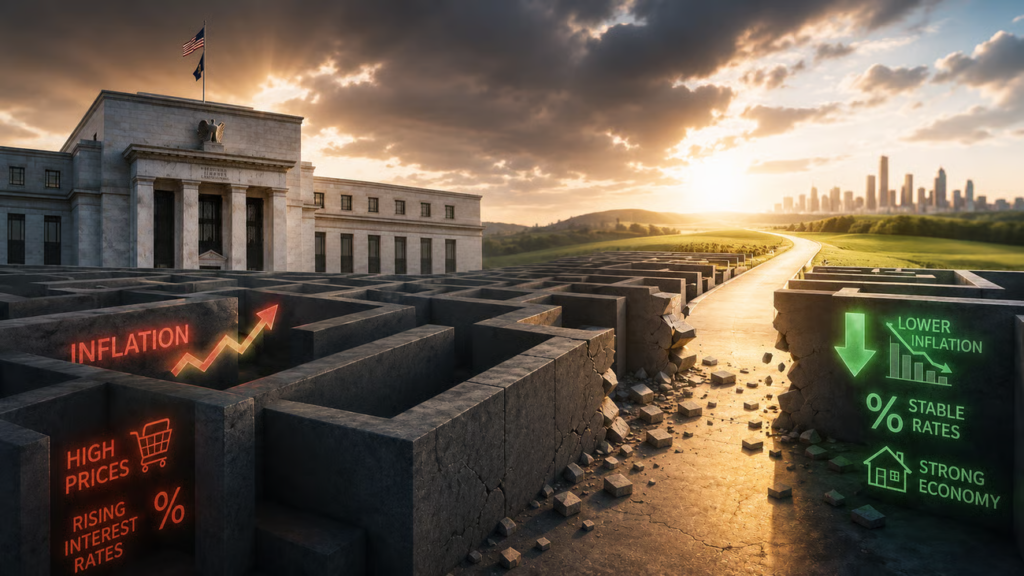
Markets are indicating strong optimism about the U.S. dollar. An article at Unleash Prosperity’s Hotline argues new Federal Reserve Chairman Kevin “Warsh Is Slaying Inflation Already.”
“Talk about instant impact!” the article begins. The evidence: “two big milestones were hit this week on prices signaling lower inflation is just around the corner,” the article states.
The first item is the Federal Reserve’s Five-Year Breakeven Inflation Rate, which measures inflation expectations by looking at prices of Five-Year Treasury Constant Maturity Securities and Five-Year Treasury Inflation-Indexed Constant Maturity Securities. Those are real numbers derived from investment choices by market participants. “The latest value implies what market participants expect inflation to be in the next 5 years, on average,” the St. Louis Federal Reserve Bank’s article on the measure states.
The breakeven rate is now 2.2 percent, “which is lower than before the Iran conflict began when gas prices were well below $3 a gallon,” the Hotline article notes.
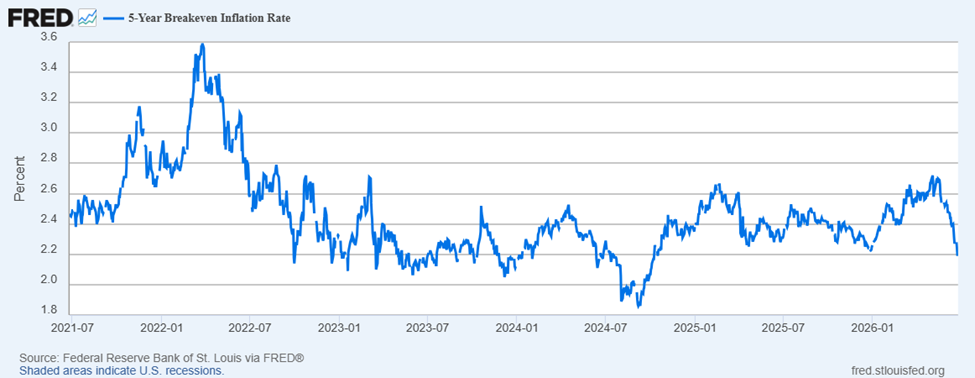
Although this is just a couple of data points at a particular moment, it’s not an implausible forecast. Another new sign of optimism toward the dollar is the price of gold, which was less than $4,000 an ounce on June 24 ($3,998.9), far below its high of $5,300 an ounce in February. The Hotline reprinted a chart from Trading Economics which I’ve updated here:
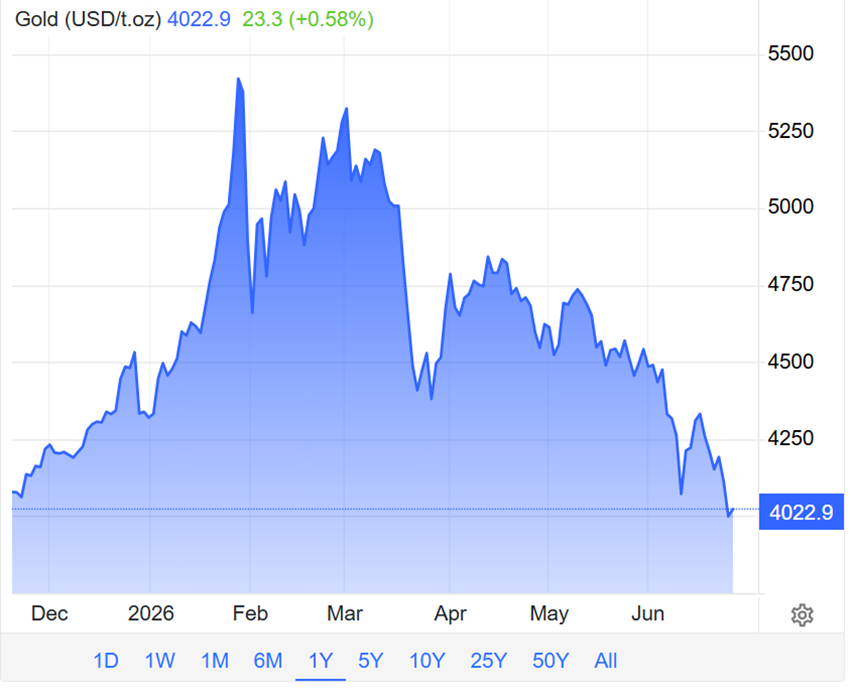
These figures suggest that the markets believe Warsh is serious about stabilizing the dollar, the Hotline argues:
We think these are undeniable indicators investors got the message last week that the new sheriff in town—Fed Chair Kevin Warsh—is fully committed to his promise of “price stability.” He is already driving down inflationary expectations, which lowers the cost of capital. It also means that worries this week of three interest rate increases at the Fed by the end of the year are laughably wrong.
The fact that Warsh clashed with his immediate predecessor, Jerome Powell, is a good sign. Warsh has long been an inflation hawk, as BNP Paribus noted in February:
During his previous term as governor, Warsh earned a reputation for his rigorous approach to fighting inflation, including during the Great Financial Crisis. His 2008–2009 speeches highlighted “inflation risks [which] are evident”, warned against appearing “too accommodative for too long” and, in the context of a possible recovery, (counseled a) … refusal “to compromise […] price stability […] to help achieve other government policy objectives”.
The last quote is from Warsh’s June 2009 Federal Reserve paper titled “Defining Deviancy,” where he firmly states that price stability is central to the Fed’s mission. “The Federal Reserve should not—and will not—compromise another kind of stability—price stability—to help achieve other government policy objectives,” Warsh wrote. That forecast proved untrue, and Warsh left the Fed two years later. (The BNP Paribus article accidentally reversed the meaning of that quote, which I corrected by the parenthetical insertion “counseled a” above.)
Warsh has been particularly critical of the Fed’s balance sheet expansion and other forceful manipulation of macroeconomic conditions over the past 18 years. BNP Paribus reports:
Warsh is an outspoken critic of the expansion of the Fed’s balance sheet, which he describes as a “proxy for the Fed’s growing imprimatur over the economy”. In 2011, he resigned from his position as governor amid disagreement over the second round of quantitative easing (QE), despite initially voting in favour of it. He deems the successive rounds of QE responsible for a[n] overheating of financial markets and widening inequalities[2]. By destroying some of the liquidity circulating in the markets, a drastic reduction in the Fed’s balance sheet would, in his view, correct the distortions created by QE and dampen inflation expectations. It would therefore enable the Fed to reduce the target range for the federal funds rate so that households and small and medium-sized enterprises could benefit from lower interest rates.
Warsh’s views echo Treasury Secretary Scott Bessent’s warnings about the Fed’s “gain-of-function” beyond its traditional mandate[3], and may have helped secure his appointment.
Addressing the press after his first Open Market Committee Meeting, Warsh made it clear that his main concern is to reestablish price stability and that the past few Fed chairs have neglected that duty: “The commitment to deliver [price stability] is strong, unanimous, and unambiguous,” Warsh said. “And that’s an important message we’ve missed for five years. And we’re going to fix that.”
Powell, like his predecessors—Ben Bernanke and Janet Yellen—benefited the big spenders in the federal government, perpetually expanding the money supply to keep the government and stock markets flush with cash. Decades of cheap money introduced wasteful distortions into the economy, especially visible in inflated equity values and commodity prices, which increased inequality and foisted powerful inflation on the country during the Biden administration.
This era of Fed manipulation and micromanagement of the economy goes back four decades, to President Ronald Reagan’s appointment of Alan Greenspan as Fed Chairman, former Office of Management and Budget Director David Stockman argued in a multipart article last week:
Upon his unfortunate appointment as Fed Chairman in August 1987, Alan Greenspan did not remotely follow the advice of his famous 1966 essay on the gold standard and the public finances. That is to say, he did not do what by that point was urgently necessary and storm into the Fed looking to shutdown its printing presses and restore the sound money financial discipline of the gold standard.
To the contrary, Greenspan quickly adopted an ersatz Keynesian modus operandi, initially in response to the very necessary crash of a bubble-ridden stock market on Black Monday October 19, 1987. But rather than allow Mr. Market to accomplish his work of cleansing the Wall Street casino of the speculative excesses fostered by a squirrely device called “portfolio insurance”, the new Chairman put the printing presses on hyper-drive. And, worse still, sent out henchman to Wall Street to man-handle the mostly old-fashioned executives who ran the major investment banks.
To wit, Wall Street executives were instructed to support the market by buying stocks and conducting trade with counter-parties, whether they thought this wise or profitable or not. And they largely did so upon threat of trouble with the Eccles Building regulators if they did not comply.
In many respects, this was the beginning of the end. After all, at the heart of true, sustainable capitalist prosperity lies free capital and money markets and a sound money regime under which to conduct business. But within weeks of his appointment and in blatant violation of his 1966 essay, Greenspan had badly monkey-hammered both.
Greenspan established the Fed’s role as “an all-powerful monetary politburo,” making the central bank the servant of a big-spending federal government addicted to deficit spending, Stockman argues. Far from being “independent,” the Fed became the partner in an enormous, decades-long fiscal crime, Stockman writes:
So doing, of course, he also became the money-printer who monetized massive amounts of public debt over the next 20 years and restored Keynesian/statist economics to the center of Washington policy-making after the Reagan Administration had briefly repudiated it in the early 1980s. The end result was a crippled crony capitalist economy saturated with debt, intrusive Big Government intervention and meddling, relentless speculation and systemic malinvestment.
The “end result” Stockman describes is the modern U.S. economy which nearly everyone hates and that bears very little resemblance to a true free market. It is full of distortions and obvious corruption as the government that has become fatally parasitic on the people has developed a massive scheme of economic control that forcibly transfers gargantuan quantities of money from productive people to … others. The Fed has partnered in this fleecing since Greenspan arrived at the Eccles Building, Stockman argues, citing a more than tripling of the central bank’s balance sheet:
By the time Greenspan got his retirement watch in Q1 of 2006, the Fed’s balance sheet had grown from $250 billion to $810 billion during his tenure. Not surprisingly, therefore, the nation’s total leverage ratio had shot the moon, as well.
As shown below, by Q1 2006 it stood at a staggering 360%. And under the similar money-printing policies of his heirs and assigns, it has remained stranded on that high plateau—reaching more than 400% during the financial crises of 2008-2009 and 2020-2021.
Even now, after four years of normalization from the inflation-peak of mid-2022, the national leverage ratio stands at the Greenspan marker of 3.63% of GDP and $116 trillion in round number. [Note: I think Stockman means 363 percent.]
Yet and yet. At the time-tested golden mean of 150%, which characterized the pre-Camp David era, the total public and private debt today would stand at just $46 trillion.
Subsequent Fed Chairs Ben Bernanke (2006-2014), Janet Yellen (2014-2018), and Powell (2019-2026) adopted Greenspan’s blueprint and expanded on it, with increasingly disastrous results, Stockman argues. It is clear that the federal government is now heading toward a crisis by the early 2030s at the latest, in which it will not be able to borrow money at any kind of feasible interest rate, which will push up interest rates for everyone, which will crush the economy.
Stephen Moore’s Unleashed Prosperity Hotline has a much more positive view of Greenspan’s tenure as Fed chair:
During his reign, inflation average[d] between 2 and 3%. He operated under the “Volcker rule” using commodity prices as a forward-looking gage of inflation to keep prices stable. And it worked magnificently.
Here is our quick overview of this amazing period:
Job Creation: 38 million
Inflation average: 2.5%
Annual Stock Market Return (nominal): 10.8%
Annual Stock Market Return (Real): 7.8%
Value of $100 invested from 1986-2007: $842
Added GDP 1986 – 2007: $4.9 trillion to $14.1 trillion
Stockman’s view is that Greenspan’s policies did not keep prices stable—2 percent inflation per year means the value of the currency is cut in half every 36 years—and his establishment of balance sheet expansion, popularly known as quantitative easing, has corrupted the U.S. dollar and the economy it applies to (which is basically global).
Absent major changes right away, the only plausible outcomes are rapid inflation or an unusually brutal recession. The latter would almost certainly lead to the former, with the government and the Fed both stepping in to “stimulate” the economy.
That is the unenviable situation Warsh is inheriting. The only way out of the current doom spiral is for the Fed to give full weight to its legal mandate to maintain price stability in addition to fostering maximum employment.
In point of fact, Greenspan and his successors achieved neither: employment has not grown as rapidly as it should, especially among native-born Americans until this past year, and unemployment has been low largely because the Baby Boomers have been leaving the workforce and the federal government has flooded the labor market with lower-wage immigrants to replace them.
The record suggests that the Fed has been acting as if its real duty were to enrich bankers and stockholders, at which it has succeeded spectacularly.
Stabilizing the value of the dollar is the only way to fix this crumbling economy. Sticking to that part of the central bank’s mandate, however, would force the federal government to make some very tough choices about taxes and spending. While the wrong decisions will lead straight to disaster, the right choices will necessarily result in a good deal of pain for millions of people as the system readjusts to real market signals and realities.
The Fed, however, has neither the responsibility nor the authority to prevent that pain. Contrary to the presumptions of Greenspan and his successors, managing the economy is not the Fed’s job. Nor is it a duty of the federal government. Management of the nation’s economy belongs solely to the invisible hand of the Mr. Market, and it always has and always will.
The Fed could make its much-ballyhooed independence a real benefit to the American people—or at least less of a force of destruction—by sticking to the price-stability part of its mandate and forcing the federal government to make the decisions the central bank has allowed it to put off for decades. The markets are indicating they believe that Warsh may be the one to do that.
Let’s hope they are right.
Sources: Hotline; Federal Reserve Bank of St. Louis; BNP Paribus; David Stockman’s Contra Corner; Hotline
Video of the Week
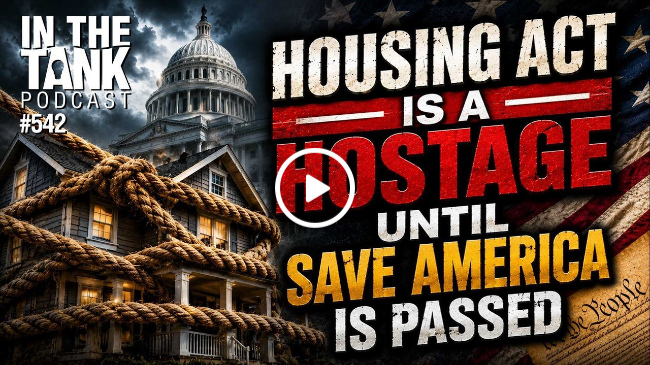
Trump is refusing to sign the 21st Century ROAD to Housing Act unless lawmakers first pass the SAVE AMERICA Act, which Trump says is far more important. There is a lot of skepticism about whether or not the now-hostage Housing Act is a good idea anyway, the panel discusses the nuances. On another issue, Trump has also said that the administration is working on a National Right to Carry bill, but again, there are potential issues down the road from this approach. Gun rights advocates say its a step in the right direction, but doesn’t affirm Constitutional rights to bear arms strongly enough to end state-level infringements.
For our Countdown to 250, we discuss this week in 1776, how colonies were feeling about breaking from the British in the week leading up to the Declaration of Independence.
And on UNHINGED: New York City Congressional elections have been swept by socialist candidates, they are far more extreme than anyone Democrats have ever platformed.
Get the latest best-seller from Heartland’s Justin Haskins!

America’s economy is teetering on the edge of disaster. Hidden beneath record stock market highs and reassuring headlines lies a fragile system riddled with debt, reckless speculation, and decades of political negligence. When the next big crash strikes—and it will—the fallout could be unlike anything we have ever experienced.
Click here to get it at Amazon.
The Housing Bill Could Solve the Affordability Crisis, but Not in the Way Its Proponents Claim
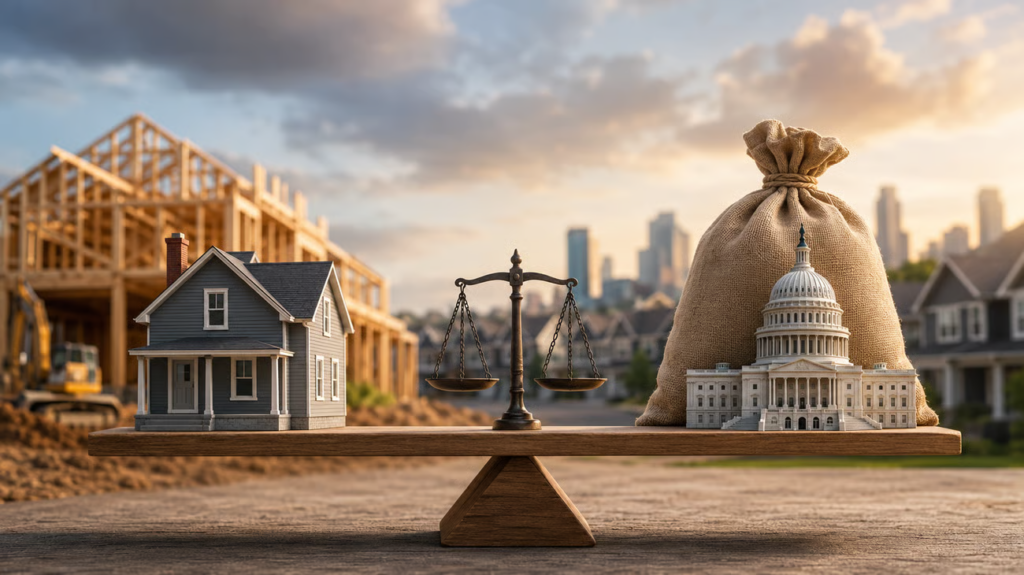
President Donald Trump surprised everybody on Wednesday by refusing to sign the ROAD to Housing Act unless the Senate also passes the SAVE America Act. He is right to tie them together. It would be even better if he refused to sign the bill outright if the SAVE act does pass.
It is a bold move, to be sure. The press has widely characterized the housing bill as a bipartisan “win” for the Republicans and the election-security legislation as an unpopular partisan move. As soon as Trump announced his decision to tie the two bills together, housing bill cosponsor Sen. Elizabeth Warren (D-MA) and the media as a whole attacked Trump as a political hit man who doesn’t care about affordability.
They are wrong. The SAVE America Act would do much, much more for affordability than the ROAD to Housing Act. The latter, in fact, would probably do far more harm than good.
The nation’s affordability crisis is caused entirely by government overspending that has unleashed inflation and driven up interest rates. That overspending results from the very election system that the SAVE act would reform and that the bill’s opponents are trying to protect.
Although Trump has long claimed to like the housing bill, and still says so, he is right to hold it hostage for the real affordability triumph that the election security bill amounts to.
The housing bill is an uneven mixture of deregulation, re-regulation, and new spending that leans hard toward government intervention.
The bill would establish a four-year pilot program, costing $200 million, to give taxpayer money to financial institutions “to incentivize the origination of small-dollar mortgages” of $100,000 or less. It would provide “direct grants for mortgagors [home buyers] who obtain small-dollar mortgages to cover costs associated with … down payments, closing costs, appraisals; and title insurance.”
That will raise housing prices, not lower them, by pouring more money on to the demand side of the price equation.
This spending is accompanied by a provision for “adjusting terms and costs imposed by the Federal Housing Administration with respect to small-dollar mortgages.” That might turn out to be mildly beneficial, but it’s certainly a very meager tradeoff. The Democrats and GOP big spenders won that round decisively.
The legislation also revises the federal government’s treatment of state and local “zoning frameworks,” defined as “zoning codes and other ordinances, procedures, and policies governing zoning and land-use.” The bill directs the Assistant Secretary of Housing and Urban Development to “publish documents outlining guidelines and best practices to support production of adequate housing to meet the needs of communities and provide housing opportunities for individuals at every income level across communities.”
These “guidelines and best practices” for zoning policy would recommend ways to reduce “obstacles, regulatory or otherwise, to a range of housing types at all levels of affordability, including manufactured and modular housing.” Specific measures include simplifying zoning codes, requiring timely decisions on building applications, establishing “cost-effective and appropriate building codes,” reducing or eliminating impact fees, increasing access to appeals and zoning variances, and “streamlining of State environmental review policies.”
Although it is possible the current administration would recommend that states and localities loosen these restrictions, the provision is nothing more than feel-good talk. The states face no consequences for refusing to comply with the recommendations, and a subsequent president could change them all, unilaterally, anyway.
Many other elements of the housing bill explicitly expand federal restrictions on housing. These include the recommendation to “limit disruption of low-income communities, and prevent displacement of existing residents,” meaning preventing “gentrification.”
Writing at X, Rep. Chip Roy (R-TX) correctly argues the housing bill is “full of big government garbage & spending.” In addition to reauthorizing and expanding the HOME grant subsidy program, Section 101 of the bill “‘reforms’ housing counseling agencies (HCAs) to provide rental dispute services to bad tenants facing lawful eviction,” and Section 106 “establishes an eviction helpline program,” Roy notes.
“There is no reason we should be providing government-funded counselors to help people derail lawful evictions,” Roy says. Those policies reduce the stock of available housing by discouraging people from renting out properties. That raises rent prices on the remaining rental properties. For example, wealthy Baby Boomers forced by high interest rates to hang on to big houses could rent rooms out and ease the shortage, but these rules prevent them from doing so.
The bill even retains the Covid-era moratorium on evictions, a policy that was blatantly unconstitutional, economically destructive, and a gross violation of individual rights, which suppressed the housing market instead of expanding incentives for building.
The legislation also reauthorizes and increases the Rental Assistance Demonstration program that provides vouchers for localities to raise private-sector money to convert units into long-term section 8 housing. That subsidizes inferior housing, taking investment money away from better projects. Like most of the bill, it will harm the housing stock, not improve it.
The legislation also does nothing to limit, much less reverse, foreign ownership of the nation’s housing, and it allows localities to keep subsidizing housing for people in the country illegally while law-abiding Americans struggle to find places to live because of the very that shortage mass immigration has caused by increasing demand enormously.
Roy is right in his criticisms of the bill. Nationalizing the immensely damaging restrictions that crony-socialist goons have imposed on benighted housing markets such as that of New York City for decades will do enormous damage nationwide while further undermining people’s morale and trust in government. Reductions of taxes, regulation, and interest rates are the only ways to expand the housing supply.
All the federal subsidies, regulations, and monetary manipulation intended to increase homeownership are economically destructive and unconstitutional. They have been barnacled to the ship of state through an absurdly wrong, infinite interpretation of the Constitution’s “general welfare” clause.
They should all be eliminated. The only constitutional and ethically justifiable course is removal of all federal government interventions in the housing market.
Using this sloppy housing bill to force the Senate to pass the SAVE America Act is a great idea. Rejecting it altogether would be an even better course, once the election integrity bill is safely on the president’s desk.
In fact, it would be a historic, genius-level, 5-D chess move.
Sources: President Donald J. Trump; U.S. Senate; Rep. Chip Roy
‘The CSDDD is the greatest threat to America’s sovereignty since the fall of the Soviet Union.’

Contact Us
The Heartland Institute
1933 North Meacham Road, Suite 559
Schaumburg, IL 60173
p: 312/377-4000
f: 312/277-4122
e: [email protected]
Website: Heartland.org



S. T. Karnick is a senior fellow and director of publications for The Heartland Institute.