Life, Liberty, Property #152: Immigration Driving Up Housing Costs
Forward this issue to your friends and urge them to subscribe.
Read all Life, Liberty, Property articles here, and full issues here and here.
In This Issue:
Immigration Driving Up Housing Costs
Video of the Week: RFK Ends the COVID Forever-Emergency
Rising Workforce Woes
DON’T MISS THIS!
Heartland and Ron DeSantis
Join us on Sept. 3
Immigration Driving Up Housing Costs
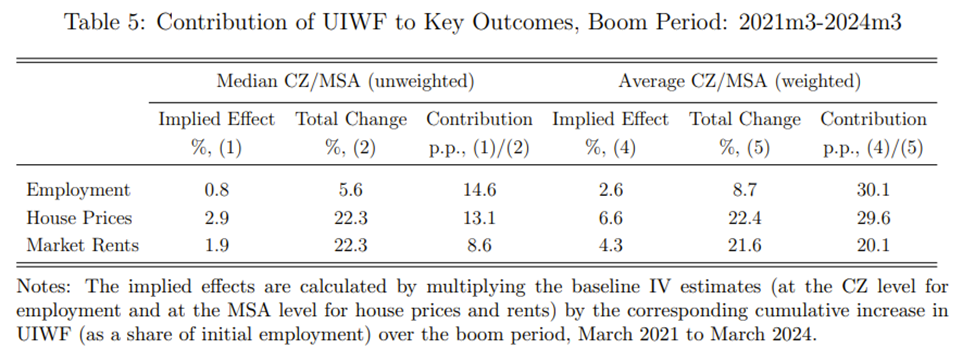
Mass immigration has contributed to the rapid increase in the price of housing, I noted in my Heartland Institute policy study on “Housing Affordability: America’s Short-Term Crisis and Long-Term Problem.” A draft working paper from the Federal Reserve confirms that conclusion, with the researchers stating illegal immigration drove 30 percent of the increase in home prices during the years 2021 through 2024, along with 20 percent of the rise in rent prices.
On average, an increase of illegally resident workers equal to 1 percent of a locality’s workforce raised home prices by 2.2 percent and rents by 1.4 percent in the years 2021 through 2024, the study found.
In total, the researchers conclude, illegal immigration raised home prices by 6.6 percent over those four years:
The authors of the study observe that the seven million people who moved to the United States illegally in those four years created a “housing demand shock in the face of short-run inelastic supply.”
During the Biden surge, over 10 million unauthorized migrants entered the country illegally. Last year, during a press conference, Border Czar Tom Homan told the Washington Examiner he estimated “at least 20 million” immigrants were living in the country illegally.
“10.5 million we know of came to the border. How many don’t we know of?” Homan said. “A thousand people could have crossed a day that we didn’t know of.”
Note that the effect the Fed researchers identified was for illegal immigration. Legal immigration would obviously have an analogous effect and raise the total immigration proportion of housing price inflation a good deal higher, given that the housing supply was inelastic regardless of the legal status of people seeking it.
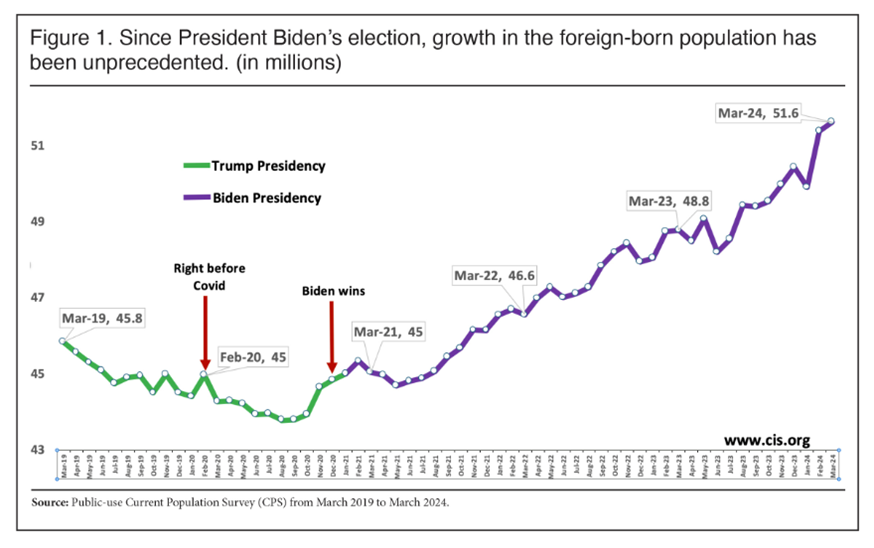
Net international migration to the United States was 379,000 in 2021 (mid-year 2020 to mid-year 2021), 1.7 million in 2022, 2.3 million in 2023, and 2.8 million in 2024, according to the U.S. Census Bureau: that is 7,179,000 people in four years.
These are net changes in population, the CIS notes, “offset by emigration and net mortality among the immigrant population,” thus representing the actual increase in the foreign-born population, not the number of immigrants (which would be higher, of course).
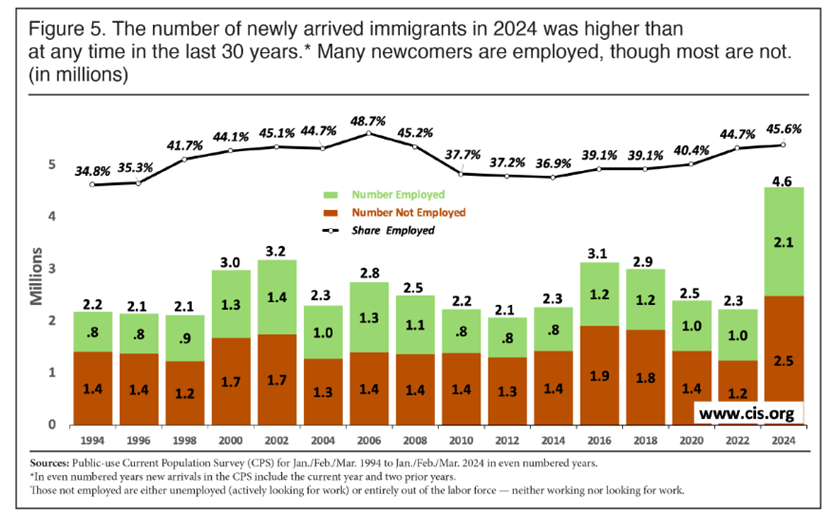
Compounding the problem was the fact that most of the new immigrants were not working, let alone building new houses, which has consistently been the case for decades, the CIS notes:
Employment Among New Arrivals. There is an unfortunate tendency to see immigrants solely as workers rather than as the full human beings that they are. As in any human population, some new immigrants do work, while others are unable or do not wish to work. Figure 5 reports the number and share of immigrants who are working and not working. The figures show that in the first quarter of 2024, 46 percent of those who arrived in 2022 or later were employed. Many new immigrants are children, elderly, disabled, caregivers, or others with no ability or interest in working. Immigration clearly adds workers to the country, but it just as clearly adds non-workers who need to be supported by the labor of others. This was the case in the past, it is true today, and it will surely be the case for immigrants who arrive in the future. Those who simply see immigration as a source of labor need to understand it is also a source of school children, retirees, and many other non-workers.
Employment of illegally resident aliens in the housing industry did not increase overall output, while those individuals increased the demand for housing, Bandelin reports in another article at The Federalist:
Though the study found that employment in the construction industry increased because of the influx of illegal aliens, there was no correlation between that increase and new construction of housing. “We find that unauthorized immigrant worker flows increased local house prices and rents, without significantly expanding new housing supply,” the study reads.
In sum native working-class renters faced decreasing wages as illegal aliens flooded into the job market, and they also took the brunt of the housing cost increase as demand for apartments and multi-family housing grew.
The full, enormous tide of people into the United States in 2021 through 2024 put even-greater pressure on housing prices than just the illegal component. As housing demand rose much faster than what the supply could possibly match, prices rose accordingly, Realtor.com reports:
Realtor.com® senior economist Jake Krimmel argues that Wilson and Zhou’s findings, which have been widely touted by conservative politicians and media outlets, align with the basic laws of supply and demand during a period when the housing market in most major metros was particularly tight.
“An influx of immigrant workers increases demand for housing. Over the short run, like the few years the study focuses on, the supply of housing is pretty inelastic. That is, it takes a while for new-home construction to catch up to that demand shock,” explains Krimmel. “So in the short run, house prices will rise as demand outstrips supply.”
With illegal immigration causing approximately 30 percent of the rise in housing prices during the Biden years, and (a probably smaller amount of) legal immigration supplying additional upward pressure, at least four-tenths of the increase must result from other factors. Greatest among these, I argue in my paper, is overall price inflation (meaning dollar devaluation) caused by excessive federal spending and consequent inflation, augmented by excessive government regulation at all levels suppressing urgently needed increases in the housing supply.
All of those are actions of government, and all have injured the well-being of the American people demonstrably and significantly.
Last week, Press Secretary Karoline Leavitt went on Fox and suggested that Gen-Z is attracted to socialism because they are lazy and entitled as well as being brainwashed by the education system. The latter is certainly partially true, the American education system skews extremely far left, but what about the other charges? This kind of rhetoric seems unlikely to win anyone over, we discuss what a better strategy may look like.
Also, Health Secretary RFK Jr. has decided to end the emergency liability protections for the COVID vaccines, terminating the forever-pandemic narrative set by his predecessor.
On UNHINGED: The Smithsonian is apparently still woke, and is misusing taxpayer funding. And for America @ 250, we’ll discuss how the Declaration was received as New York prepared for invasion.
The Heartland Institute’s Linnea Lueken, Jim Lakely, Chris Talgo, and S. T. Karnick will talk about all of this and more on Episode #544 of the In The Tank Podcast.
Hot off the Presses!
‘Today’s crisis is a product of government errors, not greedy landlords, institutional investors, and so-called market failure.’
Rising Workforce Woes
Though the employment report for June looked fairly positive, with private companies adding 98,000 net jobs and unemployment remaining steady at 4.2 percent, “there are aspects of this report that raise genuine questions,” writes Brownstone Institute President Jeffrey A. Tucker at The Epoch Times.
The factor raising concern is that Americans are dropping out of the labor force in growing numbers, Tucker writes:
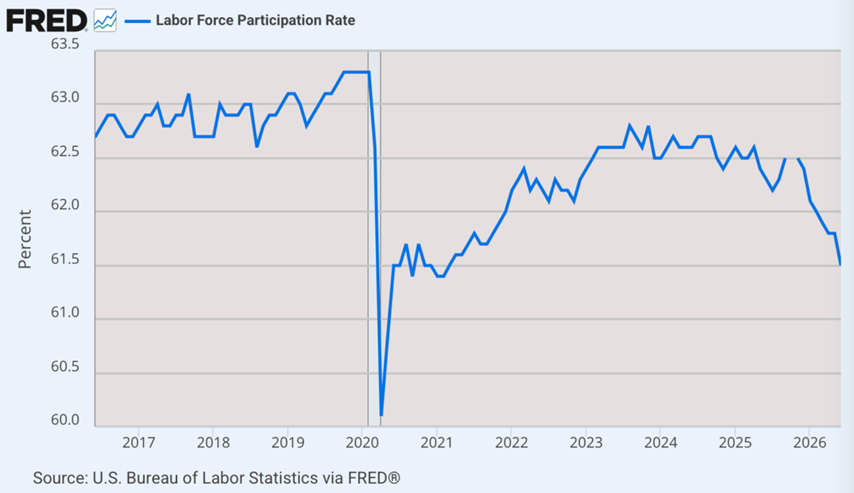
Labor force participation had hit 63.3 percent in January of 2020. That’s not a record. The record was set 20 years earlier at 67.2 percent. It fell after the turn of the millennium. A recovery began in Trump’s first term. That lasted until the lockdown disaster of March [2020], which led to mass dropouts by design.
Participation hit a low of 60.1 percent at peak disease frenzy and began to recover after. It appeared that we were on track to recover. Here is when the trouble began. Starting in August 2023, as inflation raged and life was not easing back into normalcy, a new fall began that has not stopped. Now we are hitting new lows for the period, coming in at 61.5 percent.
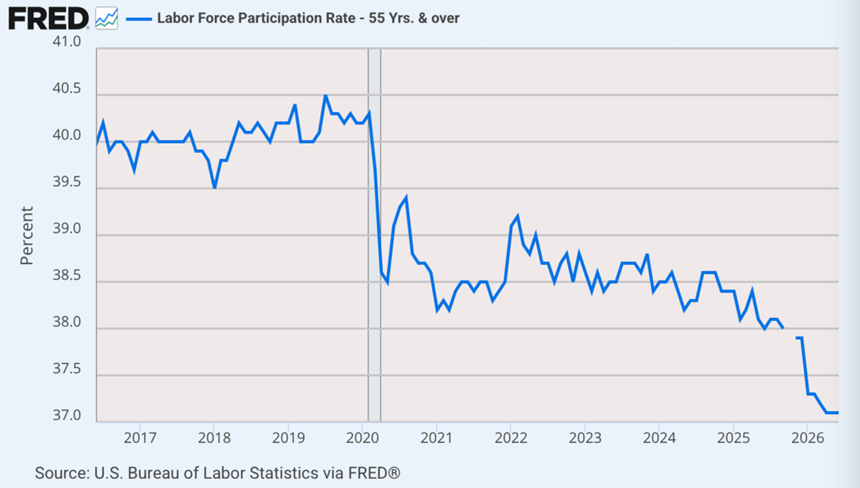
Americans well short of the traditional retirement age are leading the flight out of the workforce, Tucker notes:
The biggest hit to labor participation has come from those older than 55. Here we see the biggest change from the postwar years, in which 43 percent of people worked at a time when nearly every able-bodied male of that age held a job. Today we are down to 37.1 percent, which is an incredible drop.
Why is this? Welfare, disability, or lack or interest stemming from demoralization of one or another type might be the main culprits. In general, it’s peculiar. These are peak earning years, with women most likely facing empty nests and men carrying vast professional experience. Why have they dropped out? Why are only 37 percent of Americans over 55 holding jobs at all?
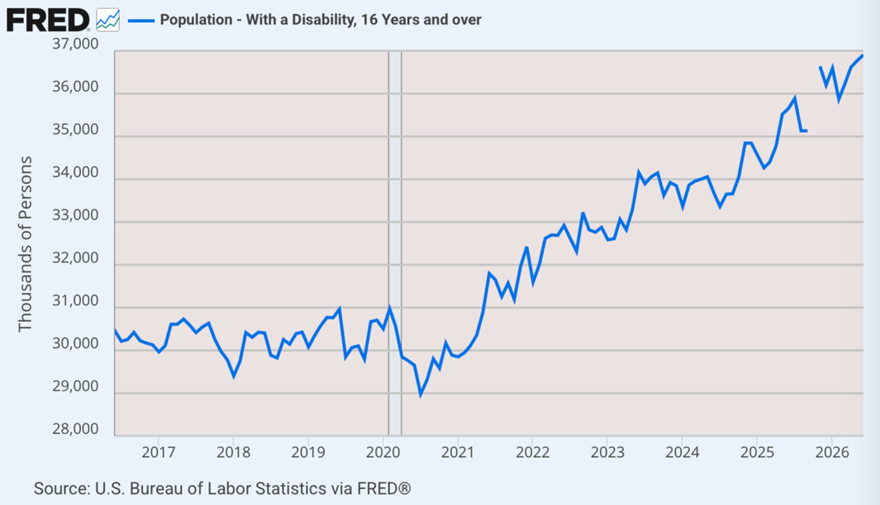
Large numbers of these older and generally high-wage workers are moving onto the disability rolls, Tucker notes:
Essentially, we have one in three working age men who have left the labor force, mainly due to disability, the rates of which have skyrocketed by an additional 7 million people since 2021.
Nor can this be attributed to greater degrees of benefits or the rise of fraud, because they are surveys independent of benefits. These are people who are reporting themselves as disabled.
Tucker speculates that the Covid injections may have ruined many older Americans’ health to the point that they can no longer work:
The shot surely has something to do with it, but it is difficult to prove because the numbers and connections are extremely hard to find. They are mostly hidden behind walls in industry vaults. Not even government agencies have had full success in gaining access.
We might have a silent mass injury on our hands here. If not, it would be nice to know either way.
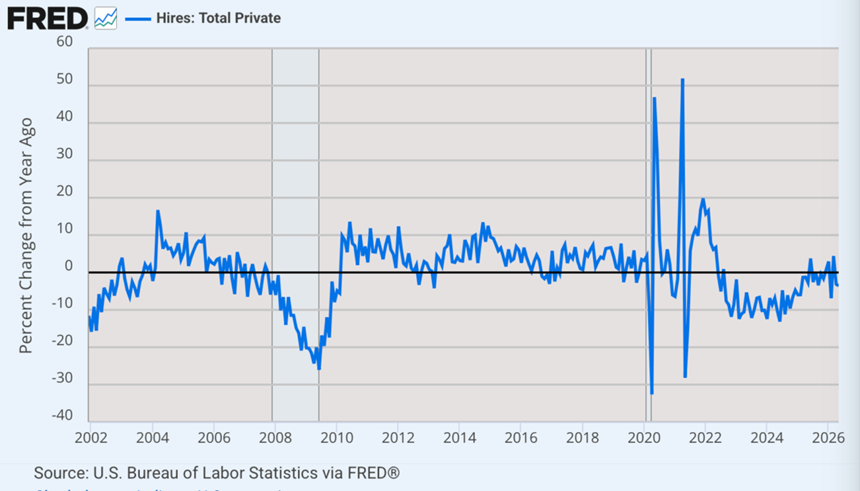
Meanwhile, young people are having great difficulty breaking into the workforce, Tucker notes:
[T]here are major problems affecting young people in their twenties who are trying to gain a foothold in labor markets. They are unprepared to do so for a whole variety of reasons. Since December 2021, we have seen a recession-level fall in new hires. This undoubtedly affects young people disproportionately to the rest of the population.
Tucker suggests that rapidly rising health insurance costs are making it very difficult for employers to hire new workers:
Meanwhile, labor markets are very sticky and much of the reason traces to problems in the health insurance industry. Companies are required to provide it but the expense is rising to the point that many companies are reluctant to hire because doing so is too risky. The law needs to be changed—with the trigger for health insurance requirements moved from 50 to 500—but Congress is not in the mood. Obamacare is coming apart at the seams and yet very few lawmakers know what to do about it.
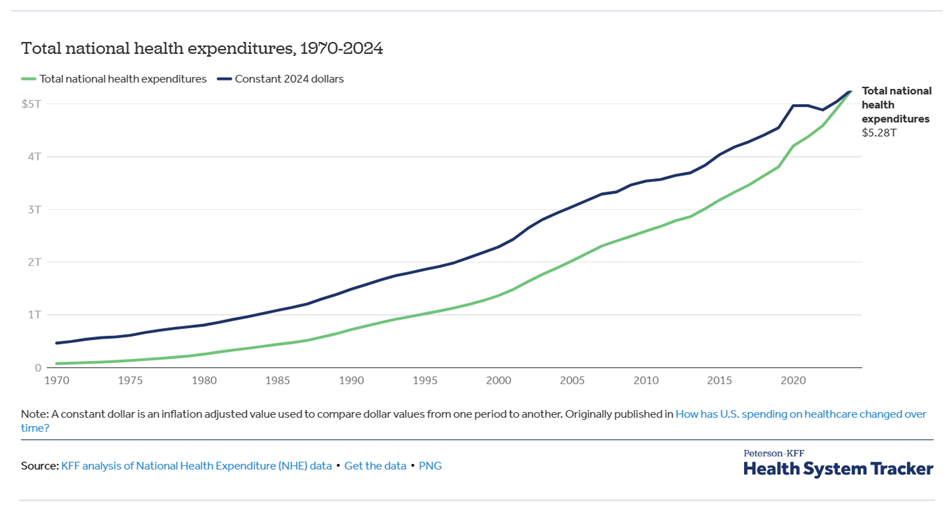
I find that argument highly plausible. Health care costs have more than doubled in inflation-adjusted terms over the past 25 years:
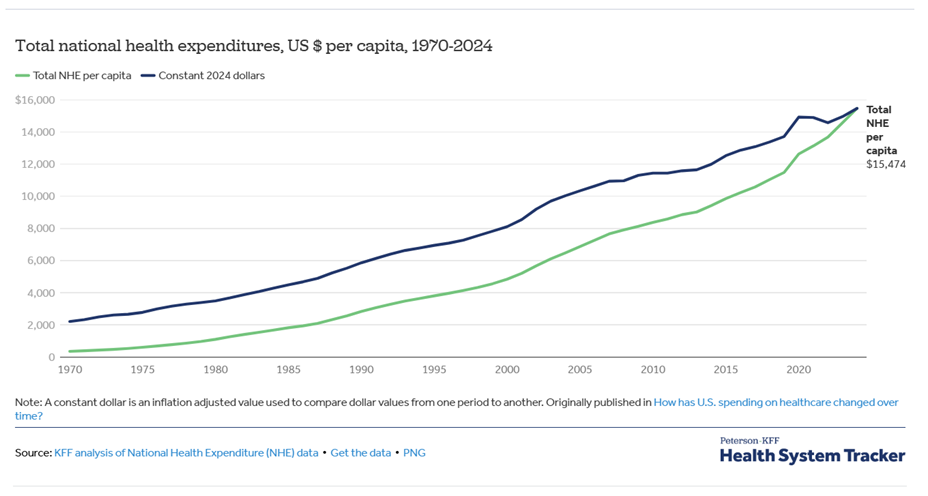
On a per capita basis, total health spending, including government, private, out-of-pocket, research, and infrastructure spending, has increased in the last five decades from $353 per year in 1970 to $15,474 per year in 2024. In constant 2024 dollars, the increase was from $2,208 in 1970 to $15,474 in 2024.
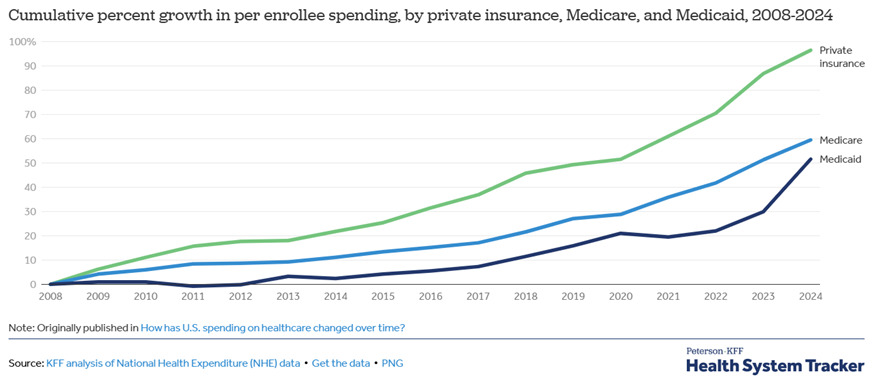
As a result, the cost of health insurance has risen drastically in recent years:
Ever-higher health insurance costs and other impediments contrived by government are contributing to “a kind of hollowing out of the workforce,” Tucker concludes. The solution is to remove or reverse the government policies that have driven people out of the job market, Tucker notes: “The American jobs machine can come back to life quickly, but it is going to require major changes in policy and culture to cause it to happen.”
With a rapidly aging population, the United States needs working-age people to be working, not retiring early on disability payments or unable to get jobs because skyrocketing health insurance costs and government mandated minimum wages make younger, less-experienced workers unprofitable employment prospects.
Those people are available but not working. Importing immigrant workers, by contrast, has enormous negative effects that have been greatly underestimated for decades, as the effect of illegal immigration in driving up housing prices demonstrates. Getting currently resident Americans back to work is the only reasonable alternative.
That will require continuing deregulation on the federal and state levels alike. It will also require reforms to the countless welfare-state benefit programs that make it unprofitable for people to transition into the workforce once they start taking benefits from the taxpayers. Politically, it will be very difficult to make the necessary changes, as the past two decades amply demonstrate. Nonetheless, it will have to happen, and soon.
‘The CSDDD is the greatest threat to America’s sovereignty since the fall of the Soviet Union.’
Contact Us
The Heartland Institute 1933 North Meacham Road, Suite 559 Schaumburg, IL 60173 p: 312/377-4000 f: 312/277-4122 e: [email protected] Website: Heartland.org