New enforcement powers give European regulators greater authority over American AI companies and technologies
EU rules could shape artificial intelligence far beyond Europe’s borders
SCHAUMBURG, IL (August 25, 2026) – The European Union has begun enforcing major provisions of its sweeping Artificial Intelligence Act, marking a new phase in Brussels’ effort to regulate the development and use of artificial intelligence around the world.
As of August 2, 2026, the European Commission’s AI Office and national authorities have new enforcement powers covering prohibited AI practices, general-purpose AI models, and transparency requirements for certain AI systems. The new transparency rules require disclosures when people interact with chatbots and other AI systems and labeling for deepfakes and certain AI-generated or manipulated content. The European Commission can now enforce compliance with requirements imposed on providers of general-purpose AI models, including through substantial financial penalties.
The law’s impact extends well beyond Europe. The AI Act asserts jurisdiction over providers and deployers located outside the European Union when their AI systems are placed on the European market or when outputs produced by those systems are used within the EU. As a result, American AI companies can fall under the European regulatory regime even when their systems are developed and operated in the United States. This extraterritorial reach was a central concern identified in a 2025 Heartland Institute Policy Study examining the AI Act and its implications for American sovereignty, free expression, and innovation.
Heartland’s study, “The European Union’s Artificial Intelligence Act: An Extraterritorial Incursion on Americans’ Inalienable Rights,” warned that the law could effectively export European regulatory standards around the world. Because maintaining entirely separate versions of the same AI systems for different markets is costly and technically difficult, global providers have strong incentives to conform their products and practices to European requirements across jurisdictions.
The beginning of enforcement makes those concerns increasingly consequential. The AI Act governs areas ranging from transparency and copyright compliance to manipulation, bias, model safety, and systemic risk. Although some of the law’s requirements for high-risk AI systems will not take effect until later phases, Brussels now possesses meaningful enforcement authority over some of the most widely used forms of artificial intelligence.
Conservatives have long been skeptical of government intervention in emerging industries, and rightly so. But a hands-off approach to AI becomes increasingly difficult to sustain when foreign governments are already writing and enforcing rules with consequences for American companies and technologies. U.S. policymakers should take the AI Act’s extraterritorial reach seriously and pursue an American approach that protects free expression, individual rights, competition, and innovation while ensuring that the rules governing American technology are ultimately determined in the United States.
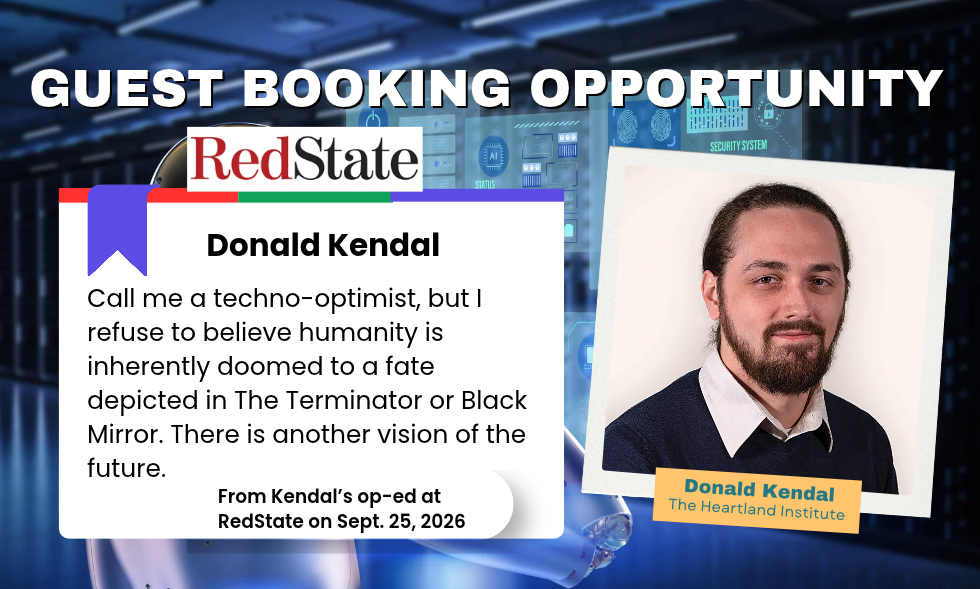
The following quotes provided by Heartland Institute experts can be used for attribution. If you’d like to interview a Heartland expert on this topic or others, please contact Donald Kendal, the director of the Glenn C. Haskins Emerging Issues Center, or Director of Communications Jim Lakely at The Heartland Institute. You can also call/text Jim at 312-731-9364.
“The European Union should not be allowed to dictate the rules governing American artificial intelligence. The EU AI Act gives European regulators extraordinary power to influence how American companies develop their technologies, what information their models can provide, and ultimately what Americans are able to see and say online.
“The United States should reject this attempt to export Europe’s regulatory regime and instead pursue policies that protect free speech, individual liberty, technological innovation, and American sovereignty.”
Donald Kendal
Director, Glenn C. Haskins Emerging Issues Center
The Heartland Institute
[email protected]
“The EU AI Act is no longer simply a regulatory proposal whose international effects can be debated in the abstract. European authorities now have meaningful enforcement powers over rules that reach American companies and technologies. U.S. policymakers should take that extraterritorial reach seriously and ensure that decisions governing American AI remain accountable to Americans.”
Jack McPherrin
Senior Policy Analyst, Research Fellow
The Heartland Institute
[email protected]
The Heartland Institute is a national nonprofit organization founded in 1984 that focuses on free-market solutions to social and economic problems. For more information, visit Heartland.org or call 312-377-4000.

Donald Kendal is Director of The Heartland Institute’s Socialism Research Center. Kendal is also the host of Heartland’s In the Tank Podcast.

Jack McPherrin is a Senior Policy Analyst and Research Fellow for The Heartland Institute.